
3.2 The Adaptive Response Cycle
Stage 1

There is hope! I’ve developed eight principles that will help you escape the Fear Response Cycle. This is not an ‘overnight’ exercise! It takes some time to understand it, and on top of that, to internalize it.
See all eight steps of ‘The Adaptive Response Cycle’ (ARC) in the figure underneath.
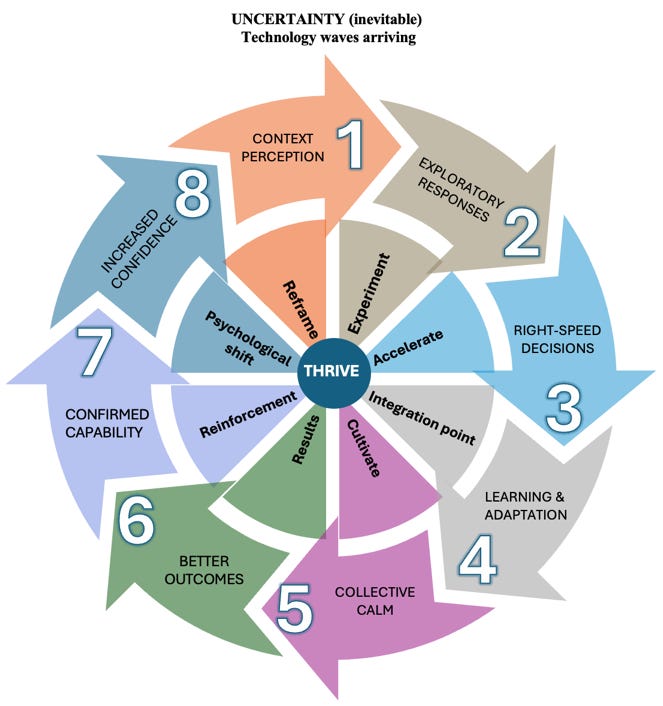
‘The Adaptive Response Cycle’
3.2.1 From Threat to Context: Cognitive Reappraisal
‘Our brain is lying to us about technology.’
Not maliciously. Not even consciously. But lying nonetheless. When you encounter news about AI disrupting your industry, quantum computing threatening encryption, or gene editing raising ethical quandaries, your brain processes these abstract uncertainties through neural pathways designed for a very different world—one where uncertainty meant a predator in the bushes, not a paradigm shift in your business model.
Education could do a better job of training our brains for the new world.
Yet here we are: immersed in turbulence not of tooth and claw, but of algorithm and cloud. The “uncertainties” we face at work, at home, and online will not eat us, but our brains register the news cycle, AI advancements, or shifting business models as implicit threats. Market volatility, technological upheaval, or social media misinformation ignite the same neural warning bells as the rustle-in-the-bushes. The body’s ancient hardware narrows attention, hardens posture, and impels defensive decision-making. No surprise, then, that large organizations responding to sudden technological change often default to entrenchment and resistance—just as individuals, when confronted with the unfamiliar, revert to habits and avoidance.
The result is a paradox: the more complex and fast-moving the environment becomes, the more rigid our responses may grow. But the ARC begins precisely at this juncture. The way out of the trap is not to suppress uncertainty—which is impossible—but to rewire our response, beginning with how we frame what we confront.
Emotion research points to the power of “cognitive reappraisal”[Gross, 2015], a deliberate reframing of narratives to alter emotional response. It is not mere positive thinking or denial, but re-contextualization. For instance, experimental studies find that when participants are told an upsetting image is “a medical training photo” rather than “real suffering,” their distress plummets.
Same stimulus; different frame; smaller emotional impact. The frame changes everything.
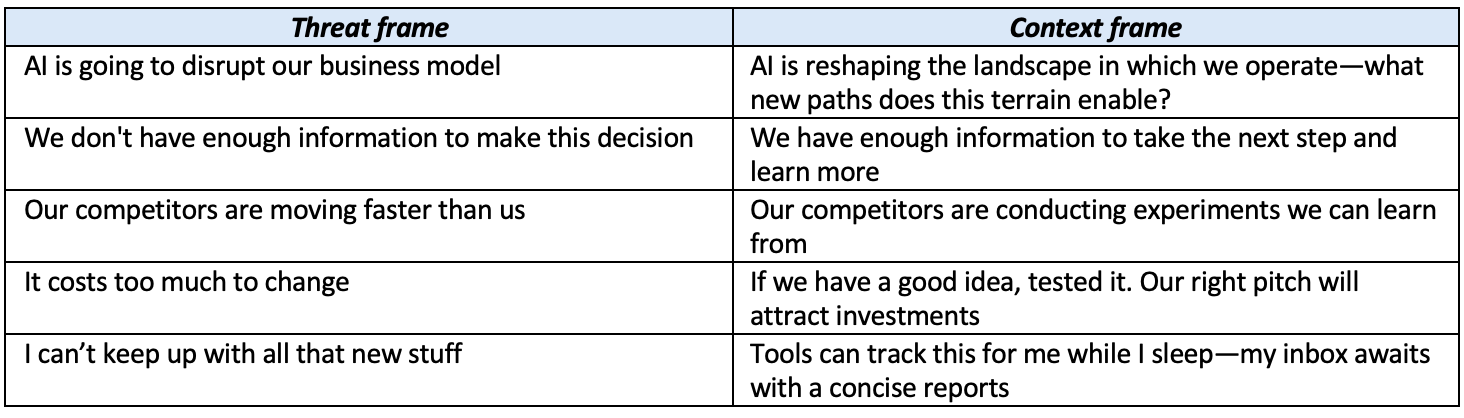
Applied to technology, cognitive reappraisal works in the language we choose:
Threat frame: “AI will disrupt our business model.”
Context frame: “AI is reshaping the landscape. What new opportunities does this open?”
Or:
Threat frame: “We don’t have enough information.”
Context frame: “We have enough to act and learn more as we go.”
This is not naive optimism. Frank Knight’s distinction between risk (measurable probabilities) and true uncertainty (unknown system changes) makes clear why [Knight, 1921]. The waves of digital transformation are not a countable risk to be hedged against, but genuine uncertainty. Control is off the table; navigation and adaptive learning are the only dependable tools.
Here, the analogy of the surfer is instructive. The ocean’s uncertainty is not perceived as a threat but as a medium. The skilled surfer does not sit paralyzed by thoughts of rogue waves but tunes into patterns, reads the tide, and adapts movement to real-time feedback. The ocean is not “attacking,” it is “producing rideable energy.” The difference is not semantic but experiential—a transformation in posture, awareness, and action.
Organizations, too, succeed when they shift from threat postures to adaptive stances. When Satya Nadella became CEO, Microsoft was locked into defensive framing: clouds were rivals to Windows, open source a threat to proprietary code. Nadella’s pivot was cognitive reappraisal writ large: “our industry respects only innovation.” Cloud was recast as a new context. Open source became a partnership model—leading to a sea change in culture, acquisitions (GitHub, LinkedIn), and strategy. The company that once built moats started to surf.
Other industry leaders—Google, Meta, Amazon, Alibaba—follow similar patterns, expanding ecosystems, converging currents, opting for collaboration and generative momentum over isolation. In all cases, success comes not from eliminating uncertainty, but recalibrating the initial response and making the unknown not the enemy, but the environment for possibility.
This is the starting line of the ARC: unfreezing defensive routines, observing the context, and preparing for the exploratory phase. The practice is not easy—our ancient wiring resists it—but it is essential. In a world defined more by ambiguity than by certainty, the essence of leadership—in organizations and lives—is not prediction, but adaptive framing.
From threat language to context language:
In such environments, the question isn’t “How do we eliminate uncertainty?” but “How do we navigate contexts we can’t (yet) fully map?” The surfer understands this intuitively. Ocean conditions are genuinely uncertain—wave sets arrive irregularly, wind shifts unpredictably, and currents flow in complex patterns. But the surfer doesn’t experience this as threatening. They experience it as the medium in which their activity and creativity occur. A surfer doesn’t say, “The ocean is threatening me with waves.” They say, “The ocean is producing waves I can ride. Let’s go!”
Same phenomenon. Radically different frame. Completely different response.
The Practice of Reframing
Reframing uncertainty as context isn’t a one-time decision. It’s a practice, a discipline, a muscle you build through repetition. When you feel your chest tighten at news of disruption, that’s your amygdala doing its job—but doing it anciently.
Pause.
Notice the threat frame. Ask: What if this isn’t a threat but a change in terrain? What new paths might this enable? What can I learn? What’s the next small step? As our brain (amygdalae) was trained to avoid physical danger, it can be trained to act in the new world as well and nuance the defense response. In technical terms: upgrading the fear algorithm, not fighting it.
The water isn’t your enemy. It’s your medium. The waves aren’t attacking you. They’re offering you rides—if you can learn to read them.
Reflection Box:
This reframing has a shadow side we’ll explore later: when powerful organizations master the art of riding waves, they can grow into what we might call “super-Molochs”—entities that create more dependencies than freedoms, that shape the water itself to their advantage. The paradox of learning to surf is that the best surfers eventually influence the ocean. How we navigate that paradox—how we maintain agency in ecosystems increasingly shaped by those who’ve mastered the waves—deserves careful attention. For now, we focus on learning to read the water. Later, we’ll examine who gets to shape it.
Practice: Uncertainty Tolerance Training: Reframe.
Develop organizational uncertainty tolerance through structured exposure:
1. Scenario planning without resolution: Run scenario planning exercises where you explicitly don’t choose which scenario is most likely. Instead, develop strategic responses for multiple futures and identify actions that work across scenarios. This trains the organization to prepare for multiple possibilities rather than betting on one prediction (Schoemaker, 1995).
2. Hypothesis-driven exploration: Frame strategic initiatives as hypotheses to be tested rather than plans to be executed. “We believe that X customer segment will value Y feature because Z” is a hypothesis. You don’t need certainty to test it; you need a well-designed experiment. This reframes uncertainty from “we don’t know enough” to “we’re learning” (McGrath & MacMillan, 1995).
3. Comfort with “I don’t know”: Create cultural permission for leaders to say “I don’t know” without loss of status. When leaders pretend to have certainty they don’t possess, it signals that uncertainty is shameful. When leaders comfortably acknowledge uncertainty while still providing direction (”I don’t know which technology will win, but I know we need to develop capabilities in both”), it normalizes uncertainty as the context in which leadership operates.
4. Meditation and mindfulness practices: While it may seem far from business strategy, research by Hougaard and Carter demonstrates that mindfulness training—which is essentially practice in sitting with present-moment experience without trying to change it—increases leaders’ tolerance for uncertainty and ambiguity (Hougaard & Carter, 2018). Companies like Google, SAP, and General Mills have implemented mindfulness programs specifically to build this capacity.
5. Celebrate productive uncertainty: Recognize and reward teams that identify important uncertainties rather than only rewarding those who resolve them. “The marketing team discovered that we don’t actually understand why customers choose us over competitors—that’s valuable” should be celebrated as much as “The engineering team shipped the feature on time.”
Separate Signal from Noise: Discernment Over Certainty
Even with reframed thinking and higher uncertainty tolerance, leaders still need to make decisions. The question becomes: how do you decide when you cannot achieve certainty? The answer lies in developing discernment—the ability to distinguish meaningful signals from random noise, and to identify the threshold of “good enough” information for different types of decisions.
Psychologist Gerd Gigerenzer’s research on “fast and frugal” decision-making reveals that in complex, uncertain environments, simple heuristics often outperform complex analysis (Gigerenzer, 2007). His work with the “recognition heuristic” shows that in certain contexts, knowing less can lead to better decisions because it prevents overthinking and analysis paralysis. The key is matching the decision strategy to the decision context.
For technological uncertainty, this means distinguishing between:
Type 1 uncertainty: Reducible through information gathering.
Example: “Will this software integrate with our existing systems?”
Response: Conduct technical due diligence, run integration tests, and get vendor guarantees.
Timeline: Days to weeks
Type 2 uncertainty: Reducible through small-scale experimentation.
Example: “Will customers value this AI-powered feature?”
Response: Build MVP, run pilot with a subset of customers, measure engagement and willingness to pay.
Timeline: Weeks to months
Type 3 uncertainty: Irreducible until you commit and learn.
Example: “Will AI fundamentally reshape our industry?”
Response: Place multiple small bets, monitor leading indicators, maintain strategic flexibility
Timeline: Months to year(s), depending on the size and location(s) of the company (cultural differences).
The drowning leader treats all uncertainty as Type 1—believing that enough analysis will resolve it—and therefore delays action on Type 2 and Type 3 uncertainties while waiting for information that will never arrive because when that expected information is available, the world has already changed. The adaptive leader correctly categorizes uncertainty type and matches the response(s) accordingly.