
Adaptive Response Cycle - Stage 8
Increased Confidence: When You Have Grown. Psychological Shift

“There comes a day when the wave that once terrified you looks like an invitation.”
— Tech-Surfing Field Notes

Increased confidence as a result of ARC (image Midjourney)
Yes! You made it! All the way through the 8 stages of the ARC. The world feels like it’s on steroids due to AI. It may create fear, as we explored in the Fear Response Cycle earlier in Chapter 3. The ARC is an essential tool that helps you make the right decisions. By now, we know that the only constant is that AI acceleration accelerates. Time to master the ARC!
We have concluded Part I of the book, and you have already acquired a wealth of knowledge. Congratulations! Mastering the art of reading the water, understanding wave anatomy, timing, patterns, paradoxes (with more to come!), as well as how fear works and how to overcome it, are essential skills for success. In Part II, we will address additional topics to prepare you for the practical aspects of this field. These include understanding the impact of technology on the business world and learning to navigate the waves of technological change.
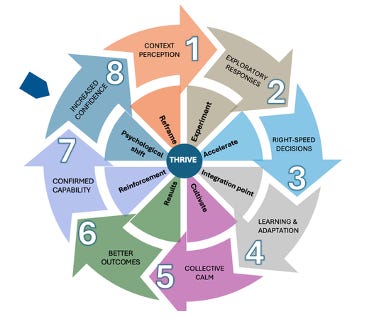
1. The Shift Beneath the Surface
Every surfer remembers that quiet turning point — the moment the sea stops looking like an adversary.
At first, all you see is a threat. Each wave is a wall. Each gust is a fight. You kick, cough, and claw your way through the white water until fatigue and humility finally meet. And then something subtle changes. You start reading the water instead of resisting it. The ocean hasn’t softened — you have grown.
That’s what Stage 8 feels like. The wave doesn’t get smaller; your sense of self gets broader.
In leadership, it’s the instant when a CEO or teacher, once overwhelmed by AI dashboards and digital jargon, begins to see patterns instead of panic. They stop fearing technology’s pull and start sensing its rhythm.
This is called the shift from an external to an internal locus of control (Rotter, 1966; Ng et al., 2006).
Before: “Technology is happening to us.”
After: “We can navigate whatever comes.”
It’s not optimism; it’s evidence. After enough wipeouts, you stop asking if you’ll fall and start asking how fast you’ll recover. The surfer who’s tasted the ocean’s indifference begins to trust their own adaptability.
Confidence, then, isn’t noise or swagger — it’s a calm undertone that says, I’ve been here before. It’s the feeling of dopamine released into your body after accomplishing a task, that your learning continues, or getting confirmation from other people around you that you did a great job!
2. Reading the Swells
Confidence, like a tide, rises from many tributaries. It’s not a single emotion but a composite current.
Four streams that feed real self-efficacy have been identified (Bandura, 1997). We might call that in the realm of tech-surfing ‘the Four Swells of Capability’.
First Swell – Mastery Experiences
Each successful ride leaves salt on the skin and data in the body. The memory of competence becomes muscle. When a team experiments with a new AI tool, struggles, adjusts, and finally makes it work, that’s a wave ridden — evidence etched into culture. Once that threshold has been taken, people are going to use it with more confidence and apply it to other areas.
Second Swell – Vicarious Learning
You watch others paddle out. The marketing team launches a bold prototype; the educators pilot a chatbot and return smiling. Their courage normalizes uncertainty. Visibility is contagious; seeing someone else stay upright reminds you that balance is possible.
Third Swell – Social Persuasion
A quiet nod from a respected peer — “You handled the last storm well” — matters more than a motivational poster. Recognition, grounded in truth, builds shared confidence. It tells the crew: we’ve done this before, we can do it again.
Fourth Swell – Physiological Recalibration
At first, uncertainty floods the body with cortisol and panic. Later, the same rush becomes readiness — heart racing, eyes sharp, breathing steady (Aston-Jones & Cohen, 2005; Kotler, 2014). The nervous system learns the difference between danger and demand.
When these four swells align, something beautiful happens: a self-reinforcing spiral of mastery and meaning (Fredrickson & Joiner, 2002). Each success feeds the next attempt; each attempt strengthens the next belief. That’s how confidence becomes current.
3. When the Horizon Changes
Once confidence takes root, perception itself tilts.
You begin noticing what was always there but filtered out by fear.
Leaders with confidence run more experiments, faster. They stop waiting for perfect forecasts. They paddle earlier, trusting their sense of timing.
The brain literally filters the world differently — its reticular activating system shifts focus from danger to discovery (Aston-Jones & Cohen, 2005). Where the anxious eye spots risk, the confident eye spots possibility.
Confidence also reshapes energy economics. Defensive meetings drain energy; exploratory meetings generate it.
Psychological research on growth mindset (Dweck, 2016) explains why: when failure is data rather than disgrace, learning accelerates.
And as confidence compounds, psychological safety widens (Edmondson, 2018). Teams stop guarding themselves and start thinking together. Ideas breathe. Mistakes surface early. The culture relaxes without losing intensity — like a surfer poised between tension and glide.
When this happens inside an organization, you can feel it in the hallway air: conversations quicken, humor returns, curiosity reappears. The company moves as a single body, alert but unafraid.
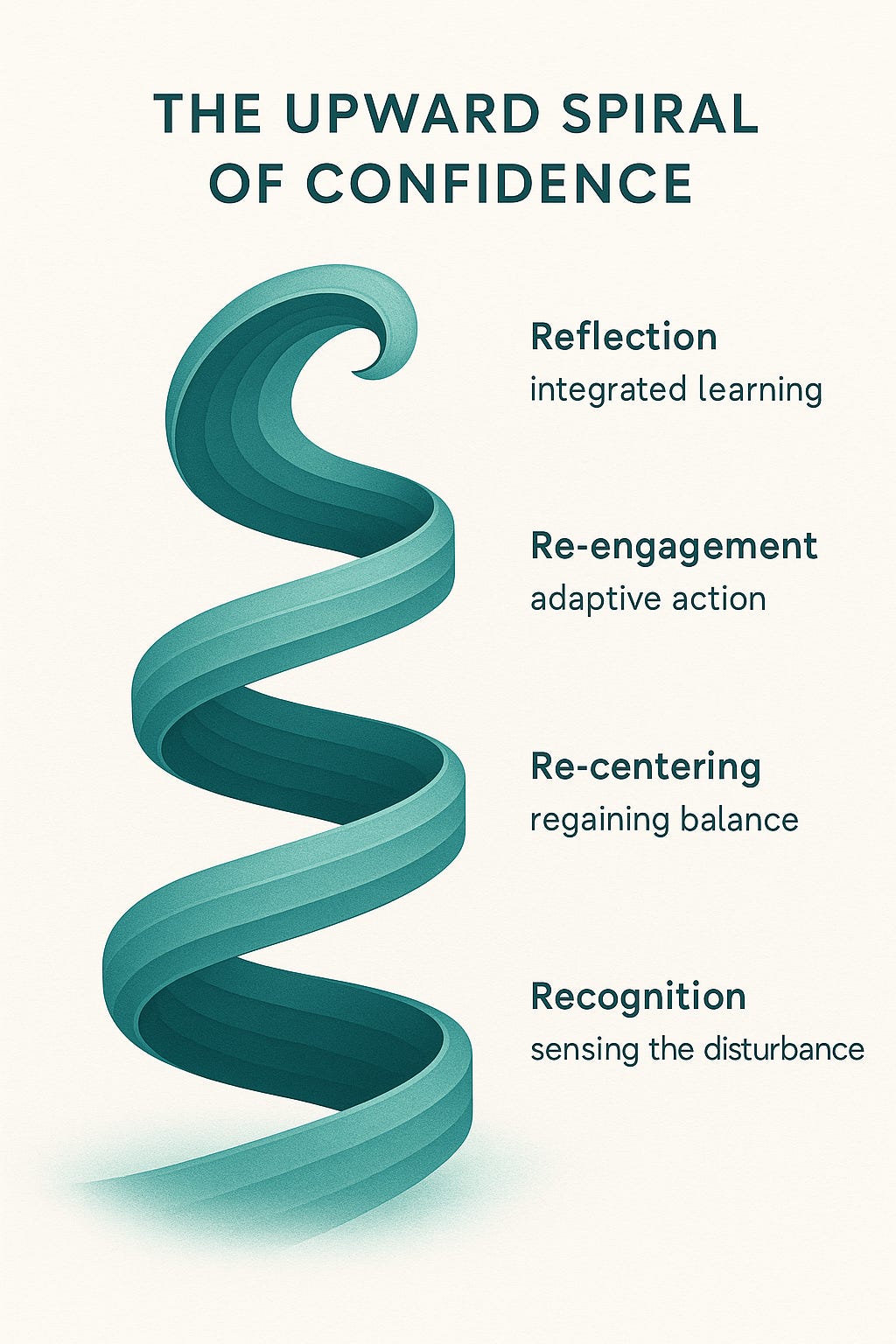
Image… Created with DALL-E ‘The confidence spiral.’
4. The Paradox of Mastery
Confidence can still betray you.
I’ve seen surfers wipe out not from inexperience but from pride — believing they “knew” the wave. The ocean loves correcting that assumption.
In leadership, overconfidence whispers, We’ve mastered disruption.
Adaptive confidence answers. We’ve mastered learning.
The difference is existential. The first ties safety to prediction; the second ties safety to adaptability.
Appropriate confidence trusts process over prophecy — the quiet certainty that you can read and respond faster than events unfold.
Cultures steeped in this stance speak a different dialect:
“Bring me problems” replaces “Don’t come without solutions.”
“Let’s try it” replaces “Let’s study it more.”
“That’s interesting” replaces “That’s threatening.”
Structures shift, too. Budgets move toward experimentation. Decision rights are decentralized. Planning horizons shorten so that discovery can breathe.
What emerges isn’t chaos but flow — the organizational equivalent of catching a clean, unbroken face of water and feeling it carry you forward.
Confidence, at this stage, becomes collective. It’s not one leader’s mental model but the organization’s stance. Every new challenge re-proves the identity: We are people who ride waves.
5. Continuous Waves
But the ocean is speeding up.
The time between sets is shrinking. Disruptions that once came once a decade — the internet, mobile, AI — now stack monthly. The next wave builds before the previous one breaks. We’ve entered an age of continuous surf.
Leaders can no longer finish one adaptive cycle before the next begins.
They need parallel motion: scout teams reading the horizon, experiment teams testing in real time, integration teams embedding what works, and validation teams confirming new competencies. Each group is on a different swell, all connected by rhythm rather than hierarchy.
Survival now depends on greater skills:
6. Deeper Skills for Adaptive Survival
Survival in the turbulence of modern transformation depends less on static expertise and more on deeper skills—meta-capabilities that keep us learning, integrating, and re-centering while the waves keep shifting.
Meta-capabilities — learning how to learn.
The ability to design one’s own learning architecture: sense-making loops, reflective practices, and adaptive feedback. This skill allows leaders and teams to unlearn, relearn, and upgrade their internal models as the environment changes.
(Zenk et al., 2024; Bates, 2022; Sott & Bender, 2025)Continuous integration — capturing insights in real time.
Instead of waiting for quarterly reviews, adaptive teams build learning pipelines: rapid reflection, feedback capture, and micro-adjustments in the flow of work.
(Zenk et al., 2024; Sott & Bender, 2025)Adaptive slack — keeping cognitive and temporal bandwidth open for the unexpected.
In volatile environments, margin equals resilience. Maintaining pockets of time and attention allows experimentation, curiosity, and strategic improvisation. Slack is not waste—it’s strategic breathing space.
(Depino-Besada et al., 2025; Sasson & Schröder, 2024)Rhythm & recovery — alternating sprint and stillness.
Sustained performance follows the wave's physiology: pulse, recover, rise again. Reflection and recovery are not downtime; they are the integration phase of learning.
(Hill-Berry, 2025; Time Course of Recovery Study, 2020)
6.1 The ultimate question
Before we move to the ‘hidden axes’ of the ARC, it’s essential to address the ultimate question as cycles accelerate toward continuity: Is there a limit to how much uncertainty humans and human organizations can navigate?
The ARC provides a framework for navigating uncertainty effectively. But effectiveness assumes that capacity exists to execute the cycle. What happens when the cycle time required exceeds human capacity to complete it?
Three possibilities:
1. We adapt: Human capacity proves more elastic than we think. We develop new capabilities, new tools, and new social structures that enable navigating continuous uncertainty.
2. We augment: We use technology to extend human capacity beyond biological limits. AI becomes not just what we navigate but what helps us navigate.
3. We limit: We collectively decide that some pace of change is too fast, and we deliberately slow technological advancement to match human capacity.
Each possibility has profound implications for how we think about technology, humanity, and the future.
6.2 Returning to the Cycle—Transformed
Despite these challenges, the ARC remains relevant—perhaps more relevant than ever. But its application must evolve:
From discrete cycles to continuous flow: The eight stages become not sequential steps but simultaneous capabilities operating in parallel.
From organizational practice to societal necessity: What began as a competitive advantage becomes a survival requirement—not just for organizations but for communities, institutions, and societies.
From navigating uncertainty to shaping it: The most advanced application isn’t just responding to technological change but influencing its direction—steering toward futures we want rather than just adapting to whatever emerges.
The surfer metaphor evolves: from riding individual waves to navigating continuous turbulence. From choosing which wave to catch to maintaining balance in perpetual motion. From mastering technique to embodying flow.
The question is no longer “Can we navigate this wave?” but “Can we navigate in perpetual waves?”
The answer will determine not just which organizations thrive, but what kind of future we create together.
Rest
Even the most seasoned surfers know to rest between sets.
Confidence without pause erodes into fatigue; flow without reflection collapses into drift.
So we learn to treat confidence not as a peak but as a pulse — a rhythm of rise, ride, rest, repeat. Each cycle strengthens the next.
Stage 8 closes the loop of the ARC, but it also opens the next horizon — the Locus of Control — where we explore who truly steers when everything moves.
7. The Psychological Core of Adaptive Response: Locus of Control
Every adaptive movement begins in perception — and perception begins with control.
At the heart of the ARC — Recognition → Re-centering → Re-engagement → Reflection — lies a hidden axis: the locus of control. Julian Rotter’s original idea (1950s–1966) described how people differ in whether they attribute outcomes to their own agency (an internal locus of control) or to external circumstances (external locus of control).
1. Recognition — Reclaiming Perception
The cycle begins with recognizing disturbance. At this point, locus of control acts like the surfer’s inner compass:
- Those with a strong internal locus notice shifts early — they read the ripple and sense their role within it.
- Those with a predominantly external locus experience the same wave as fate or misfortune.
Leadership implication: Training recognition means cultivating internal anchoring — teaching teams to look for controllable variables even in chaotic conditions.
2. Re-centering — Shifting from Reaction to Response
Once turbulence hits, the re-centering phase separates panic from poise.
- Individuals with an internal locus engage self-regulation: breathing, reframing, choosing a response over a reflex.
- Those with an external orientation tend to externalize (“The system is broken,” “We can’t do anything”).
Re-centering is therefore the pivot where locus of control becomes practice — the conscious move from victimhood to agency.
3. Re-engagement — Action from Agency
Confidence loops upward when people act and see results. Each successful adjustment strengthens internal control beliefs: “I influence outcomes.” Conversely, repeated helplessness pushes individuals toward external attribution: “It doesn’t matter what I do.” The Upward Spiral of Confidence visual captures this feedback — each loop tightens the link between perception and agency.
4. Reflection — Integrating Control Beliefs
The reflection stage solidifies the learning. Here, the surfer reviews not just what happened, but how much agency was exercised. Did I act within my circle of influence or react to forces beyond it? Reflection with a growth mindset strengthens internal control — one of the most reliable predictors of resilience and motivation.
In this sense, locus of control is the psychological wave beneath the behavioral wave. It determines whether we enter the ARC as passengers or pilots. Internal locus aligns with proactive adaptation, curiosity, and resilience — core surfer traits. External locus aligns with passivity, fatalism, and volatility amplification — the undertow.
Leadership Practice: Assess team locus orientations (Rotter or Levenson scales). Design reflection rituals (“What did we control this week?”). Use micro-wins to expand perceived agency. Integrate these moments into the Rhythm & Recovery loop: active adaptation followed by mindful reflection.
8. Key Takeaways
1. Adaptive leadership begins where fear ends—at recognition, not reaction.
2. Calm is an operational asset: physiology precedes strategy.
3. Small experiments reduce uncertainty faster than big bets.
4. Decision velocity matters more than decision volume.
5. Capability confirmed in practice builds lasting confidence.
6. Internal locus of control fuels resilience and collective efficacy.
7. Adaptive response is not a crisis reflex—it’s a continuous art form.
Having learned to respond with agility, we now turn to stability. Part II—Mastering the Board—begins with Chapter 4: Finding Your Stance. It explores how to balance awareness and movement, anchoring agility with strength. Because surfing isn’t just about reacting to waves; it’s about standing tall on them.
9. References
Rotter (1966); Ng et al. (2006); Bandura (1997); Aston-Jones & Cohen (2005); Fredrickson & Joiner (2002); Dweck (2016); Edmondson (2018); Flavell (1979); Schraw & Dennison (1994); Bourgeois (1981); Loehr & Schwartz (2003).
Bates, A. (2022). Towards meta-competences in higher education for tackling complex problems. International Journal of Sustainability in Higher Education, 23(8), 290–307. https://doi.org/10.1108/IJSHE-07-2021-0289
Depino-Besada, J., Jiménez, A., & Cruz, D. (2025). An integrative review and research agenda on organisational slack: Addressing assumptions, conflicted theoretical proposals and conclusions. Journal of Management & Organization. https://doi.org/10.1007/s11301-025-00502-y
Hill-Berry, C. (2025). Educational leadership and resilience in times of crises. Management in Education, 39(2), 87–101. https://doi.org/10.1177/17577438241297242
Sasson, A., & Schröder, J. (2024). Employee slack, wealth, and organisational adaptation. Copenhagen Business School Research Paper Series. https://research.cbs.dk/en/publications/employee-slack-wealth-and-organizational-adaptation
Sott, A., & Bender, H. (2025). The role of adaptive leadership in times of crisis: A systematic review and conceptual framework. Social Sciences, 5(1), 2. https://doi.org/10.3390/socsci5010002
Time Course of Recovery after Cycling Repeated Sprints. (2020). Journal of Strength and Conditioning Research, 34(11), 3145–3152. https://doi.org/10.1519/JSC.0000000000003695
Zenk, L., Hoffmann, K., & Meyer, T. (2024). Meta-competences in complex environments: An interdisciplinary perspective. Systems Research and Behavioral Science. https://doi.org/10.1016/j.techfore.2024.123456
Aston-Jones, G., & Cohen, J. D. (2005). An integrative theory of locus coeruleus-norepinephrine function: Adaptive gain and optimal performance. *Annual Review of Neuroscience*, 28, 403-450.
Bandura, A. (1997). *Self-efficacy: The exercise of control*. W.H. Freeman.
Bernerth, J. B., Walker, H. J., & Harris, S. G. (2011). Change fatigue: Development and initial validation of a new measure. *Work & Stress*, 25(4), 321-337.
Bourgeois, L. J. (1981). On the measurement of organizational slack. *Academy of Management Review*, 6(1), 29-39.
Cyert, R. M., & March, J. G. (1963). *A behavioral theory of the firm*. Prentice-Hall.
Dweck, C. S. (2016). *Mindset: The new psychology of success* (Updated ed.). Random House.
Edmondson, A. C. (2018). *The fearless organization: Creating psychological safety in the workplace for learning, innovation, and growth*. Wiley.
Flavell, J. H. (1979). Metacognition and cognitive monitoring: A new area of cognitive-developmental inquiry. *American Psychologist*, 34(10), 906-911.
Fredrickson, B. L., & Joiner, T. (2002). Positive emotions trigger upward spirals toward emotional well-being. *Psychological Science*, 13(2), 172-175.
Gioia, D. A., Patvardhan, S. D., Hamilton, A. L., & Corley, K. G. (2013). Organizational identity formation and change. *Academy of Management Annals*, 7(1), 123-193.
Loehr, J., & Schwartz, T. (2003). *The power of full engagement: Managing energy, not time, is the key to high performance and personal renewal*. Free Press.
Ng, T. W., Sorensen, K. L., & Eby, L. T. (2006). Locus of control at work: A meta-analysis. *Journal of Organizational Behavior*, 27(8), 1057-1087.
Rotter, J. B. (1966). Generalized expectancies for internal versus external control of reinforcement. *Psychological Monographs: General and Applied*, 80(1), 1-28.
Schraw, G., & Dennison, R. S. (1994). Assessing metacognitive awareness. *Contemporary Educational Psychology*, 19(4), 460-475.