
ARC Phase 3: Right Speed Decisions: Accelerate Decision Velocity Without Recklessness
Re-engagement: Action in Motion


Image created with MidJourney, Paul Epping
Surfer principle: “Hesitation costs the wave; recklessness costs the wipeout. Timing is everything.”
The surfer floating beyond the break faces a perpetual dilemma: commit too early and you waste energy surfing for waves that aren’t ready; commit too late and you watch perfect waves pass by, unrealized potential dissolving into foam. The window of optimal commitment is narrow, measured in seconds. Miss it in either direction and the opportunity vanishes.
Leaders navigating technological disruption face an identical timing challenge, but with stakes measured in millions of dollars and thousands of jobs rather than a single missed ride. The fear response cycle pushes leaders toward one of two timing errors: paralysis (waiting for certainty that never arrives) or panic (lurching into action without adequate preparation). Both are forms of poor timing. Both lead to wipeouts. Panic is a bad advisor!
Breaking free from the fear response cycle requires developing what surfers call “wave sense”—the ability to read conditions, recognize the optimal commitment moment, and act decisively when that moment arrives. In business terms, this means accelerating decision velocity (the speed at which you move from uncertainty to action) without tipping into recklessness (action without adequate consideration). The goal isn’t faster decisions universally; it’s right-speed decisions contextually.
A. Establish Decision-Making Protocols for Different Wave Types
Not all decisions are created equal, yet organizations often apply the same decision-making process to radically different types of choices. A decision about which AI vendor to pilot gets the same committee review, analysis depth, and approval chain as a decision about which AI platform to standardize across the enterprise. The result: trivial decisions consume disproportionate time while critical decisions get inadequate attention, and everything moves at the speed of the slowest, most risk-averse process.
Jeff Bezos’s 2015 shareholder letter introduced a crucial distinction that has since become canonical in technology leadership: Type 1 versus Type 2 decisions (Bezos, 2016). Type 1 decisions are consequential and irreversible—one-way doors where you can’t easily go back if you’re wrong. Type 2 decisions are reversible—two-way doors where you can walk back through if the decision doesn’t work out. Bezos observed that most decisions are Type 2, but organizations treat them like Type 1, applying heavyweight processes that slow everything down.
The implications for decision velocity are profound:
Type 1 decisions (irreversible, high-stakes):
- Require senior leadership involvement
- Deserve thorough analysis and debate
- Should move deliberately (weeks to months)
Examples: Acquiring a company, shutting down a product line, entering a new market, choosing a core technology platform
Type 2 decisions (reversible, lower-stakes):
- Can be delegated to individuals or small teams
- Require “good enough” information, not exhaustive analysis
- Should move rapidly (hours to days)
Examples: Piloting a new tool, testing a feature, trying a marketing channel, experimenting with a process change
The surfer makes this distinction instinctively. Deciding which break to surf today is Type 2—if you get there and conditions are poor, you go somewhere else. Deciding to surf into a 20-foot wave at a shallow reef break is Type 1—once you commit, you’re committed, and the consequences of being wrong are severe. The experienced surfer moves quickly on Type 2 decisions (trying different positions in the lineup, adjusting equipment) while moving deliberately on Type 1 decisions (whether to sail into that massive set wave).
Amazon institutionalized this distinction by explicitly empowering teams to make Type 2 decisions without escalation. The cultural norm became: if you can reverse the decision, make it quickly and learn; if you can’t reverse it, slow down and get input. This simple framework dramatically accelerated decision velocity on 90% of decisions that are reversible while maintaining appropriate deliberation on the 10% that aren’t.
However, even this binary distinction is insufficient to capture the full complexity of organizational decision-making. Military strategist John Boyd’s OODA loop framework—Observe, Orient, Decide, Act—provides additional nuance (Boyd, 1987; Richards, 2004). Boyd, a fighter pilot, recognized that in competitive environments, decision speed itself becomes a weapon. If you can complete your OODA loop faster than your opponent completes theirs, you can act on information they haven’t yet processed, forcing them into reactive mode.
Applied to the technology competition, this means:
Observe: Gather relevant information about market shifts, customer needs, competitor moves, and technology capabilities. The keyword is “relevant“—not exhaustive. What information do you need for this specific decision?
Orient: Interpret that information through your strategic context, mental models, and cultural lens. This is where cognitive biases live—and where reframing uncertainty (Section 1) matters most.
Decide: Choose a course of action based on your interpretation. This is often the fastest step if Observe and Orient are done well.
Act: Execute the decision and observe the results, beginning the loop again.
The organization that completes this loop faster than its competitors gains a compounding advantage. While competitors are still in “Observe” mode (gathering more data), you’re already in “Act” mode (learning from real-world results). While they’re debating in “Orient” mode (interpreting what the data means), you’re back in “Observe” mode (gathering data from your action’s results).
Spotify exemplifies rapid OODA loops through its “squad” structure (Kniberg & Ivarsson, 2012). Small, autonomous teams (squads) can observe user behavior, orient around insights, decide on experiments, and act—all within a single week or even a single day. Traditional organizations might take months to complete the same loop, requiring data to flow up hierarchies, decisions to flow down, and coordination across silos. By the time they act, the market has shifted, and their action is based on outdated observations.
Now, imagine if we add 'becoming' as a meta-state of the OODA loop, thus (OODA)-B?
Becoming the internalized state where OODA operates unconsciously: the goal isn’t just to execute the loop—it’s to embody it until it becomes your default mode of engaging with complexity. That accelerates the speed of (right) decisions.
When we take a closer look at the expanded (OODA)-B, we see a company like NVIDIA that has made this the core of its business.
The Pivot: NVIDIA spent 15+ years building GPU technology for gaming, then became an AI infrastructure company almost overnight when ChatGPT launched.
OODA-B in Action:
Observe: I noticed AI researchers were repurposing their gaming GPUs for machine learning
Orient: Recognized this wasn’t a side market—it was the future market
Decide: Pivoted the entire company strategy toward AI compute
Act: Redesigned chips (H100, A100), built a Compute Unified Device Architecture (CUDA) ecosystem, partnered with every major AI lab
Becoming: Now they don’t just sell AI chips—they are the AI infrastructure layer. The loop is internalized; they anticipate AI compute needs before customers articulate them
Why it’s powerful: Jensen Huang (CEO) has said they “reinvent the company every few years.”
That’s becoming—the OODA loop is their organizational DNA.
Some other ‘masters’ of the (OODA)-B beyond Spotify and Nvidia.
While Spotify’s squad model is well-documented, a couple of more cutting-edge examples reveal how companies operationalize instinctive adaptation:
a. ByteDance’s “Flesh and Machine” Feedback Loop
Observe: Real-time A/B testing across 1.5 billion users generates 15MB of behavioral data per second
Become Moment: Their recommender algorithm now preemptively surfaces content trends 12-48 hours before they peak
Key Insight: Human editors (the “flesh”) initially guided the AI, but the system internalized cultural pattern-recognition so deeply that it now outpaces human intuition.
b. SpaceX’s Failure-Driven Cadence
Act Faster Than Physics: Rapid prototyping cycles compress rocket development from years to months
Become Threshold: After 150+ engine tests, teams now instinctively adjust designs mid-test based on acoustic signatures alone
Data Point: Starship iterations now incorporate “muscle memory” fixes without formal review (e.g., automatic weld pattern adjustments)
The New (OODA)-B Playbook
These cases reveal three implementation rules:
Overdose on Feedback (ByteDance’s 15MB/sec immersion)
Normalize Micro-Failures (SpaceX’s daily engine explosions)
Train Cross-Modal Intuition (Nvidia’s synesthetic engineers)
The surfer’s OODA-B loop operates on a timescale of seconds: observe the approaching swell, orient your position and timing, decide whether to paddle, and act by committing. Hesitate at any stage, and the wave passes. But rush through “orient” without reading the wave properly, and you paddle for a closeout that slams you. Speed matters, but so does the quality of orientation.
Practice: The Decision Matrix.
Implement a simple 2×2 matrix to categorize decisions and assign appropriate processes:
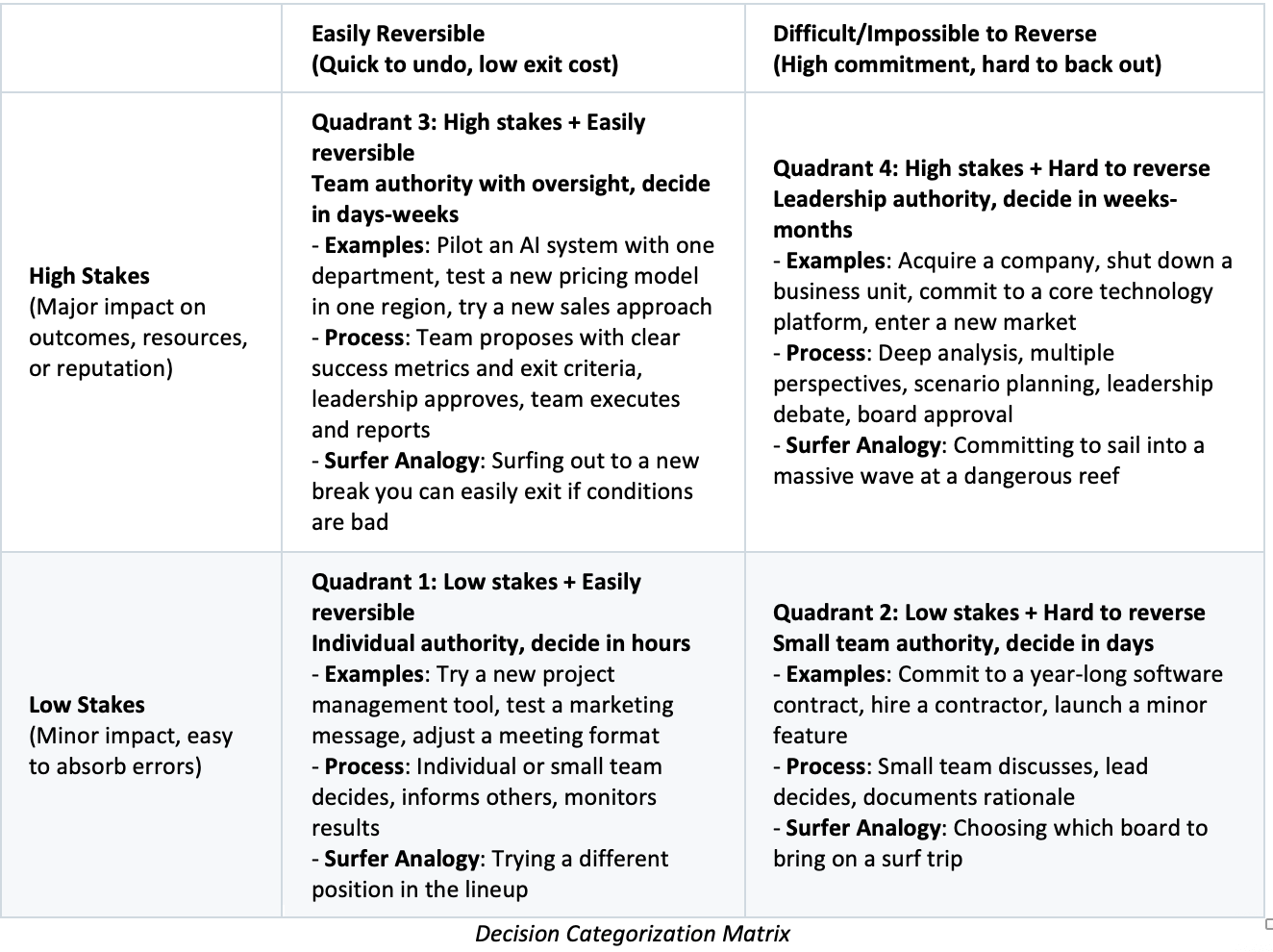
Decision Categorization Matrix
The key insight: most decisions fall into Quadrants 1-3, yet many organizations treat them all like Quadrant 4. By explicitly categorizing decisions and matching the process to the category, you can accelerate velocity on 80-90% of decisions while maintaining appropriate deliberation on the truly consequential, irreversible ones.
B. Create “Commitment Triggers” to Overcome Hesitation
Even with clear decision protocols and safe-to-fail experiments, organizations can still hesitate at the critical moment—the instant when you must commit. The surfer knows this moment intimately: you’ve positioned yourself, you’ve read the wave, you know it’s rideable, but there’s still a moment of decision where you must commit to go for it. Hesitate and the wave passes. Commit and you’re riding.
Research on “implementation intentions” reveals a powerful technique for overcoming hesitation: pre-commitment through “if-then” rules (Gollwitzer, 1999). Rather than relying on in-the-moment willpower to decide, you decide in advance what you’ll do when specific conditions arise. The format is simple: “If X happens, then I will do Y.”
In experimental settings, subjects who form implementation intentions are 2-3 times more likely to follow through on intended behaviors than those who simply set goals. The mechanism: by deciding in advance, you bypass the moment of hesitation where fear, uncertainty, and rationalization can derail action. The decision is already made; you’re just executing.
Applied to technological decision-making, implementation intentions become “commitment triggers”—pre-defined conditions that automatically trigger specific actions.
Example commitment triggers:
- “If our pilot AI system achieves >80% accuracy and >70% user satisfaction after 3 months, then we will immediately allocate budget for department-wide rollout.”
- “If a competitor launches a feature that 3+ customers request within a month, then we will initiate a rapid response sprint to evaluate and potentially match it.”
- “If our quarterly technology scan identifies a breakthrough that could disrupt our core business, then we will immediately fund a small team to explore how we could leverage it before competitors do.”
- “If an experiment fails to meet its success criteria after the defined time period, then we will shut it down within two weeks and reallocate resources—no extensions without new evidence.”
- “If we reach 60% confidence (based on our Bayesian framework) that a technology will create significant value, then we commit $X to full implementation.”
The power of commitment triggers lies in separating the decision from the moment of action. You make the decision when you’re calm, strategic, and not under immediate pressure. Then, when the triggering condition occurs, you execute the pre-made decision rather than re-litigating it under stress.
Intel’s famous “10x rule” functioned as a commitment trigger. Andy Grove established that if a technology or market shift represented a 10x change (not 10% incremental change, but order-of-magnitude transformation), Intel would treat it as a strategic inflection point requiring fundamental response (Grove, 1996). This rule helped Intel navigate the shift from memory chips to microprocessors—a wrenching transformation that required abandoning the business Intel was founded on. The 10x rule provided the commitment trigger: when the evidence showed memory was becoming commoditized (a 10x shift in competitive dynamics), Intel committed to the painful but necessary pivot to microprocessors.
The surfer uses commitment triggers constantly, often unconsciously: “If the third wave of the set is three meters or bigger, I’m going.” “If I’m positioned in line with that other surfer, I’m taking off.” “If the wind shifts offshore, I’m switching to my smaller board.” These pre-decisions eliminate hesitation at the critical moment. The surfer doesn’t debate whether to paddle when the wave arrives; they’ve already decided the conditions under which they’ll paddle, and now they’re just executing.
These are called “pre-commitment devices” by behavioral economists —mechanisms that lock in future behavior before the moment of temptation or hesitation (Thaler & Sunstein, 2008). Odysseus ordering his crew to tie him to the mast so he could hear the Sirens’ song without steering the ship to destruction is the classical example. Modern examples include automatic retirement savings (committed before you see the money and are tempted to spend it) or website blockers that prevent you from accessing distracting sites during work hours (committed when you’re motivated, enforced when you’re tempted).
For organizations, commitment triggers serve as pre-commitment devices against the fear response cycle. When uncertainty triggers anxiety, the instinct is to delay, gather more information, and form another committee. But if you’ve pre-committed—”If X condition is met, we act”—the decision is already made. You’re not deciding whether to act; you’re verifying whether the condition is met, which is a much simpler, less emotionally fraught question.
Example commitment trigger framework for AI adoption:
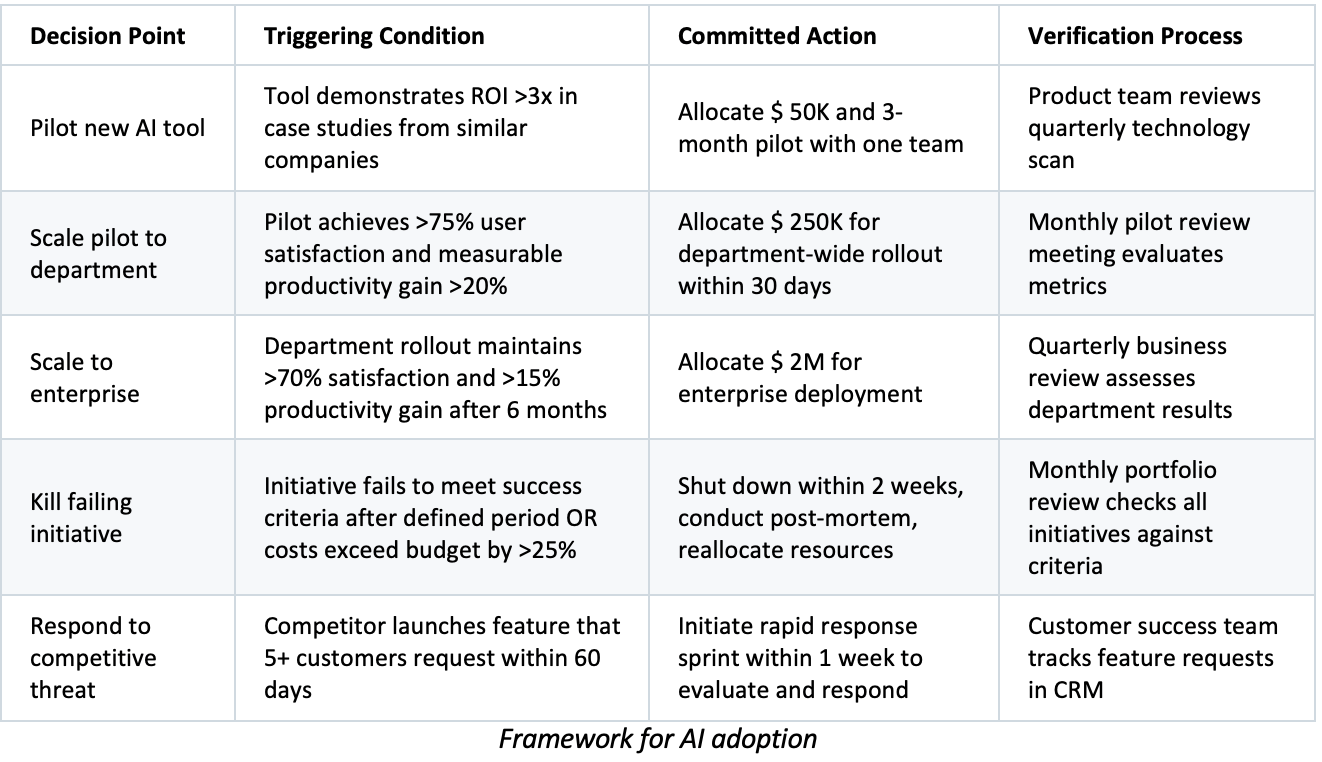
Framework for AI adoption
This framework transforms vague intentions (”We should be more decisive about technology”) into concrete, actionable commitments (”When X happens, we do Y”). It removes the moment of hesitation that the fear response cycle exploits.
Netflix’s approach to content decisions exemplifies commitment triggers in action. Rather than endless debate about which shows to greenlight, Netflix established clear triggers: if a pilot’s completion rate (percentage of viewers who finish the episode) exceeds X% and its audience satisfaction score exceeds Y, greenlight a full season. If a show’s viewership drops below Z threshold, cancel it. These triggers don’t eliminate judgment—there’s still human decision-making about the thresholds and exceptions—but they eliminate the paralysis of re-deciding the same question repeatedly (Keating, 2012).
The commitment trigger approach also addresses what Daniel Kahneman calls “decision fatigue”—the deteriorating quality of decisions after making many decisions (Kahneman, 2011). By pre-making certain categories of decisions through if-then rules, you preserve cognitive resources for the truly novel, complex decisions that require fresh thinking.
Practice: Strategic If-Then Rules
Develop a set of commitment triggers for your organization’s key technology decisions:
1. Identify recurring decision points: What decisions does your organization face repeatedly? (Whether to pilot new technologies, when to scale pilots, when to kill failing initiatives, how to respond to competitive moves)
2. Define triggering conditions: What observable, measurable conditions would indicate it’s time to act? Be specific. “When market conditions improve” is too vague. “When three enterprise customers request this feature” is specific.
3. Specify committed actions: What exactly will you do when the trigger occurs? “We’ll consider it” is not a commitment. “We’ll allocate $X budget and assign Y team within two weeks” is a commitment.
4. Establish verification processes: How will you know when the triggering condition has been met? Who checks? How often? What’s the evidence standard?
5. Communicate widely: Share these commitment triggers across the organization so everyone knows the rules of engagement. This creates accountability and prevents re-litigation of decisions.
6. Review and refine: Quarterly, review your commitment triggers. Are they still relevant? Do the thresholds need adjustment based on what you’ve learned? Are people actually following them?
The right balance
The acceleration of decision velocity—through appropriate protocols, safe-to-fail experiments, and commitment triggers—doesn’t mean recklessness. The surfer who commits quickly to waves isn’t being reckless; they’ve developed the judgment to recognize which waves are worth committing to, the skill to ride them successfully, and the experience to know their limits. They move fast because they’ve built the capabilities that make fast movement safe.
Similarly, organizations that accelerate decision velocity do so on a foundation of reframed uncertainty, clear decision frameworks, experimental discipline, and pre-commitment mechanisms. Speed without this foundation is indeed reckless—thrashing rather than purposeful action. But with this foundation, speed becomes a strategic advantage.
The fear response cycle creates slow organizations that mistake deliberation for wisdom and delay for prudence. Breaking free creates fast organizations that mistake neither speed for recklessness nor caution for cowardice. They’ve learned what the surfer knows: in dynamic environments, timing is everything, and the cost of missed opportunities often exceeds the cost of imperfect decisions.
Wow, the wave sense idea! So true, but data helps.