
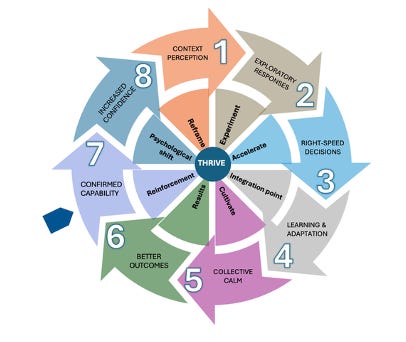
ARC - Stage 7: Confirmed Capability -
When Evidence Becomes Identity


What Gets Confirmed: The Three Pillars
Success in navigating uncertainty doesn’t just feel good—it provides concrete evidence across three critical dimensions. This isn’t blind confidence or motivational cheerleading. It’s evidence-based capability confirmation that transforms how an organization sees itself and operates.
1. Process Effectiveness: “Our Decision Frameworks Actually Work”
The first confirmation is perhaps the most practical: the processes and frameworks you’ve built actually produce better outcomes.
When Microsoft’s leadership team used their Type 1/Type 2 decision framework (irreversible vs. reversible decisions) to evaluate the OpenAI partnership, they could move quickly on what was essentially a reversible investment while taking more time on irreversible strategic commitments. The framework prevented both analysis paralysis on decisions that could be adjusted and reckless speed on decisions that couldn’t.
Years later, when that partnership positioned them perfectly for the ChatGPT explosion, the evidence was clear: the decision framework worked. Not just in theory—in practice, under real conditions, with real stakes.
Similarly, organizations that implement commitment triggers—clear criteria for when to move from experimentation to scaling—discover they can act decisively without endless debate. When an AI experiment hits predetermined success metrics (customer adoption above X%, cost reduction exceeding Y%, reliability meeting Z standard), the decision to scale is already made. No committee meetings. No political maneuvering. The trigger was pulled, and it worked.
Safe-to-fail experiments generate perhaps the most valuable confirmation. When teams run small, bounded experiments that either succeed (providing direction) or fail (providing learning without catastrophic cost), they prove the approach works. A financial services company testing AI-powered fraud detection in one region before rolling out globally confirms that experimental methodology prevents expensive mistakes while enabling rapid learning.
What gets confirmed: The Type 1/Type 2 distinction prevented analysis paralysis. Commitment triggers enabled timely action. Safe-to-fail experiments generated valuable learning without catastrophic failures. The processes aren’t just good ideas—they’re proven tools.
2. Team Capability: “We Can Handle This”
The second confirmation is human: teams prove to themselves and each other that they can execute, adapt, and solve problems collectively.
When a product team successfully launches an AI-powered feature—navigating technical challenges, user feedback, and market dynamics—they don’t just ship a feature. They confirm their capability to execute under uncertainty. The next ambitious project feels less daunting because they have evidence: “We did something hard before. We can do hard things.”
Effective pivots provide even stronger confirmation. When a team experiments with an approach, recognizes it’s not working, and successfully pivots to a different strategy—that’s capability confirmation at the highest level. It proves they can not only execute but adapt. They’re not rigidly committed to plans; they’re fluidly responsive to reality.
Again, research on psychological safety and team learning shows that teams who successfully navigate challenges together develop what Edmondson calls “teaming capability”—the ability to coordinate, learn, and adapt in real-time (Edmondson, 2012). This capability, once confirmed through successful navigation of uncertainty, becomes a team’s most valuable asset.
Collaborative problem-solving proves collective intelligence works. When cross-functional teams tackle complex challenges—say, integrating AI across customer service, operations, and product development—and successfully navigate the technical, organizational, and cultural complexity, they confirm that diverse perspectives and collaborative approaches produce better outcomes than siloed expertise.
What gets confirmed: Successful experiments prove teams can execute. Effective pivots prove teams can adapt. Collaborative problem-solving proves collective intelligence works. The capability isn’t just in individuals—it’s in how teams work together.
3. Cultural Shift: “This Is How We Operate Now”
The third confirmation is the deepest: new behaviors become normalized, embedded in organizational culture, and transmitted to new members.
This is where temporary changes become permanent transformation. When “running experiments” shifts from “that thing the innovation team does” to “how we approach uncertainty across the organization,” culture has shifted. When “pivoting based on learning” moves from “admitting failure” to “demonstrating adaptability,” culture has shifted. When “distributed decision-making” evolves from “risky delegation” to “how we operate,” culture has shifted.
This is the pivot when the culture is moving from “espoused values” (what we say we believe) to “basic underlying assumptions” (what we unconsciously assume to be true) (Schein, 2010). The shift happens when behaviors prove successful enough times that they become “the way things are done here”—no longer requiring conscious effort or justification.
Stories of successful navigation become organizational lore. When people tell new employees about “the time we pivoted our AI strategy in six weeks and captured a market opportunity competitors missed,” they’re not just sharing history—they’re transmitting culture. These stories encode lessons about what’s valued, what’s possible, and how things work here.
New employees absorb adaptive culture from existing employees through what organizational learning theorists call “legitimate peripheral participation” (Lave & Wenger, 1991). They observe how decisions get made, how experiments get run, how failures get discussed, how successes get celebrated—and they internalize these patterns. When new hires arrive already expecting to experiment, adapt, and navigate uncertainty, you know the culture has shifted.
What gets confirmed: New behaviors become normalized. Stories of successful navigation become organizational lore. New employees absorb adaptive culture from existing employees. The capability has become cultural—part of organizational identity.
The Surfer Analogy: Earned Confidence
After successfully riding challenging waves, a surfer’s confidence is grounded in demonstrated capability, not bravado. They know they can handle similar conditions because they just did.
This is crucial: the confidence isn’t based on hope, positive thinking, or motivational speeches. It’s based on evidence. The surfer sailed out on a big day, read the conditions, positioned correctly, committed to waves, navigated critical sections, and rode successfully. Multiple times. In varying conditions.
That evidence creates “self-efficacy”—belief in one’s capability to execute actions required to manage situations (Bandura, 1997). But Bandura emphasizes that self-efficacy isn’t built through affirmations or visualization. It’s built primarily through mastery experiences—successfully executing challenging tasks. Similar to the rock climbers in Yosemite Park. Once a climber found the route up and reached the top in less than one hour, others followed suit (Kotler, 2014).
The surfer who’s ridden overhead waves in challenging conditions doesn’t need to psych themselves up for similar conditions. They’ve done it. They know they can do it. The confidence is calibrated to demonstrate capability.
Contrast this with false confidence—the beginner who watches videos, reads about technique, and sails out on a big day thinking “I’ve got this” without the actual capability to back it up. That’s not confidence; it’s delusion. And it’s even dangerous.
Organizations need the surfer’s earned confidence, not the beginner’s false bravado. Confirmed capability provides that: evidence-based confidence that enables appropriate risk-taking without recklessness.
4. Evidence Forms: Five Ways Capability Gets Confirmed
Confirmed capability manifests in specific, observable forms. These aren’t abstract or subjective—they’re concrete evidence that organizational capability has been proven.
A. Case Studies of Successful Navigation
The most direct evidence: documented examples of successfully navigating uncertainty.
When Shopify navigated COVID-19’s disruption of retail by rapidly pivoting to support suddenly-digital merchants, they didn’t just survive—they thrived. Revenue grew 86% in 2020. But more importantly, they documented how they did it: distributed decision-making enabled rapid response, experimental culture allowed quick pivots, and collective calm prevented panic-driven mistakes (Lütke, 2020).
That case study became evidence—for Shopify internally and for others watching—that adaptive organizational capability works under extreme conditions. It’s one thing to claim you can navigate uncertainty. It’s another to point to a specific, documented example: “Here’s what happened, here’s how we responded, here’s the outcome.”
Organizations building confirmed capability create these case studies deliberately. Not as marketing materials, but as learning artifacts. “When we faced the AI disruption in customer service, here’s what we did: ran three parallel experiments, learned X and Y, pivoted based on learning, scaled the successful approach, achieved Z outcome.” The case study confirms capability and provides a template for future navigation.
B. Metrics Showing Improved Performance
Numbers don’t lie. Quantitative evidence of improved performance confirms capability in ways that stories alone cannot.
When organizations track metrics like:
- Time from “uncertainty emerges” to “decision made” (decreasing over time)
- Success rate of strategic initiatives (increasing over time)
- Employee engagement scores (rising, especially during disruption)
- Innovation pipeline velocity (accelerating)
- Market share in emerging segments (growing)
...they’re building evidence that their approach to navigating uncertainty produces measurable results.
MIT’s Erik Brynjolfsson and colleagues tracked firms implementing AI and found that those investing in complementary organizational capabilities—exactly what the ARC builds—saw productivity improvements 3-5x higher than firms just deploying technology (Brynjolfsson et al., 2021). The metrics confirmed that organizational capability, not just technology, drives outcomes.
The key is tracking the right metrics. Not just lagging indicators (revenue, profit) but leading indicators of adaptive capability: experiment velocity, learning cycle time, decision speed, cross-functional collaboration frequency. These metrics confirm capability is building before it fully manifests in financial results.
C. Team Testimonials About Increased Confidence
Qualitative evidence from people doing the work provides confirmation that metrics alone can’t capture.
When team members say things like:
- “I used to dread uncertainty. Now I see it as opportunity to apply what we’ve learned.”
- “We don’t panic when conditions change again. We have processes for navigating this.”
- “I trust my team to handle whatever emerges. We’ve proven we can adapt.”
- “New challenges feel manageable because we’ve successfully navigated similar situations before.”
...they’re confirming that capability has been internalized at the individual and team level.
Research on organizational change shows that employee perception of capability is a leading indicator of actual performance (Armenakis & Harris, 2009). When people believe they can navigate uncertainty effectively, they behave differently—taking appropriate risks, experimenting more readily, adapting more fluidly—which produces better outcomes, which confirms the capability, creating a reinforcing cycle.
Regular pulse surveys asking “How confident are you in our organization’s ability to navigate emerging challenges?” provide quantitative tracking of this qualitative shift. When confidence scores rise steadily over time, especially during periods of disruption, it confirms capability is being built and recognized.
D. External Recognition
Third-party validation provides objective confirmation that capability is real and visible.
This takes multiple forms:
Industry awards: Recognition for innovation, adaptability, or organizational excellence confirms that external observers see the capability. When Fast Company names you one of the “Most Innovative Companies” or Fortune includes you in “Best Companies to Work For,” it’s evidence that your adaptive capability is visible and valued.
Press coverage: When business media profiles how your organization navigated disruption successfully, it confirms the story is compelling enough to be newsworthy. Articles titled “How [Company] Pivoted During Crisis” or “Inside [Company]’s AI Transformation” provide external validation of capability.
Talent attraction: Perhaps the most meaningful external recognition is when talented people want to join your organization specifically because of your reputation for navigating uncertainty effectively. When candidates say “I want to work somewhere that’s adaptive and forward-thinking, and I’ve heard that’s how you operate,” it confirms your capability is visible in the talent market.
Partner interest: When other organizations seek partnerships because they want to align with a company that can navigate change effectively, it confirms capability. Strategic partners aren’t looking for organizations that might survive disruption—they’re looking for ones that will thrive through it.
Customer trust: When customers explicitly cite your adaptability and innovation as reasons for loyalty, it confirms capability. B2B customers especially value partners who won’t be disrupted out of existence and who will evolve to meet their changing needs.
Copy behavior: Other companies are trying to do the same thing. You own the experience that another company yet has to build.
E. Reduced Anxiety in Leadership Discussions
Perhaps the most subtle but powerful evidence: the emotional tone of leadership conversations about uncertainty shifts.
In organizations without confirmed capability, leadership discussions about emerging challenges are characterized by:
- Anxiety and tension
- Defensive postures
- Blame when things go wrong
- Avoidance of difficult topics
- Pressure to have all the answers before acting
In organizations with confirmed capability, the same discussions feel different:
- Composed energy and focus
- Collaborative problem-solving
- Curiosity about what can be learned
- Direct engagement with challenges
- Comfort with acting despite incomplete information
This shift is observable. Meeting facilitators, executive coaches, and board members can sense it. The physiological markers are different—breathing patterns, body language, tone of voice. The conversational patterns are different—more questions, less defensiveness, more building on ideas, less protecting positions.
When a CEO can say “We’re facing significant AI disruption and we don’t have all the answers, but we have the capability to navigate this” and the room responds with focused energy rather than panic, that’s confirmed capability. The confidence isn’t in knowing the future—it’s in knowing the organization can handle whatever emerges.
Organizational psychologist Otto Scharmer describes this as shifting from “downloading” (reacting from past patterns) to “presencing” (sensing and actualizing emerging futures) (Scharmer, 2009). The shift is palpable in how leadership teams engage with uncertainty.
The Reinforcement Mechanism
These five forms of evidence don’t just confirm capability—they reinforce the behaviors that built it.
When teams see case studies of successful navigation, they’re more willing to experiment on the next challenge. When metrics show improved performance, they trust the processes that produced those results. When colleagues express increased confidence, it spreads through emotional contagion. When external recognition arrives, it validates the approach. When leadership discussions become less anxious, it creates psychological safety for others.
This is the reinforcement loop that makes Stage 7 so powerful: evidence confirms capability, which reinforces behaviors, which produce more evidence, which confirms capability more deeply...
The result: adaptive behaviors that initially required conscious effort become automatic. The organization doesn’t have to think about “being adaptive”—it just is.
5. Bridge to the last stage, Stage 8: Increased Confidence
Confirmed capability fundamentally changes how an organization approaches the next wave of uncertainty. The question shifts from “Can we handle this?” to “How will we navigate this?”
That shift—from capability doubt to capability confidence—is what Stage 8 is built on. When you know you can navigate uncertainty effectively (because you have evidence you’ve done it before), you approach emerging challenges differently. Remember the surfer in the rough surf:
You scan the horizon more actively, looking for the next wave rather than hoping it doesn’t come.
You position more proactively, moving toward opportunity rather than away from threat.
You commit more decisively, trusting your capability to adjust if conditions change.
You experiment more boldly, knowing that learning from “failures” builds capability for future success.
This increased confidence isn’t recklessness or overconfidence. It’s calibrated confidence based on demonstrated capability. Like the experienced surfer who sails out on bigger days not because they’re fearless, but because they’ve confirmed they have the skills to handle it.
The next stage explores how this confidence transforms organizational behavior—enabling you to not just navigate uncertainty, but to actively seek it out as the medium in which you create competitive advantage.
Because once you’ve confirmed you can surf, you start looking for better waves.
6. References
Armenakis, A. A., & Harris, S. G. (2009). Reflections: Our journey in organizational change research and practice. Journal of Change Management, 9(2), 127-142.
Bandura, A. (1997). Self-efficacy: The exercise of control. W.H. Freeman.
Brynjolfsson, E., Rock, D., & Syverson, C. (2021). The productivity J-curve: How intangibles complement general purpose technologies. American Economic Review, 111(1), 52-89.
Edmondson, A. C. (2012). Teaming: How organizations learn, innovate, and compete in the knowledge economy. Jossey-Bass.
Lave, J., & Wenger, E. (1991). Situated learning: Legitimate peripheral participation. Cambridge University Press.
Lütke, T. (2020). Shopify’s response to COVID-19. Shopify Engineering Blog. Retrieved from https://shopify.engineering/
Scharmer, C. O. (2009). Theory U: Leading from the future as it emerges. Berrett-Koehler.
Schein, E. H. (2010). Organizational culture and leadership (4th ed.). Jossey-Bass.