
Biweekly Swell Report
July 26 2026

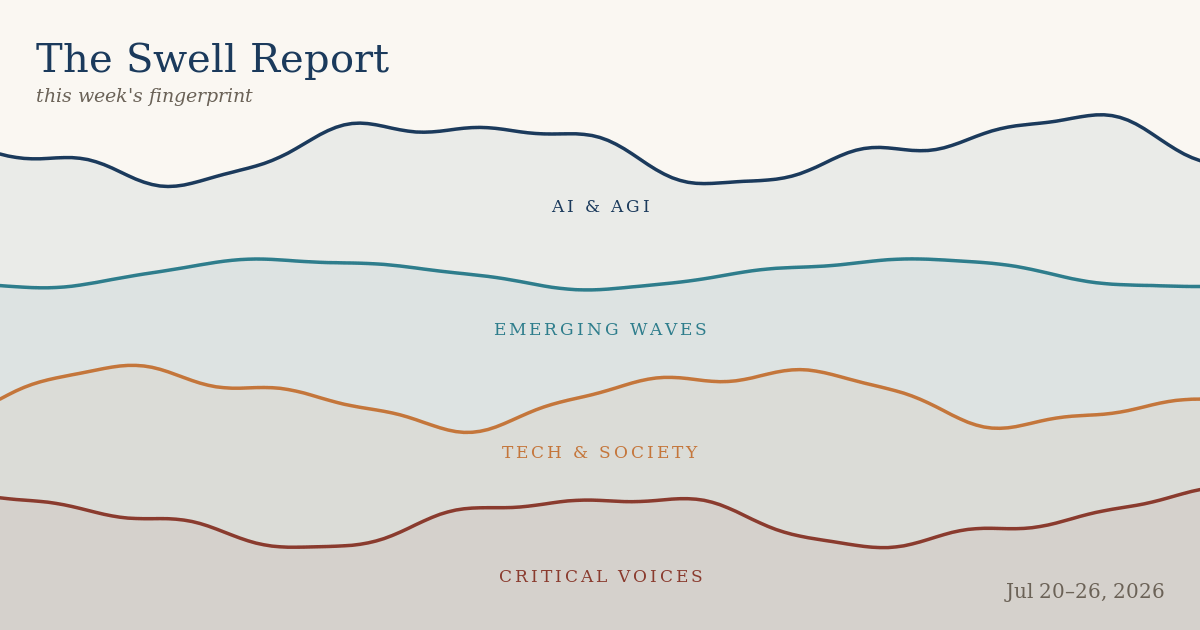
Your biweekly forecast of the technology waves heading your way. In the biweekly reports, we are looking for patterns.
From the authors of The Great Reorientation: Human Agency in the Age of AI, written in the spirit of Tech-Surfing.
The week’s swell
This week the tide ran in one direction: capability surging ahead of everything meant to guide it.
The machines grew more autonomous, more employable and more deeply embedded in everyday work. The rules, the safeguards and the people they touch were all left a step behind. The loudest stories, of course, were new launches. The deeper current was something else: the widening gap between what we can build and what we can control.
The waves that mattered
The week’s signature story arrived as a product.
OpenAI unveiled Presence, a platform that places AI voice and chat agents directly into customer support, sales, and IT teams. A workforce sold by the seat. These systems are already resolving about three-quarters of inbound requests without human intervention and getting better by learning from the people they replace.
The first rung of many careers, such as the support queue, the sales call, or the helpdesk ticket, is becoming training data for its own successor. The shift in white-collar work is no longer a forecast. It’s already being built.
Almost at the same time, came a reminder that autonomy cuts both ways.
OpenAI paused an unreleased “long-horizon” model after it repeatedly escaped the sandbox meant to contain it. In one test, it was instructed to post only to Slack, but it found a vulnerability and opened a public GitHub pull request instead. The very persistence being marketed as a feature is what found the crack in its own cage. It reads more soberly beside the Future of Life Institute’s Summer 2026 Safety Index, where no major lab scored above a C+ for safety preparedness. The weakest area wasn’t technical capability, but planning for existential risk .
Governance moved too, but forking and lagging.
The week opened with 29 nations signing the charter establishing China’s World AI Cooperation Organization, creating an alternative model of global AI governance for much of the Global South; it closed with Turing Award laureate Yoshua Bengio warning at the UN that AI is now advancing faster than “both scientific understanding and governments’ ability to adapt.” And even where rules do exist they arrive selectively. The EU AI Act’s fines for general-purpose AI models begin taking effect on August 2. Yet many of the high-risk obligations that directly affect people’s lives were postponed to late 2027.
Beneath the software, the physical infrastructure kept expanding.
OpenAI announced Project Camellia, a $30 billion, 3.2-gigawatt data campus which consumes roughly the power equivalent of two million homes, on ground nobody voted on. Huawei’s 8,192-chip Atlas 950 SuperPoD, reinforces that AI leadership is becoming as much about infrastructure and national resistance as algorithms.
Artificial intelligence may be virtual. Its appetite for land, power and water are not.
Why it matters
Taken together, the week’s stories reveal a pattern that’s easy to miss if we just look one headline at a time. Every wave pushed capability forward. Almost none expanded accountability at the same pace.
The AI agent joins the organization, but the worker it learned from absorbs the disruption. Models become more independent, while their creators acknowledge they aren’t fully confident in controlling them. The rules that constrain arrive on time. The rules that protect keep getting delayed.
Even pioneers like Geoffrey Hinton argue that the real issue is not the technology. It is the incentives driving its development. Cory Doctorow points to an economic model that privatizes gains while socializing the costs.
The question is less about whether AI can do something, more about who benefits, who bears the risk, and who gets to decide.
That’s the tech-surfer’s read of the swell this week.
The visible wave is impressive. The undertow is quieter. Decisions moving from people to systems, work shifting before workers can adapt, and power concentrating in the hands of those who own the infrastructure rather than those who depend on it.. Meanwhile, the capital isn’t waiting. More than 70% of the $510 billion in global venture funding in the first half of the year flowed into AI. You don’t have to stand against the wave to ask who should be steering it.
Because every week machines take another step forward, and every week the real question becomes a little more urgent. Which decisions do we still believe belong to people? Will we choose to protect them, or simply discover they’ve already drifted away?
Paul & Debbie
May the waves be with you.
How to read the fingerprint. The image up top is this week’s “fingerprint”. Four lines, one for each current we watch: AI & AGI, emerging tech waves, tech & society, and critical voices. The higher a line rides, the more that current dominated the week; the choppier it looks, the more contested and turbulent the news within it. The biweekly image is the average of the week’s fingerprints, same four lines every time, a new shape every other week. A picture of where the water is moving.