
Tech-Surfing - Chapter 3 -Section 3- The Adaptive Response Cycle
Turning Fear into Flow: How to Overcome Fear of Technological Changes and Master Adaptive Responses.


After the swimmer’s mistake and the fear-response cycle, the question becomes simple:
If we can’t control the waves of technology, how do we ride them?
The answer is an eight-stage rhythm — the Adaptive Response Cycle (ARC) — that turns paralysis into participation.
Each stage is a movement from threat to flow, from reaction to response, from fear to confidence. Here, surfers can guide you on how to adapt to the real visible thing, which is called the big waves or monsters, and apply it to the invisible big waves that propel technology. Without that capability, survival will be hard.
— If you’re afraid of the waves, don’t touch the water. Watch how others do it and change the world. All that’s left is to adapt to their rules. —
- - - - - - - - - - - - - - - -
Want the Deep Dive?
The full Adaptive Response Cycle (TM) — complete with the Upward Spiral of Confidence visual and the Locus of Control inset — unpacks each stage, the underlying neuroscience, and practical frameworks for boards and teams. This is the condensed version.
→ Read the extended version: “The Adaptive Response: Escaping the Fear Cycle.”
- - - - - - - - - - - - - - - - -
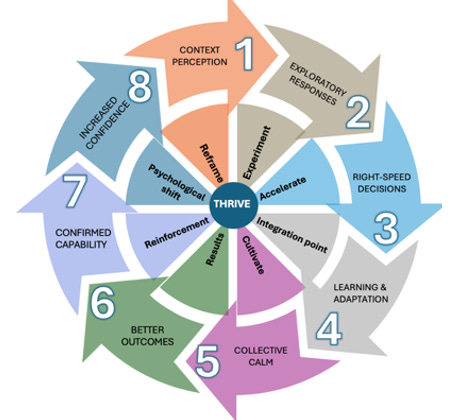
The Adaptive Response Cycle
Stage 1 — Recognition: Seeing the Wave
The first skill of a surfer is awareness. You can’t ride what you can’t see.
When disruption appears — an algorithm, a regulation, a new competitor — most people react late because they interpret novelty as noise. Recognition means widening perception: noticing subtle changes before they crest.
Why it matters
Fear starts with blindness. The earlier you see the pattern, the more options you have.
Curiosity is the antidote.
Leader moves
Practice signal spotting: dedicate time to scan weak signals instead of reacting to headlines.
Ask, ‘What might this mean if it continues?’, and not ‘Can we ignore it?’
Reward those who surface anomalies early — they’re your lookout posts.
The surfer’s truth: The wave that surprises you is the one that breaks you.
Stage 2 — Re-centering: From Reaction to Response
Recognition triggers emotion. The second move is composure.
When turbulence hits, biology screams do something!; re-centering teaches breathe first.
Our amygdalae fire faster than reason. Calm is therefore not luxury — it’s capability.
Why it matters
In neurological terms, breathing and naming the emotion reactivate the prefrontal cortex — the part that makes good decisions.
Leader moves
Introduce two-minute resets before high-stakes meetings.
Replace “What should we do?” with “What’s actually happening?”
Model calm; your nervous system sets the tone for everyone else’s.
The surfer exhales before the drop. So should you.
Stage 3 — Re-engagement: Action in Motion
Once centered, move. Frozen awareness solves nothing.
Re-engagement means taking the smallest meaningful step that converts fear into feedback.
Why it matters
Action breaks anxiety’s loop. Small experiments create data that replaces speculation.
Leader moves
Define next best move, not perfect plan.
Give teams permission to test while everyone else debates.
Celebrate momentum over mastery — every paddle counts.
The surfer sails or paddles even when unsure; movement reveals balance.
Stage 4 — Reflection: Learning While Wet
Reflection turns activity into insight.
Without pause, organizations mistake motion for progress. Reflection asks, What did the wave teach us?
Why it matters
Learning consolidates in stillness. Neuroscience calls it memory integration; surfers call it reading your last ride.
Leader moves
Schedule reflection rituals — brief, structured, and psychological-safe.
Replace “What went wrong?” with “What did we learn?”
Document and share insights quickly so learning compounds.
Surfers talk and share experiences after every session. Companies should too.
Stage 5 — Exploration: Safe-to-Fail Learning
Fear shrinks horizons; exploration re-opens them.
In complex surf, you learn by testing conditions, not by building models on shore.
Why it matters
Small, bounded experiments create discovery without catastrophe. The goal is learning, not perfection.
Leader moves
Run safe-to-fail pilots with clear hypotheses and exit rules.
Balance your portfolio: 70 % core, 20 % adjacent, 10 % transformational.
Track learning velocity: how fast did we reduce uncertainty?
The surfer tests smaller waves before committing to the big set. Each ride refines judgment.
Stage 6 — Decision Velocity: The Right Speed
In uncertainty, timing beats certainty.
Slow decisions miss opportunities; rash ones waste energy. The mastery is right-speed choice.
Why it matters
Every decision sits somewhere between reversible and irreversible. Most are reversible — but organizations treat all as final.
Leader moves
Classify decisions:
Type 1 = irreversible → move slow and deliberate.
Type 2 = reversible → move fast and learn.Embed if-then commitment triggers (“If X metric occurs, we act.”).
Push authority down; delay kills initiative.
The surfer’s motto: hesitate and the wave passes; rush and it crushes you.
Right-speed means acting at the rhythm of reality.
Stage 7 — Confirmed Capability: Proof in Practice
After several loops, capability becomes evidence. The team has ridden real waves.
Meetings sound different: less anxiety, more analysis; less hierarchy, more trust.
Why it matters
Confidence without proof is noise; capability confirmed by results is signal.
This is the transition from learning about adaptation to being adaptive.
Signs of confirmation
Experiments deliver repeatable results.
Decision cycles shorten naturally.
People self-correct without waiting for instruction.
External observers notice the difference.
Leader moves
Conduct capability reviews: What can we do now that we couldn’t six months ago?
Tell stories of successful navigation; they become the organization’s living memory.
Replace “project completion” metrics with “adaptation rate.”
The surfer who has mastered one reef carries that muscle memory into every ocean.
Stage 8 — Increased Confidence: The Upward Spiral
Capability gives rise to confidence — not bravado, but earned composure.
The organization stops asking Can we handle this? and starts asking Which wave shall we ride next?
Why it matters
Confidence reshapes perception itself. The brain’s filters move from detecting threat to detecting opportunity.
It’s the difference between surviving change and surfing it.
Four Swells of Confidence (adapted from Bandura):
Mastery experience — each success proves competence.
Vicarious learning — seeing peers succeed normalizes courage.
Social persuasion — authentic encouragement builds belief.
Physiological recalibration — adrenaline feels like readiness, not fear.
Together they create the Upward Spiral of Confidence: success → belief → exploration → more success.
Leader moves
Design visible mastery moments (public wins).
Showcase learning journeys across teams.
Protect rhythm & recovery: fatigue erodes confidence faster than failure.
True mastery stays humble. Surfers who think they control the ocean are the first to wipe out.
Adaptive confidence says: We’ve mastered learning, not the sea.
The New Identity
When confirmed capability and increased confidence meet an internal locus of control, something profound happens: adaptability becomes identity.
The organization stops “doing change management” and starts being change-ready.
The surfer no longer thinks about balancing; balance has become their nature.
This is where Tech-Surfing leadership lives—not in prediction or protection, but in presence.
The question is no longer Will the next wave hit us? but Which one are we choosing to ride?
The Psychological Core: Locus of Control
Beneath all eight stages flows a deeper current — locus of control.
Julian Rotter showed that people differ in where they locate agency:
Internal locus: outcomes depend on my actions.
External locus: outcomes depend on luck or others.
Within the ARC:
Recognition relies on internal control to notice signals instead of blaming noise.
Re-centering demands self-regulation rather than externalizing stress.
Re-engagement builds evidence that action matters.
Reflection reinforces agency through insight.
Exploration and Decision Velocity multiply these beliefs through repeated learning loops.
Confirmed Capability and Increased Confidence complete the feedback: proof of agency becomes culture.
Each stage feeds the next: Recognition enables Re-centering; Re-centering enables Re-engagement; and so on, until capability and confidence reinforce the loop.
The result is a self-sustaining rhythm of adaptation — what surfers call staying in the set.
From Fear to Flow
The Adaptive Response Cycle isn’t another management model; it’s a way of being.
It reminds us that disruption isn’t an enemy, uncertainty isn’t failure, and fear isn’t final.
They’re all waves — energy in motion — waiting for skilled riders.
When leaders and teams learn to move through these eight stages together, the organization stops thrashing in whitewater and starts gliding across the face of change.
The wave hasn’t calmed.
We’ve simply learned to move with it.
Surfer’s wisdom: she/he who has mastered the ARC, the chance to thrive in turbulent circumstances will increase dramatically.
Leader moves
Use “circle of influence” mapping in reviews.
Celebrate what was controllable and learned, not only outcomes.
Create micro-wins that expand perceived control.
Teach re-centering as a daily micro-skill.
You cannot command the wave, but you can command your stance, stroke, and breath. That difference defines survival.