
Chapter 3 The Wipe out generation
Section 1 & 2 SUMMARY

Chapter 3: Sections 1 & 2
Why This Summary?
Many readers today skim rather than dive deep. Waves of content and distraction compete for attention. This condensed version of The Wipeout Generation captures the heart of the story—the difference between swimmers and surfers in a world of technological turbulence—so you can grasp the flow in minutes, not hours. The full chapter remains in the archive for those who want to explore every current and undertow.
The Wipeout Generation – Why So Many Leaders Are Drowning
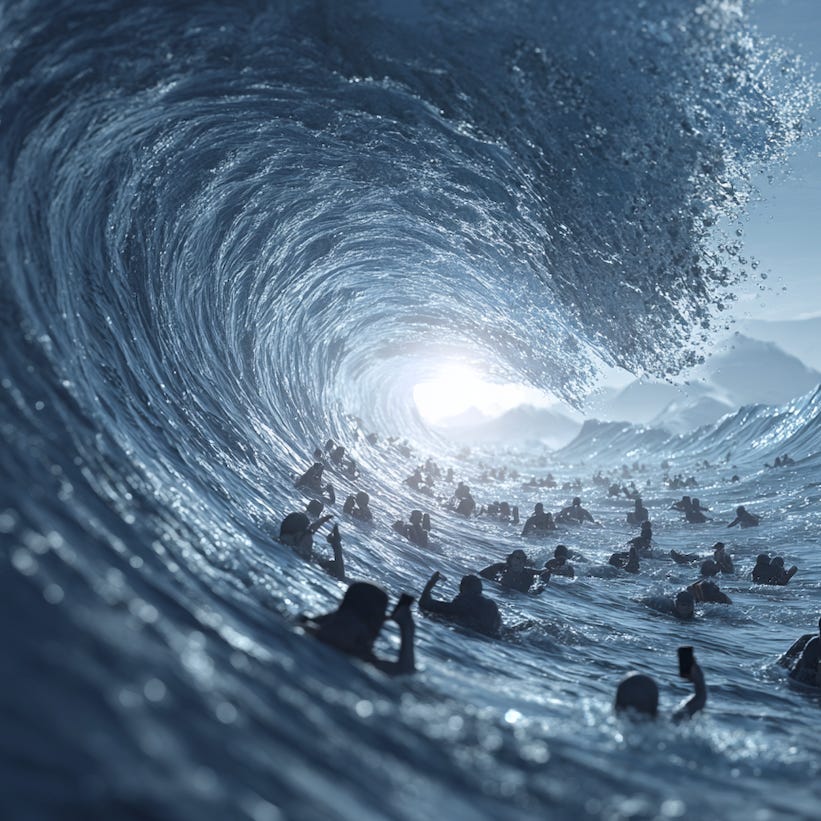
Picture: MidJourney, Paul Epping
1. The Swimmer’s Mistake: Fighting Forces Larger Than Yourself
The ocean of technology humbles everyone. Some leaders behave like swimmers—expending frantic energy against incoming waves of disruption. They plan, resist, and attempt control. Others act as surfers—observing, conserving, and harnessing momentum.
The swimmer’s tragedy begins with ego. Past success creates the illusion of control; experience becomes a trap. Like Blockbuster or Nokia, many executives cling to legacy mental models, blind to the new swells forming on the horizon. They treat technology as a storm to contain rather than as wind to catch.
This illusion is amplified by linear thinking. In reality, technology evolves combinatorially: AI merges with robotics, quantum computing reshapes data, and synthetic biology redefines health. The result is exponential turbulence—“confused seas” where overlapping waves from distant storms collide. Five-year plans and risk frameworks designed for calm waters cannot steer through that.
The energy economics of swimming are fatal. Fighting the current drains strength; every wave depletes more energy, with diminishing progress. Organizations defending obsolete models experience the same exhaustion: resources locked in legacy systems, bureaucracy multiplying faster than innovation. In contrast, digital “surfers” generate momentum—each experiment builds on the next, regenerating energy through learning and flow.
Positioning, not power, determines survival. Swimmers stay trapped in the impact zone, reacting wave by wave. Surfers paddle beyond the break, gaining perspective to choose which waves to ride. In business, that means balancing stability and experimentation—what Eisenhardt called “competing on the edge.” Amazon’s small autonomous “two-pizza teams” exemplify this dynamic equilibrium: agility at the frontier, coherence at the core.
Mindfulness marks the divide. Swimmers operate on autopilot; surfers stay attentively calm, scanning for patterns. Organizations fail not for lack of intelligence but for lack of awareness—the inability to pause, read the water, and reposition before the next set arrives.
2. The Fear Response Cycle: How Uncertainty Creates Paralysis
Beneath leadership behavior lies biology. When uncertainty feels like a threat, the amygdalae—our twin emotional filters—ignite the ancient fear response cycle:
Uncertainty → Threat perception → Defensive action → Delay → Escalating fear → Panic → Poor outcomes.
Evolution wired this for predators, not platforms. Yet our bodies react to algorithmic change as if chased by tigers: cortisol surges, reasoning shuts down, and decisions shrink to fight, flight, or freeze.
Organizations mirror this physiology. When leaders frame technological change as danger, teams tighten up—avoid risk, hide errors, and silence curiosity. Innovation withers not from lack of ideas but from fear of failing under threat.
The result is the whipsaw effect—long paralysis followed by panic. Companies ignore disruption for years, then overreact when a crisis hits: retailers belatedly buying digital firms, banks scrambling into ill-planned “transformations.” Fear becomes self-fulfilling; the more leaders resist uncertainty, the more uncertainty grows.
But fear itself isn’t the enemy—misdirected fear is. The amygdala is a radar, not a dictator. Removing it, as some “post-biological” enthusiasts joke, would erase judgment entirely. The task is not suppression but surfing the signal:
Name it: labeling emotions re-engages rational circuits.
Pause it: breathing and grounding reset physiology.
Reframe it: ask if the “threat” might be an opportunity.
Train it: exposure to novelty builds tolerance for change.
Uncertainty will never vanish. The danger lies in seeking absolute clarity—the illusion of information. In complex, evolving systems, more data doesn’t equal more control; it often deepens confusion. Leaders commission endless analyses, mistaking activity for insight. They become “hedgehogs”, certain of one big idea while reality shapeshifts beneath them.
True surfers accept Knightian uncertainty—where probabilities are unknowable—and learn through action. They cultivate “patient capital” and emotional range: the capacity to stay balanced on the board even when visibility drops.
The swimmer’s mindset clings to the past; the surfer’s mindset learns from wipeouts. Every fall is data. Every fear can be transmuted into awareness.
Bridge to the next (summarized) Section 3 – The Adaptive Response Cycle
If the Fear Response Cycle traps leaders beneath the wave, the Adaptive Response Cycle is how they resurface. It replaces reactivity with rhythm: sensing, learning, repositioning, and flowing with change. Where fear constricts, adaptation expands. The next section explores how curiosity transforms anxiety into momentum—how leaders can read the pulse of disruption and turn chaos into coordinated movement.
Stay tuned, and please let me know if you like condensed versions like this one, better than the deep-dive chapters. The full text is still available for those who want to get the full flavor of ‘sailing out’.
Hey, great read as always. Your distinction between swimmers and surfers really highlights the systemic challenge. What if the 'swimmer's mistake' isn't just individual ego, but deeply embedded in bureaucratic structures and pollicy-making frameworks that inherently resist agile adaptation to combinatorial tech shifts? This has huge implications for governance.