
Chapter 3: The Wipeout Generation
Why So Many Leaders Are Drowning

Introduction
The Difference Between Swimmers and Surfers
The surfing metaphor is more than poetic—it is diagnostic. In the ocean, let’s focus on two types of people: surfers and swimmers.
Every experienced windsurfer has witnessed the same scene: a swimmer caught in the impact zone, exhausted from fighting waves that keep coming. They push against each swell with desperate energy, making no progress, burning through the strength they’ll need for the next set. Meanwhile, nearby, a surfer waits patiently beyond the break, reading the rhythm, conserving energy, and when the right wave arrives, they harness its power and ride it to shore with seemingly effortless grace.
This scene plays out daily in boardrooms and executive suites across the global economy. Leaders face wave after wave of technological disruption — artificial intelligence, blockchain, quantum computing, synthetic biology, robotics, or IoT — and their instinctive response mirrors the struggling swimmer: resist, control, manage the threat. They convene task forces to “contain” AI, create policies to “govern” emerging technologies, and build defenses against digital transformation as if it were an invading army rather than the very medium in which their organizations must now operate.
The fundamental error is categorical: treating technology as an external threat to be managed rather than an environmental force to be harnessed. This chapter examines why so many leaders and organizations struggle to navigate technological change, why their wipeouts are becoming more frequent and more catastrophic, and what separates those who drown from those who ride the waves with increasing mastery.
Regardless of your skill level, putting your ego aside so that you can properly read the water assists you in avoiding potentially horrifying near-death experiences. The ocean doesn’t care about your title, your market capitalization, or your previous successes. Neither does technological disruption. The question isn’t whether you’ll face wipeouts—you will—but whether you’ll learn from them or let them compound into organizational drowning.
This chapter explores why so many leaders are wiping out in today’s technological surf. We examine the psychological, structural, and cultural forces that turn capable executives into struggling swimmers. More importantly, we identify the practices that enable adaptive leaders—the true surfers—to thrive amid volatility. By understanding the anatomy of wipeouts and cultivating what Rick Hansen calls “wave sense,” leaders can transform from drowning victims into skilled navigators of the digital age.
Section 1
The Swimmer’s Mistake - Fighting Forces Larger Than Yourself
The Illusion of Control
The first and most dangerous mistake leaders make is bringing ego into the water. In surfing, ego blinds you to the ocean’s reality. It convinces you that your skill, strength, or determination can overpower the wave. Experienced surfers know better: the ocean is indifferent to your confidence, and hubris leads directly to wipeouts. With his red cap turned backward because of the strong wind, his face tanned from hanging out on the water, and staring intently at a stray surfer, my coach muttered something like “Regardless of your skill level, putting your ego aside so that you can properly read the water, helps you to avoid unpleasant near-death experiences”. And I can share with you: I’ve been there! Since that long moment of washing between life and death, these words resonate in all sorts of my future situations.
In business, ego manifests as the belief that past success guarantees future relevance. Leaders assume their expertise in traditional markets will translate seamlessly to digital arenas. They cling to mental models forged in stability, even as the landscape shifts beneath them. This cognitive rigidity—what psychologists call the “expert trap”—blinds leaders to emerging signals and new patterns. They dismiss early warnings as noise, double down on legacy strategies, and rationalize failures as temporary setbacks rather than systemic misalignments.
The result is predictable: leaders miss the wave entirely or attempt to force their way through it. Companies like Blockbuster and Nokia exemplify this pattern. Each possessed immense resources, talented teams, and market dominance. Yet their leaders’ egos prevented them from seeing the waves forming on the horizon—streaming media, digital photography, smartphone ecosystems—until it was too late. They treated technology as a threat to be contained rather than a force to be harnessed, and they drowned as a result.
Not only companies! What to think of our education systems? After having coached about a hundred students in the age of 13 -17, from around the planet, no one expressed that they learned what was needed in the rapidly changing world! Caught in the egos of teachers who know better!
The swimmer’s fundamental error is believing they can overpower the ocean through sheer effort. This illusion of control runs deep in traditional management thinking, rooted in what organizational theorist James March called “the technology of foolishness”—the belief that rational planning and forceful execution can overcome environmental uncertainty (March, 1971). For decades, this approach worked reasonably well in relatively stable environments where change occurred at human-manageable speeds.
But as complexity scientists have demonstrated, technology doesn’t evolve linearly—it evolves combinatorially (Arthur, 2009). Each new technology becomes a building block for future technologies, creating exponential rather than linear change. The steam engine enabled railroads, which enabled time zones, which enabled telegraph networks, which enabled financial markets, which enabled... The combinatorial explosion means that the “waves” of technological change aren’t discrete events to be managed sequentially but overlapping, interfering patterns that create what surfers call “confused seas”—conditions where multiple swells from different storms arrive simultaneously, creating chaotic, unpredictable water.
Reflection box
AI Ecosystems and Combinatorial Explosion
Each AI advancement—be it machine learning, natural language processing, or robotics—interacts with others, creating exponential possibilities. Think of chatbots merging with IoT for smart homes or generative AI enhancing medical diagnostics. This cascading effect reshapes industries overnight. New chips, server farms, small modular reactors, grid priority, fiber connection between farms, identity storage, new business model, new operating systems, and AI app stores. Are we prepared for the unintended ripple effects of such rapid convergence? Leaders must anticipate this explosion, navigating the chaos of creation with foresight to harness AI’s potential without being overwhelmed by its pace.
Leaders trained in the swimmer’s mental model approach these conditions with tools designed for calm water: five-year strategic plans, stage-gate innovation processes, risk mitigation frameworks. These tools aren’t wrong—they’re simply insufficient. As management professor Rita McGrath observes, “planning” has given way to “discovery-driven strategy,” where the goal isn’t to predict and control but to probe, learn, and adapt (McGrath, 2019). The swimmer tries to impose order on chaos; the surfer seeks to perceive pattern within apparent randomness.
Consider the response of traditional media companies to digital disruption. Newspapers didn’t lack intelligence or resources—they had some of the most sophisticated business minds in the world. Yet they consistently fought the digital wave rather than riding it. They erected paywalls as defensive barriers, cut costs to preserve print operations, and treated online as a separate, inferior channel. Each response was rational within a swimmer’s framework: protect the core, manage the threat, maintain control. Each response also accelerated their decline (Christensen et al., 2012).
Contrast this with Netflix’s evolution. Reed Hastings didn’t fight the streaming wave—he created it, even though it cannibalized his own DVD-by-mail business. When asked why he would destroy a profitable model, Hastings replied: “If we don’t do it, someone else will” (Keating, 2012). This is surfer thinking: recognizing that the wave is coming regardless of your preferences, and that your choice is whether to position yourself to ride it or be crushed by it.
The illusion of control manifests in what Kahneman calls “theory-induced blindness”—once you’ve accepted a theory, it’s extraordinarily difficult to notice its flaws (Kahneman, 2011). Leaders who see themselves as controllers of their organizational destiny literally cannot perceive information that contradicts this self-concept. They interpret technological disruption through a lens of threat management rather than opportunity navigation, and this interpretive frame determines their response options before they consciously choose.
Energy Economics: Exhaustion vs. Efficiency
The swimmer fighting waves experiences exponential energy depletion. Each wave requires maximum effort, and the effort yields minimal progress. Worse, the exertion accumulates as fatigue, reducing capacity for subsequent waves. This creates a death spiral: effort leads to exhaustion, exhaustion reduces effectiveness, and reduced effectiveness requires more effort.
Organizations exhibit identical dynamics when fighting technological change. They pour resources into defending legacy business models—upgrading old systems, retraining staff on obsolete platforms, lobbying for protective regulations. Each defensive investment depletes resources available for adaptive innovation. Meanwhile, digitally-native competitors operate with entirely different energy economics, building on modern infrastructure that requires a fraction of the maintenance overhead.
Research on scaling laws reveals why this matters so profoundly (West, 2017). As organizations grow, they typically become less efficient per unit—bureaucracy increases faster than output. But digital platforms exhibit the opposite pattern: network effects mean they become more valuable per user as they scale. A traditional retailer adding its millionth customer faces increased complexity; Amazon adding its millionth customer gains data, network density, and algorithmic improvement. The swimmer’s energy economics are linear at best, degenerative at worst. The surfer’s energy economics are exponential and regenerative.
This explains why disruption often comes from unexpected quarters. Kodak invented the digital camera but couldn’t commercialize it because doing so would have required abandoning the chemical film business that generated 70% of profits (Lucas & Goh, 2009). The energy required to transform the entire organization exceeded what leadership could mobilize. Meanwhile, companies with no legacy film business—and thus no energy drain from defending it—could invest entirely in digital futures.
The energy economics of swimming versus surfing appear starkly in talent dynamics. Organizations fighting technological change experience “defensive routines”—patterns where people protect themselves and the organization from threat by avoiding the very conversations needed for adaptation (Grant, 2021). Or flexible immunity, as explained in the prior chapter. Meetings become performative rather than productive. Innovation theater replaces genuine experimentation. The best talent, sensing the exhaustion and futility, leaves for organizations riding rather than fighting waves.
Conversely, organizations that harness technological waves become talent magnets. They offer the conditions for flow: clear goals, immediate feedback, and challenge matched to skill (Csikszentmihalyi, 1990). Working at the frontier of technological possibility, with resources to experiment and permission to fail, creates the psychological conditions where people perform at their peak (Edmondson, 2019). The energy economics shift from depletion to regeneration.
The Positioning Problem
The swimmer caught in the impact zone faces a positioning problem: they’re in the worst possible location—where waves break with maximum force and minimum rideable energy. Every wave hits them at full power, and they lack the perspective to see the next set approaching. They’re trapped in reactive mode, responding to each wave as it arrives rather than positioning themselves strategically.
Leaders exhibit the same positioning problem when they remain embedded in operational details rather than developing a strategic perspective. They’re so busy responding to immediate technological pressures—implementing the latest software, responding to competitor moves, managing vendor relationships—that they never achieve the vantage point needed to read larger patterns.
The “planning fallacy” is the belief that strategy can be formulated separately from operations (Mintzberg, 1994). In stable environments, this separation works: executives plan, managers execute. But in turbulent technological environments, the separation becomes fatal. By the time strategic plans reach implementation, the technological landscape has shifted. The swimmer’s positioning problem is temporal: they’re always responding to the last wave while the next one is already forming.
The surfer solves the positioning problem through what oceanographers call “reading the outside”—positioning beyond where waves break, with clear sightlines to the horizon where new sets first appear as faint lines on the water (Holthuijsen, 2007). This requires temporarily disengaging from the action, accepting short-term vulnerability (you can’t catch waves from outside the break) for long-term advantage (you can see what’s coming and choose which waves to catch).
Organizationally, this translates to “competing on the edge”—maintaining enough stability to function while keeping enough flexibility to pivot (Eisenhardt & Brown, 1998; Ismail, Malone, van Geest, 2014). Leaders need what she terms “semi-structures”: clear enough to provide direction, loose enough to permit improvisation. They need to position themselves and their organizations at the edge between order and chaos, where they can perceive emerging patterns while maintaining the capability to respond.
Amazon’s “two-pizza teams” exemplify this positioning (Bryar & Carr, 2021). Small, autonomous teams can experiment at the edge while the larger organization maintains operational stability. When experiments succeed, they can be rapidly scaled; when they fail, the failure is contained. This organizational structure positions the company to catch emerging waves without betting the entire enterprise on any single technology.
The positioning problem also manifests in cognitive terms. Research on “mindfulness” reveals that people in routine situations operate on autopilot, missing novel information (Langer, 2014). The swimmer fighting waves is maximally mindless—pure reaction without reflection. The surfer waiting outside cultivates mindfulness—active attention to subtle signals that indicate what’s forming.
Leaders trapped in operational firefighting operate mindlessly, processing information through established categories and responding with habitual patterns. They literally cannot see disruptive innovations because those innovations don’t fit existing mental models. Additional research on disruptive innovation demonstrates this repeatedly: established companies fail not because they’re incompetent but because their very competence blinds them to alternatives (Christensen, 1997). They’re positioned in the impact zone, getting pummeled, unable to see that the solution is repositioning rather than fighting harder.
Section 2
The Fear Response Cycle - How Uncertainty Creates Paralysis
What to expect?
Fear Response Cycle (the trap):
Uncertainty → Threat perception → Defensive responses → Delayed decisions → Increased uncertainty → Panic → Poor outcomes → Confirmed threat perception
The Neuroscience of Threat Response
When the brain perceives threat, it activates what neuroscientist Joseph LeDoux calls the “low road”—a rapid, unconscious pathway from sensory input through the amygdala to immediate response (LeDoux, 2015). This system evolved to handle physical dangers: see snake, jump back, ask questions later. It’s fast, automatic, and often life-saving. It’s also terrible at handling complex, ambiguous, long-term threats like technological disruption.
The amygdala cannot distinguish between a physical threat (tiger in the bushes) and an abstract threat (AI might disrupt our business model). Both trigger the same physiological cascade: cortisol and adrenaline flood the system, heart rate increases, blood flow shifts from the prefrontal cortex (reasoning) to the limbic system (emotion), and muscles (action). This is the famous “fight, flight, or freeze” response—perfect for escaping predators, but may hamper strategic decision-making. Let’s unpack this a bit more, because in the world of ‘exponential thinkers’, the function of this almond-shaped mass is an annoyingly one-sided view. ‘Fear of change for the beauty of technological change, is because of our reptile mindset’, is a quote that I’m hearing so many times during podcasts, presentations, or posts.
We’re asking this 90-million-year-old organ to filter danger in a world that now changes faster than it can learn.
Why Do We Have Two Amygdalae?
We have two amygdalae—left and right—because our brains are lateralized. Just as we have two hemispheres for processing language, motor control, and visual input, we have dual amygdalae that each play slightly different roles:
- The right amygdala is more reactive and responds quickly to threats.
- The left amygdala processes emotional stimuli more slowly and analytically, often tied to social or contextual cues.
Not Just Fear: The Amygdalae as a Master Filter
Mainstream science likes to simplify the amygdala as the “fear center,” but that’s misleading. It’s actually an emotional salience detector—a biological filter deciding which emotions matter enough to act on.
It processes:
Fear and anxiety
Anger and aggression
Social rejection
Even positive arousal like excitement or curiosity
Robert Sapolsky, in his brilliant book ‘Behave’, reminds us that the amygdala isn’t evil. It’s just an old ‘reptile’ functionality. And it’s wired to say “BE CAREFUL!” more often than “Let’s explore!”
That bias made sense when danger was everywhere. Today, it can keep us from surfing exponential waves of change.
Occasionally, someone riding the wave of exponential enthusiasm says, “What if we just removed the amygdala? Then we’d never fear change again!”
To which neuroscience politely responds: That is a terrible idea!
Which one? Without your amygdalae, you wouldn’t just stop fearing change—you’d also stop recognizing danger, social nuance, arousal, or emotional meaning. You’d walk into traffic while smiling, trust every scam email, and never realize your partner is upset until the divorce papers arrive.
Fear, like friction, exists for a reason. The goal is not to eliminate it—but to understand and evolve it.
Organizational psychology research reveals how this individual threat response scales to organizational level (Edmondson, 2018). When leaders signal—through words, tone, or action—that technological change represents a threat, it triggers collective anxiety. Teams become risk-averse, avoiding experiments that might fail. Information flow constricts as people hide problems rather than surfacing them. Innovation dies, not from lack of ideas, but from fear of the consequences of trying because leaders or colleagues make you believe that there is a threat.
This creates what I call the “Fear Response Cycle”
Riding the Fear Wave – The Cycle Behind Our Reactions to Change
In the age of Techsurfing—where humans are riding exponential waves of AI, biotech, and digital disruption—our brains are still wired for survival in a world of slow threats. At the center of this misalignment is the fear response cycle.
When change hits fast—whether it’s a new AI that replaces jobs or a viral news story about an economic collapse—our ancient biological systems kick in. But instead of a tiger, it’s an algorithm. Still, the response is the same. Here’s how the fear response cycle works, and what it means for thriving in a tech-driven world.
The Fear Response Cycle – Step by Step
1. Sensory Perception
The cycle begins when we detect a stimulus—something we see, hear, or sense that might be dangerous.
This could be a news alert, a headline about job loss, or even a shift in someone’s tone of voice. Our thalamus (brain’s relay station) passes this to other regions for evaluation.
2. Amygdala Activation
If there’s a hint of threat, the amygdala sounds the alarm.
This activation happens before conscious thought, which is why we often feel fear before we understand why.
Studies show the amygdala reacts even to ambiguous stimuli, especially in individuals with higher trait anxiety (Stein et al., 2007).
3. Hypothalamus Response
The amygdala signals the hypothalamus, which activates the HPA axis—the hormonal cascade that floods your system with stress chemicals like cortisol and adrenaline.
These signals prepare your body to react fast—whether or not the threat is real.
4. Physiological Changes
Now the body gets ready:
Heart rate increases
Pupils dilate
Muscles tense
Breathing accelerates
This is the classic fight-flight-freeze physiology.
5. Behavioral Reaction
We act—sometimes consciously, often instinctively. We might:
Lash out (fight)
Avoid (flight)
Go blank or freeze
In a tech context, this may look like panic, doomscrolling, quitting a job abruptly, or avoiding innovation altogether.
6. Memory Encoding
Finally, the hippocampus (memory center) records the emotional experience—especially if it was intense.
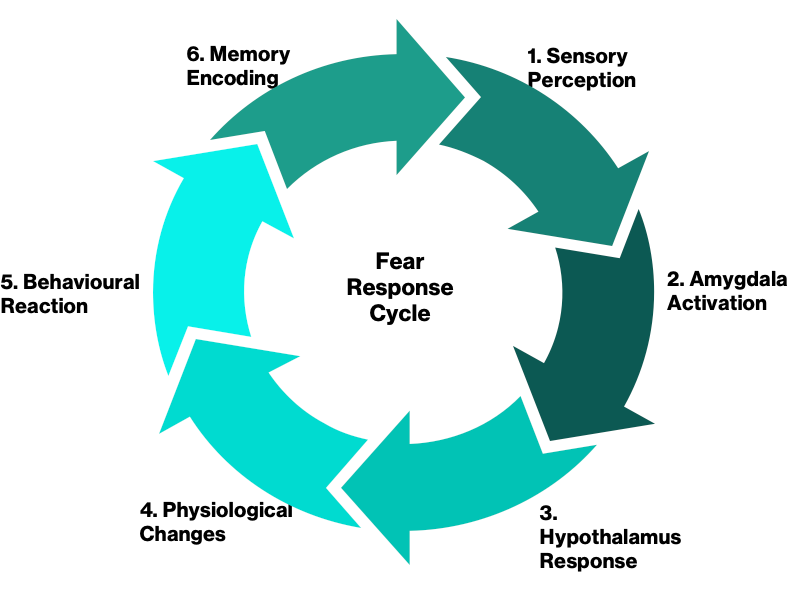
This is how trauma forms. The brain flags the moment for future avoidance, even if the original trigger was misunderstood.
Over time, this cycle becomes self-reinforcing. The more we respond to change with fear, the more our brains expect fear in future novelty. It’s a feedback loop—until we intervene.
Fear in the Age of Techsurfing
In Techsurfing, fear isn’t the enemy—misguided fear is. We don’t need to suppress our emotions or “cut out the amygdala” as some people think is needed to resolve corporate immune systems. Please don’t! In the end, it contributed to the fact that we are still around! Instead, we need to recognize the cycle and learn to surf it.
Think of the amygdala as your emotional radar. You wouldn’t fly a plane without one—but you wouldn’t trust it blindly either.
Breaking the Cycle: Techsurfer’s Toolkit
Name it – Labeling your emotion reduces amygdala activation and activates the prefrontal cortex.
Pause the loop – Breathing, movement, and grounding techniques interrupt the physical reaction.
Reframe the story – Was that AI really a threat—or an opportunity in disguise?
Train your brain – Gradual exposure to novelty (via learning, creativity, and experimentation) strengthens the “relevance filter” in the brain.
Each iteration of the cycle makes the next iteration worse. The organization becomes progressively less capable of adaptive responses precisely when adaptive responses become most necessary. Fear is a bad advisor and may lead to decisions that people regret in hindsight.
Neuroscientific research on decision-making reveals why this cycle is so pernicious (Damasio, 1994). Effective decisions require integration of emotional and rational processing—what Damasio calls “somatic markers,” bodily signals that guide judgment. But chronic threat overwhelms this integration. The emotional system becomes hyperactive while the rational system becomes suppressed. Leaders in this state make poor decisions not because they’re stupid but because their neurobiology is optimized for immediate survival rather than strategic thinking.
The fear response cycle explains otherwise inexplicable organizational behavior. Why did Blockbuster reject multiple opportunities to acquire Netflix? Why did Nokia, once dominant in mobile phones, collapse so completely? Why did Kodak, inventor of digital photography, fail to commercialize it? In each case, leaders weren’t blind or incompetent—they were trapped in fear response cycles that made adaptive response neurologically difficult.
Conclusion: Don’t Fight the Wave—Ride It
The fear response cycle is ancient, beautiful, and vital. But in a world that evolves faster than biology can adapt, we must upgrade not just our tech—but our emotional intelligence. Understanding the fear cycle gives us the surfboard we need to ride exponential waves, not be wiped out by them.
The Swimmer vs. Surfer Mental Orientation
The fundamental difference between those who drown and those who thrive in technological turbulence is their mental orientation. Swimmers see the ocean as an adversary. Surfers see it as a partner. This distinction maps directly onto leadership approaches:
Swimmers (Resisters):
- Control-Oriented: Believe they can dictate outcomes through sheer force or planning.
- Risk-Averse: View uncertainty as danger; seek to eliminate or avoid it.
- Ego-Driven: Trust their past expertise over present signals.
- Reactive: Respond to crises only when forced; lack foresight.
- Exhausted: Burn energy fighting currents rather than leveraging them.
Surfers (Harvesters):
- Flow-Oriented: Accept that the ocean sets the terms; focus on positioning and timing.
- Risk-Intelligent: View uncertainty as opportunity; manage rather than avoid it.
- Ego-Aware: Remain humble, open to learning, and attentive to changing conditions.
- Proactive: Study patterns, anticipate shifts, and position early.
- Energized: Conserve effort by working with forces rather than against them.
Hansen (2011), a business leader and surfer, captures this beautifully: “Surfing creates for me an environment that helps me believe in myself, face my insecurities, and pushes me to lift the ceilings of my preconceptions. The limits I place on myself have no place in the water”. He uses surfing as a metaphor to inform how he leads: “Our primary job as leaders is to help our people see and realize their yet unknown potential... We have to create an environment that draws our teams into the challenge of solving complex problems where intelligent risk is encouraged”.
Leaders who adopt the surfer mental model recognize that technology waves—like ocean swells—cannot be stopped. They can only be read, respected, and ridden. This requires a strategic stance (positioning yourself where opportunity will emerge) and wave sense (intuitive understanding of patterns, timing, and momentum).
Uncertainty Intolerance and the Illusion of Information
Humans have profound difficulty tolerating uncertainty. Research on “need for closure” demonstrates that when faced with ambiguity, people experience psychological discomfort that motivates them to seek definitive answers—even wrong answers—rather than remaining in uncertainty (Kruglanski & Webster, 1996). This creates what I call “the illusion of information”: the belief that gathering more data will resolve uncertainty and enable confident decisions.
In stable environments with clear cause-and-effect relationships, this works. If you’re uncertain whether a bridge will support a truck’s weight, you can calculate load-bearing capacity and resolve the uncertainty through engineering analysis. But technological disruption creates what economists distinguish as “uncertainty” rather than “risk”—situations where not only the outcomes are unknown, but the probability distributions themselves are unknown (Knight, 1921). You cannot calculate your way out of Knightian uncertainty because the underlying system is itself evolving.
Leaders trapped in the fear response cycle respond to technological uncertainty by demanding more analysis. They commission consulting studies, form task forces, conduct pilot programs, and await “proof” before committing. Each of these activities feels productive and reduces psychological discomfort. Each also delays action while the technological landscape shifts, making previous analysis obsolete and requiring new analysis, perpetuating the cycle. But the problem here is that these are fragmented solutions and are lacking a holistic oversight.
This is what is called “analysis paralysis”—the paradox that the more complex and uncertain the environment, the less useful detailed analysis becomes, yet the more desperately organizations pursue it (Weick, 1995). The swimmer caught in the impact zone doesn’t need more information about wave physics—they need to stop fighting and reposition. But the psychological discomfort of uncertainty makes repositioning feel reckless while analysis feels responsible.
The illusion of information manifests in “the hedgehog trap”— experts who know one big thing become increasingly confident in predictions even as accuracy declines (Tetlock, 2005). Technology consultants, industry analysts, and internal experts provide confident forecasts that reduce leaders’ psychological discomfort. But Tetlock’s research reveals that expert predictions about complex systems are barely better than chance. The information provides false confidence rather than genuine insight.
Venture capitalist Bill Janeway offers a crucial distinction between “patient capital” and “impatient capital” (Janeway, 2012). Patient capital accepts uncertainty as inherent and invests in learning through experimentation. Impatient capital demands certainty before investing and thus either misses opportunities or invests at precisely the wrong moment—when everyone else has reached certainty and valuations have peaked. The fear response cycle produces impatient capital: leaders delay until panic forces action, then overcommit at the worst possible time. Effects of a dominant ’left brain culture’ (McGilchrist, 2010).
All these mental orientations are like surfing in the valley of the waves and the only thing that you are seeing is the masses of water dunes around you, not having the skills to climb a dune that will result in an overview, which only then allows you to assess the wave patterns around you.
From Paralysis to Panic: The Whipsaw Effect
The fear response cycle doesn’t produce steady-state paralysis—it produces what I call “the whipsaw effect”: extended periods of inaction punctuated by sudden, dramatic overreactions. Leaders delay decisions while uncertainty accumulates, then when the crisis becomes undeniable, they lurch into panic-driven action that often makes situations worse.
This pattern appears repeatedly in technological disruption. Traditional retailers ignored e-commerce for years, then panic-bought digital capabilities at inflated prices when Amazon’s dominance became undeniable. Media companies dismissed streaming until cord-cutting became epidemic, then launched competing services that fragmented audiences and destroyed profitability. Banks ignored fintech until regulatory pressure and customer defection forced hasty digital transformations that often degraded rather than enhanced customer experience.
Kahneman’s research on “loss aversion” explains the whipsaw dynamic (Kahneman, 2011). People feel losses roughly twice as intensely as equivalent gains. This asymmetry means that potential losses from action (investing in unproven technology) loom larger than potential losses from inaction (missing technological opportunities)—until the losses from inaction become undeniable. At that point, the pain of loss triggers panic, and leaders overcorrect.
The whipsaw effect is particularly destructive because it combines the worst of both worlds: missing opportunities during the paralysis phase, then making poor decisions during the panic phase. Organizations that delay digital transformation miss the learning curve that early adopters climb. When they finally act, they’re simultaneously behind on technology and company readiness.
The good news is that fear isn’t final. Every surfer knows that after a wipeout comes the chance to sail back out—wiser, calmer, more attuned. In the same way, leaders can learn to escape the Fear Response Cycle by shifting from reaction to adaptation. The next section introduces the Adaptive Response Cycle—the surfer’s playbook for transformation. It shows how to convert threat into curiosity, anxiety into momentum, and resistance into flow. Where the fear cycle traps us beneath the wave, the adaptive cycle teaches us how to surface, regain balance, and ride again—stronger each time.