
Chapter 4: Finding Your Stance
The Board I Built Wrong + SECTION 1 — Your Board Type: Identity Before Strategy

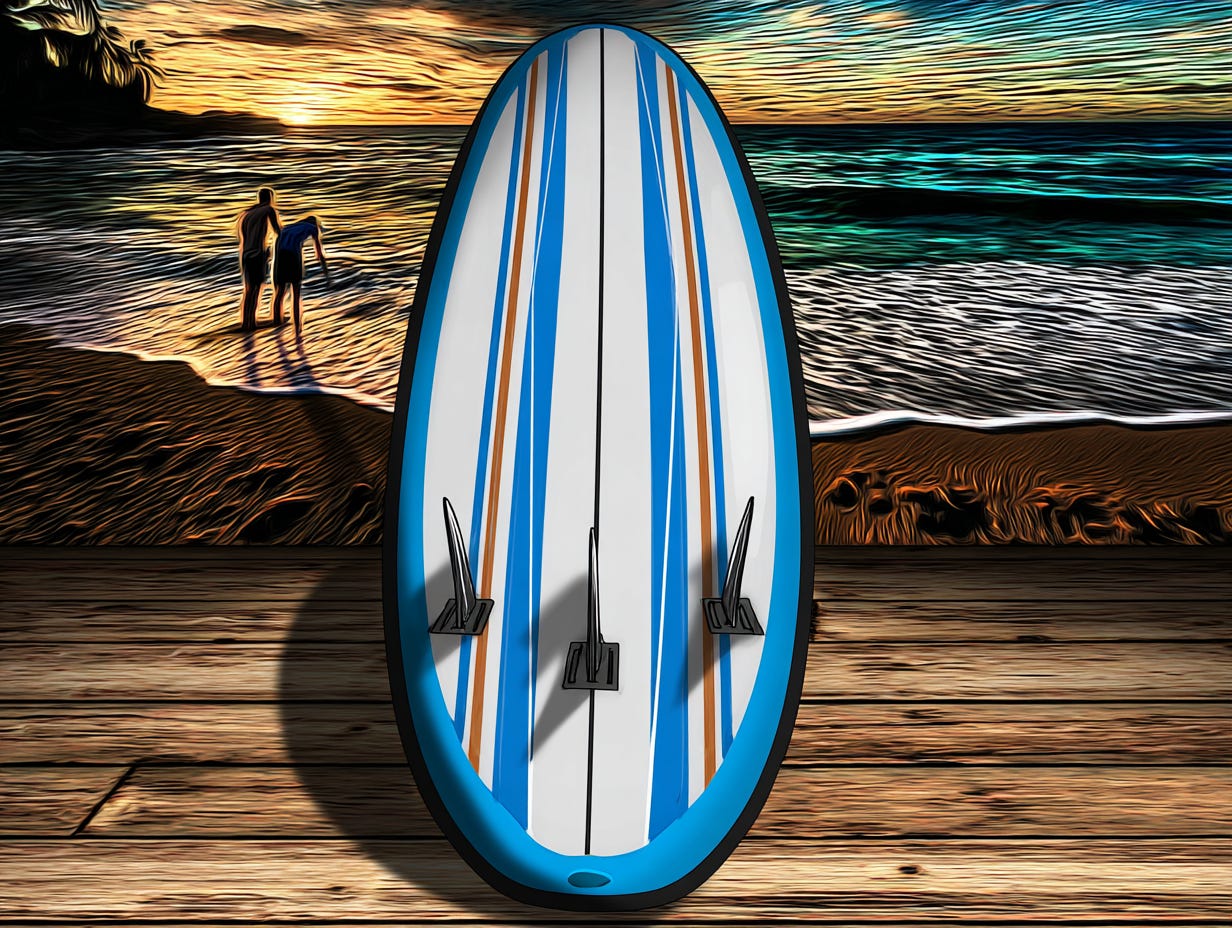
The smell of resin still triggers something in me—part nostalgia, part embarrassment. I was 32 when I decided to build my own windsurfing board. Don’t buy one. Build one.
I’d been windsurfing for three years by then, mostly on outdated equipment, and I was convinced I understood what made a board work. I’d read everything I could find about hull design, rocker curves, and foam densities. I spent weeks in my colleague’s garage, working from plans I’d adapted from a magazine article, shaping foam with a homemade hot-wire cutter, laminating fiberglass, obsessing over every detail.
The board looked beautiful. Racing stripes. A professional-grade finish. My friends were impressed.
Tricks to Ride Technology Waves is a reader-supported publication. To receive new posts and support my work, consider becoming a free or paid subscriber.
It was completely unrideable.
The problem wasn’t the shape, exactly. The problem was that I’d designed it based on what I thought made a board fast, not what worked in the water. I’d studied boards in magazines, not under my feet. I’d theorized about hydrodynamics without understanding how water actually moved around a hull, how flex responded to chop, how a board communicated with its rider through vibration and pressure.
The first time I tried to sail it, the board felt numb. Dead. Like riding a two-by-four. There was no feedback, no conversation between rider and water. Every gust was a surprise. Every wave was a threat. I lasted twenty minutes before I gave up, exhausted from fighting a board that gave me no information about what was happening beneath me.
I’d built a board that looked right but had no feel.
Twenty years of working with organizations trying to navigate technology change has taught me that this same mistake—building something that looks right but has no feel—is everywhere. Companies redesign their org charts. They rebrand. They announce new missions and values. They adopt the language of agility, innovation, and transformation.
And then they wonder why nothing responds the way they expected.
What You’ll Learn in This Chapter
This chapter is about developing organizational proprioception—the felt sense that lets you know where you are and how you’re moving without having to think about it. Specifically, you’ll learn:
How to diagnose your organization’s actual identity (not the one in your strategic deck)—what I call your “board type.”
How to configure purpose as strategic direction rather than inspirational wallpaper—your “fin setup.”
How to develop dynamic sensing capabilities that let you feel and respond to change in real time—your “stance.”
These aren’t metaphorical concepts. They’re practical frameworks for building the kind of organizational awareness that lets you navigate technology winds without constant crisis management.
Let’s start with the foundation: understanding what board you’re actually riding.
SECTION 1 — Your Board Type: Identity Before Strategy
The Five Types of Tech Organizations
In windsurfing, your board determines everything else. Not your skill level, not your ambition—your board. Try to ride a longboard like a shortboard, and you’ll spend more time in the water than on it. Try to pull shortboard moves on a longboard and you’ll just look ridiculous.
The same is true for organizations. Before you can set strategy—before you can choose which technology winds to catch—you need honest clarity about what kind of organization you actually are.
Not the one you want to be.
Not the one your founder was twenty years ago.
The one you are right now, with your current culture, capabilities, and constraints.
Through two decades of working with companies navigating technology change, I’ve observed five distinct organizational identities, each with its own hydrodynamics.
1. The Longboard Organization: Stability as Strategy
Profile: Large, established organizations (typically 10,000+ employees, 20+ years old) with mature markets, complex stakeholder ecosystems, and deeply embedded institutional knowledge.
Examples: General Motors, Siemens, Walmart, Procter & Gamble.
Hydrodynamics: Long waterline, high buoyancy, slow to turn but immense momentum once moving. These organizations are built for consistency, scale, and riding large waves that would overwhelm smaller players.
The Longboard Mistake: Trying to ride them like shortboards.
General Motors (GM, 2020) made this mistake in its early response to Tesla. The instinct was to “move fast,” “think like a startup,” “break things.” But GM is not a startup. It’s a 115-year-old manufacturing giant with 162,000 employees, multibillion-dollar factory infrastructure, and complex labor agreements.
What worked wasn’t pretending to be Tesla—it was recognizing that longboards ride bigger waves, not tighter turns. GM’s real strength wasn’t agility; it was patient, massive capital deployment. The Ultium battery platform—centered around a $35 billion commitment—is the kind of bet only a Longboard Organization can make.
Longboard Organizations excel when they:
Deploy patient capital that compounds over decades
Leverage regulatory relationships and institutional knowledge
Use scale as a feature, not a bug (standardization, bulk purchasing, distributed risk)
Serve the 80% of customers who value reliability over novelty
They struggle when they:
Confuse momentum with velocity
Let size create numbness (loss of board-feel)
Try competing on agility rather than stamina
Mistake stable operations for strategic positioning
2. The Shortboard Organization: Agility as Advantage
Profile: Startups and scale-ups (10–1,000 employees) optimized for rapid iteration, market discovery, and explosive growth.
Examples: Early-stage SaaS companies, VC-backed consumer apps, pre-IPO tech firms.
Hydrodynamics: Short waterline, low buoyancy, extreme manoeuvrability. They can pivot through narrow windows that longboards could never respond to.
The Shortboard Mistake: Confusing agility with directionlessness.
OpenAI’s (Altman, 2023) evolution from 2018 to 2025 illustrates this perfectly. In seven years, it pivoted from:
Nonprofit research → capped-profit entity
Academic publishing → proprietary technology
AGI research → multibillion-dollar product company
This kind of aggressive manoeuvring is only possible on a shortboard. But every turn burns energy, creates whiplash, and risks spinning out. The challenge is not whether shortboards can turn—it’s whether they should.
Shortboard Organizations excel when they:
Exploit narrow windows before they close
Iterate toward product–market fit through rapid experimentation
Attract talent that thrives on uncertainty
Create new markets rather than compete in existing ones
They struggle when they:
Mistake activity for progress
Burn through capital and talent with excessive pivots
Scale prematurely
Assume agility alone is a long-term advantage
Have to choose between following an agreed route and shortcuts
3. The Hydrofoil Organization: Exponential Velocity
Profile: Organizations built around exponential technologies (AI, biotech, robotics, quantum), operating above traditional market constraints.
Examples: DeepMind, Moderna, SpaceX, current-era OpenAI, ABB.
Hydrodynamics: Hydrofoils lift out of the water. They use speed itself to escape drag, achieving velocities impossible for displacement-style boards. But they are unstable: small errors at high speeds cause catastrophic failures.
Hydrofoil Insight: They’re fastest in moderate conditions—not extremes.
AI companies struggle in regulatory doldrums (foil never lifts) and in chaotic turbulence (foil crashes). They need steady, strong winds—the kind present in today’s AI deployment landscape.
Moderna’s COVID-19 response (Baden, 2020) exemplifies hydrofoil dynamics: sequence to clinical trials in 63 days. Impossible for a Longboard Organization. But the conditions were perfect: clear regulatory mandate, immense capital, focused problem, and an inherently exponential platform (mRNA).
Hydrofoil Organizations excel when they:
Exploit exponential curves (10× improvements)
Operate in greenfield spaces
Attract frontier technical talent
Use speed as their competitive moat
They struggle when they:
Encounter regulatory resistance
Face “valley of death” scaling challenges
Lose key technical riders
Compete in mature markets where speed isn’t enough
Experience sudden changes in external conditions
4. The Fish Organization: Niche Mastery
Profile: Small-to-medium organizations (50–500 employees) that dominate very specific niches.
Examples: Athletic Brewing Company, Basecamp, and early Patagonia.
Hydrodynamics: Wide, flat, agile in small, messy waves. Fish boards aren’t built for speed or size—they’re built for fit.
Fish Strategy: Define success so narrowly that you have only one competitor—yourself.
Athletic Brewing is the perfect case. They ignored Big Beer. They obsessed over:
Athletes and health-conscious drinkers
Taste parity with craft beer
Community-building around active lifestyles
By 2023, they owned ~19% of the non-alcoholic beer market—without competing in Big Beer’s category at all. (Walker, 2023).
Fish Organizations excel when they:
Define niches so precisely that scale doesn’t matter
Treat constraints as features
Build fierce loyalty in small communities
Ignore 95% of potential customers to delight 5%
They struggle when they:
Attempt unnatural scaling beyond their natural niche (scale pressure from investors)
Get acquired by Longboard Organizations, which “optimize” away their specialization
Encounter niche collapse (the specific wave disappears)
Mistake niche success for mainstream validation
5. The Hybrid Organization: Strategic Ambidexterity
Profile: Organizations that maintain multiple operating models simultaneously. A mature core fund’s experimental ventures (shortboards and hydrofoils).
Examples: Amazon (retail + AWS), Google (search + X), Microsoft (Office/Azure + AI research), Samsung.
Hydrodynamics: Not one board—many. Requires different governance, metrics, cultures, and incentives.
Hybrid Challenge: Most companies that claim to be hybrids are actually confused longboards.
Microsoft under Satya Nadella is a true hybrid:
Longboard operations: Windows, Office, Xbox
Shortboard operations: Azure, Power Platform
Hydrofoil operations: Microsoft Research, OpenAI partnership
Each uses different leadership, incentives, and time horizons—and crucially, explicit interfaces connect them.
Hybrids excel when they:
Maintain genuine separation between operating models
Use core cash flows to fund frontier bets
Build integration layers intentionally
Accept internal contradictions
They struggle when they:
Apply longboard governance to shortboard units
Let the immune system attack experimental divisions
Starve experiments too early
Attempt hybridization before establishing core stability
Diagnostic: What Board Are You Actually Riding?
Most organizational dysfunction arises from misidentifying your board type. You can’t fix this with a better strategy. You must first develop accurate identity awareness.
Use these signals:
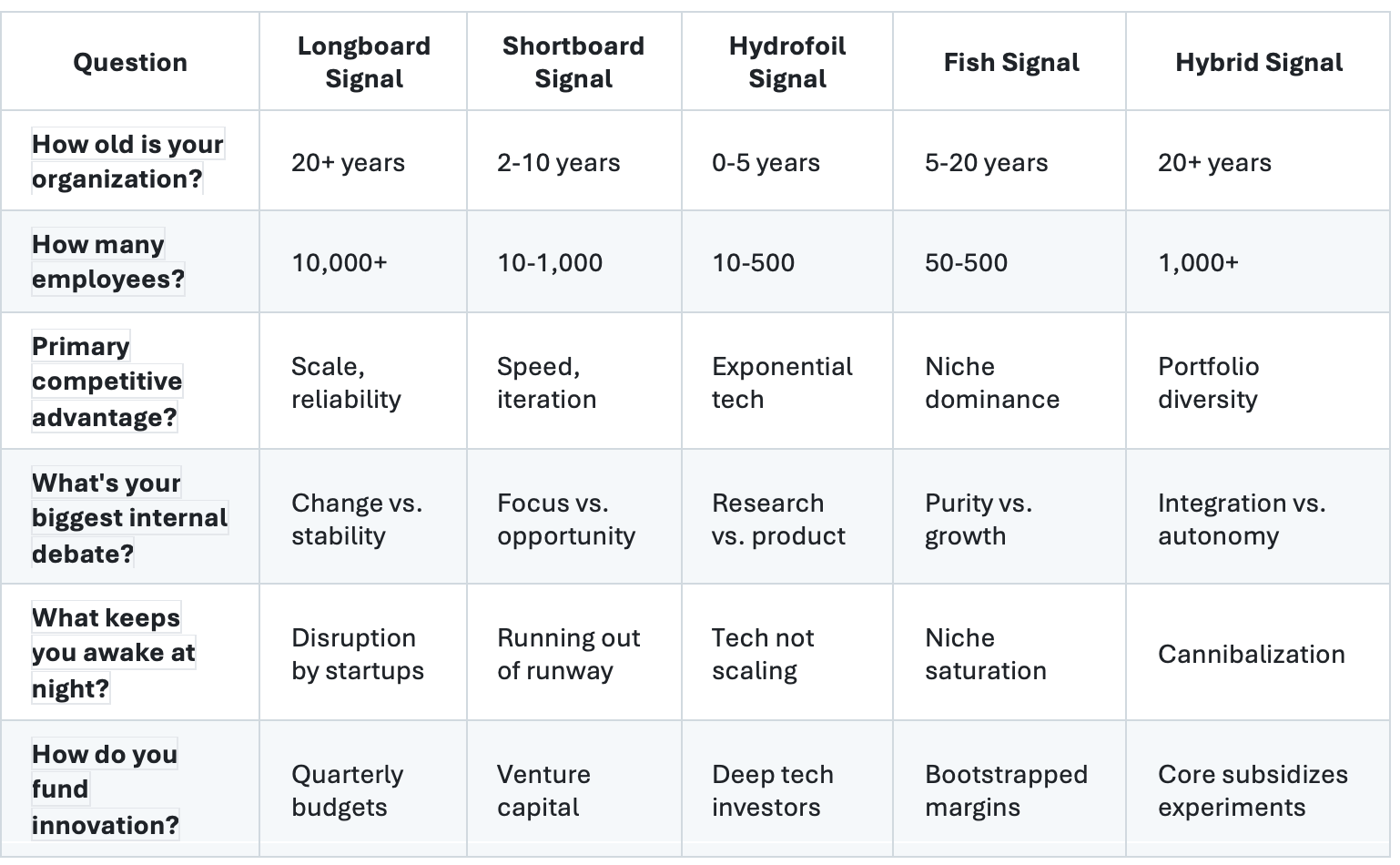
Table 1: The signalling dashboard
Scoring interpretation:
Longboard: Stability player; stop apologizing for not being a startup.
Shortboard: Agility player; seek repeatability before scaling.
Hydrofoil: Exponential player; the most significant risk is instability.
Fish: Niche player; focus on your natural habitat.
Hybrid: Rare and powerful—or a confused longboard pretending to be one.
The Board-Feel Decay Problem
As organizations grow, they lose the ability to feel their own board type.
I call this organizational numbness—the gradual loss of sensory feedback that tells leaders what’s actually happening beneath them. You start windsurfing with intense awareness of every ripple, every shift in wind pressure, every vibration through the board. Over time, if you’re not careful, all that feeling fades into vague impressions.
The same happens to organizations. Early on, founders know exactly what their company is—they feel it through every customer conversation, every product decision, every hire. But as the organization scales, layers accumulate between leadership and reality.
This is organizational numbness—the drift from sensory reality.
Examples:
Customer experience becomes survey data
Product decisions become roadmap meetings
Hiring becomes algorithmic screening
Reality becomes a slideshow
Three diagnostic questions help detect numbness:
Three diagnostic questions to test for board-feel decay
1. Can you still feel the water?
Test: Describe your most important customer’s day-to-day experience using your product without referencing metrics, dashboards, or reports. Can you narrate their actual lived experience in specific, sensory detail?
What numbness sounds like: “Our NPS (Net Promoter Score) score is 42, and user engagement is up 15% quarter-over-quarter.” Have you ever had a conversation with an average customer about your product or service?
What feels like: “Sarah opens our app at 6:47 AM while making coffee, dreading the 19 unread notifications. She dismisses 17 without reading, clicks one, gets interrupted by her kid, forgets what she was doing, and closes the app frustrated. Our ‘engagement’ counted all of that as success.”
2. Can you feel your own momentum?
Test: Distinguish between moving and changing. Is your organization building momentum toward a clear destination, or just maintaining velocity through activity?
What numbness sounds like: “We shipped 47 features last quarter and launched in 3 new markets.”
What feels like: “We shipped 47 features, but only 2 changed user behavior. We launched in 3 new markets, but we’re still losing share in our core market. We’re moving fast but not changing position.”
3. Can you feel when you’re about to crash?
Test: How many days of warning do you have before critical problems surface? If your board is about to ventilate (lose grip and slide out), can you feel it coming, or does it always catch you by surprise?
What numbness sounds like: “We had no idea the reorg would cause this much attrition.” / “The regulation caught us completely off guard.” / “We didn’t see the security breach coming.” / “We didn’t know that personal data was used without consent”.
What feels like: “Three weeks ago, I noticed our senior engineers getting quiet in planning meetings. Two weeks ago, I saw LinkedIn activity spike. Last week, I started exit conversations with our highest-flight-risk people. The attrition wasn’t a surprise—it was a lagging indicator of something we’d been feeling for a month.”
If you’ve lost board-feel, strategy documents won’t fix it. You need to rebuild a direct sensory connection between leadership and reality:
- Reinstitute founder-mode sensing: Senior leaders spending unstructured time with customers, frontline employees, and products (not “town halls”—actual field observation)
- Shorten feedback loops: Move decision-makers closer to consequences (if you decide on a product feature, watch real users encounter it within 48 hours)
- Measure what you can feel: If you can’t physically sense it, you can’t manage it (customer sentiment scores are worse than useless if leaders never talk to customers)
Board-feel isn’t optional. It’s the foundation everything else rests on. You can’t set your fins if you don’t know what board you’re riding.
In a world where we outsource everything, the feel has become a strange thing.