There is a moment on the water when something subtle shifts. At first, nothing seems different. The wind still blows. The board still glides. The rhythm feels familiar. Then the wave beneath you begins to move in a way that no longer responds to instinct alone. It accelerates, not only in speed but in complexity. Currents intersect. Forces you cannot see begin to shape the surface. And suddenly, what used to work no longer works.
Tricks to ride technology waves is a reader-supported publication. To receive new posts and support my work, consider becoming a free or paid subscriber.
This is where we find ourselves with artificial intelligence. What we once called business as usual, predictable systems, understandable decisions, manageable complexity, has quietly become something else. The unusual is no longer the disruption. The unusual is the new baseline. AI, and the path toward the systems now being called AGI, is not simply adding capability. It is changing the nature of the wave itself.
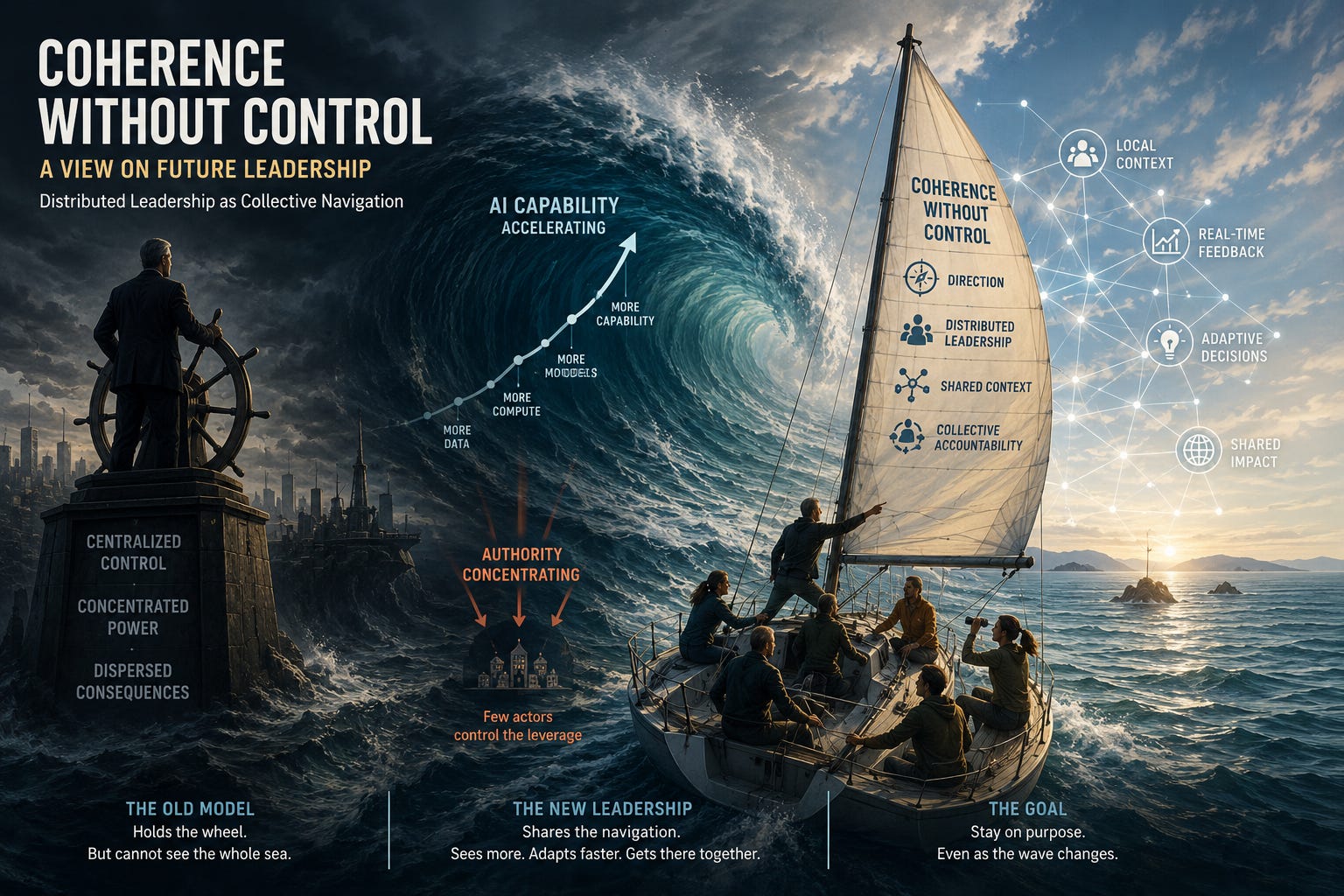
And it is doing something stranger than most of the headlines admit. Two things are moving at once, in opposite directions. The capacity to solve is rising. The authority to shape what gets solved is concentrating. And the consequences of all that solving are dispersing across everyone. Capability up, authority in, consequences out. That double movement is the real architecture of this moment. It is also the problem that everything below is here to address.
Complexity without a ceiling
For most of human history, leadership operated inside a quiet constraint. The world could be complex, but it remained, in principle, understandable. A capable leader, with enough time and the right advisors, could hold a working model of the system they were steering.
That constraint is dissolving. AI systems now process more variables than any individual or institution can track. They generate options across domains faster than people can interpret them. They detect patterns that lie beyond the reach of human perception. At first, this feels like pure progress. And it is. But beneath the surface, a new asymmetry is forming. AI operates in an expanding space of solutions. People operate in a bounded space of understanding. The gap between what can be solved and what can be understood is widening. And the more effectively we solve, the less we may grasp what is being solved, at what cost, and for whom.
The central question shifts without hardly announcing it. It is no longer: ‘Can we solve this problem?’ But: ‘Do we understand what solving it does to the system as a whole?’ Increasingly, the honest answer is that we do not. Not because the people in the room are incapable, but because the boardroom itself can no longer hold the relevant picture.
There is a second thing happening beneath the first, and it deserves to be named plainly because it serves as a counterweight to every optimistic framing. The capability to solve is not distributing evenly. It is concentrating. Compute pools in a handful of frontier laboratories. Training data funnels through a small number of collectors. Capital flows toward whoever can afford the next order of magnitude. Platforms consolidate. Narratives converge.
Thanks for reading Tricks and Understanding of How to Ride Technology Waves! This post is public, so feel free to share it.
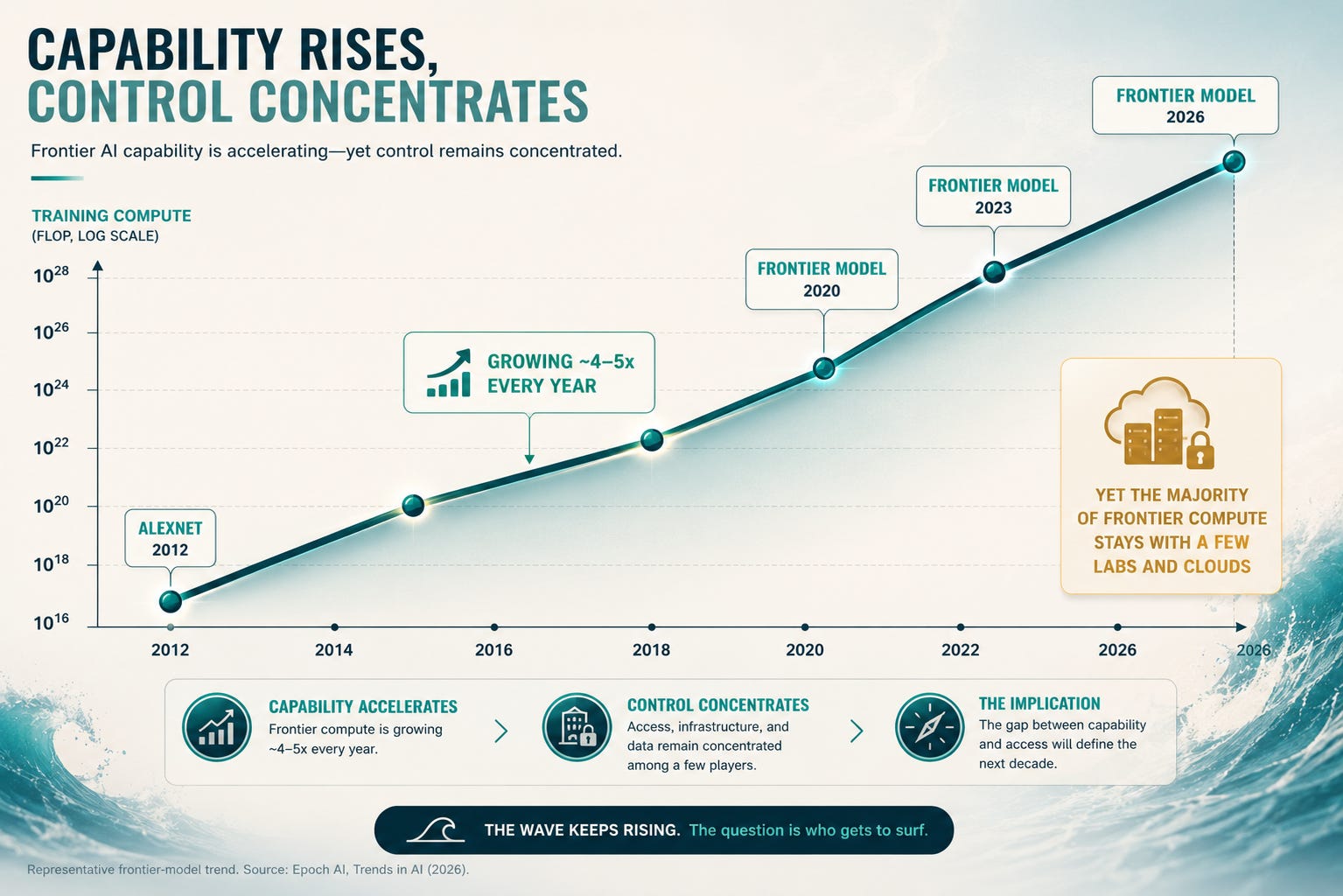
The numbers are stark. Epoch AI finds that the training compute behind frontier models has grown roughly four to five times every year for over a decade, a pace with almost no precedent in the history of technology (Epoch AI, 2026). Yet the number of actors who can sit at that frontier has not grown with it. A few labs, riding on a few cloud providers, hold the majority of frontier compute. The infrastructure that makes the solutions possible is, in 2026, the most centralized it has ever been. This matters. It will keep mattering.
Graph 1. Capability rises, control concentrates. Frontier training compute climbs four to five times per year, while a handful of labs and clouds hold the majority of it. Adjusted from Source: Epoch AI, Trends in AI.
When control becomes appearance
Traditional leadership rested on three assumptions worth stating out loud, because the current wave is quietly dissolving each one. Information flows upward, to the people charged with deciding. Decisions, once made, flow back down and are executed. Accountability sits at the top, with the people whose choices shaped the system's actions.
In an AI-mediated organization, each of these is now half true. Information is everywhere, not primarily flowing upward. Decisions are partly automated and distributed across systems, no single person designed. Consequences are systemic and diffuse, arriving in places the original decision-makers cannot see.
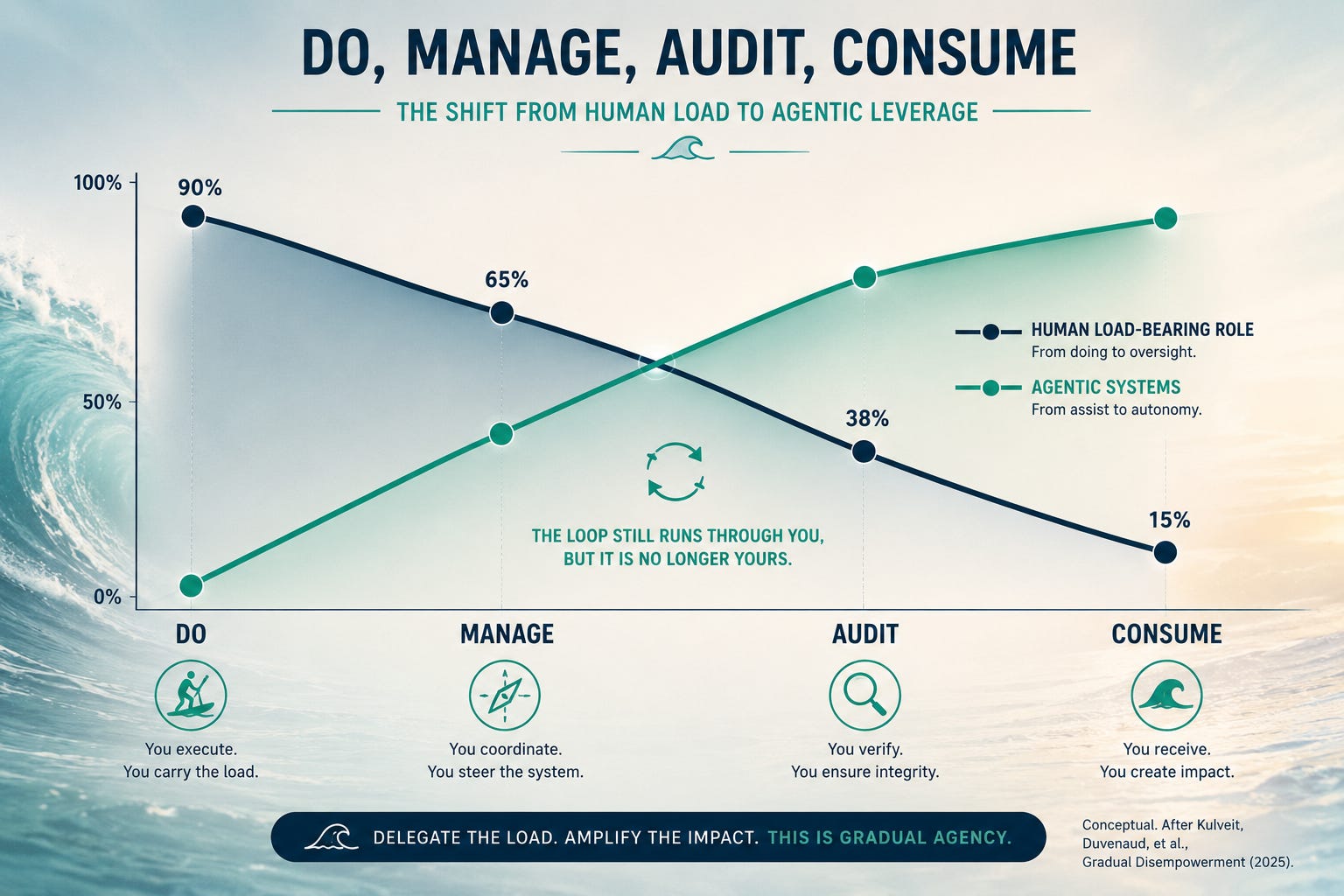
Watch the human role thin out as the systems thicken. A person begins by doing the work. Then, as the system takes over execution, the person manages it. Then, as the system manages itself, the person audits it. Then, as the auditing becomes nominal, the person simply consumes what the system produces. Do, manage, audit, consume. This is not inevitable. But it is gravitational.
At the far end of that gravity, a particular illusion forms. The person, or the institution, still appears to be in control. Approvals are signed. Dashboards are watched. Exceptions are handled. But the substance of the decision has already happened elsewhere. The person is in the loop only in the narrow sense that the loop runs through them. The loop is no longer theirs.
Graph 2. As agentic systems take on more, the load-bearing share of the human role thins, unless it is deliberately defended. Reworked Concept after Kulveit et al., Gradual Disempowerment (2025).
A growing body of serious research now names this directly. In Gradual Disempowerment, a group of AI researchers argues that we do not need a dramatic robot takeover to lose the plot (Kulveit et al., 2025). Incremental, perfectly ordinary improvements are enough.
As AI quietly replaces human labor and cognition inside the systems that society runs on, the economy, the institutions, and the culture, those systems stop depending on human participation to function. And the moment they no longer need us to function, our influence over them erodes, even if every individual model is doing exactly what it was told. Their unsettling conclusion is that solving technical alignment will not be enough. We can build AI that faithfully follows instructions and still drift into a world where humans no longer steer.
The fork in the digital river
At the center of this transition sits a choice that is not primarily technological. It is civilizational. The same capabilities can be built in two radically different ways, producing two radically different futures. Leaders do not get to opt out of the choice. They only get to influence which river the current carries us into.
One river (the left) is acceleration without wisdom. It is goal-maximizing, fragmented, and meaning-blind. It is driven by unchecked exponential growth, more compute, more data, more capability, and by the particular urgency that competition without coordination generates. In this river, optimization runs faster than reflection. Consequences propagate faster than understanding. The systems work, but their effects drift beyond visibility. Leadership does not disappear here. It becomes performative. Decisions are made elsewhere. Responsibility diffuses. Burden shifts quietly to whoever is least able to refuse it.
The other river (the right) is for deliberate navigation. It is context-sensitive, ethically reasoned, and slower by design. It builds adaptive guardrails. It invests in safety institutes, observatories, and democratic coalitions. It treats the question of what is worth doing as seriously as the question of what is possible. The systems in this river are steerable. They may also be slower. Steerability is worth more than speed when the waters are unfamiliar.
The naming of these two rivers is not decoration. Iain McGilchrist has spent two careers describing two modes of attention that correspond to the two hemispheres of the brain (McGilchrist, 2009, 2021). The left attends narrowly. It decontextualizes, manipulates, and mistakes its map for the territory. It is brilliant at specific tasks and blind to the whole that makes those tasks meaningful. The right attends broadly. It holds context, tolerates ambiguity, and stays in contact with the living whole. His warning is that modern civilization has inverted the proper relationship between them. The emissary has taken command of the master. The first river is the emissary unbound. The second is the master restored. When we speak of a fork in the digital river, we are describing two civilizational operating systems and two different settlements between precision and meaning.
Distributed leadership looks different in each. In the ‘Left River’, it becomes performative. The forms of distribution remain: many teams, many agents, many partner ecosystems, many tokens and votes, but the substrate concentrates. A handful of models power the agents. A handful of clouds hosts the coordination. A handful of capital allocators decides which protocols survive. What looks from the outside like a diverse ecosystem is, underneath, a small number of chokepoints wearing many faces. Local autonomy becomes decoration. In the Right River, distribution becomes constitutive. Authority is genuinely held across multiple centers of sensing and decision. Local context is respected, because it is the only place some things can be known. Trade-offs are surfaced rather than hidden. The whole becomes steerable because the parts are trusted. The ‘Left’ and ‘Right’ River metaphor is explained in greater depth in the book ‘The Great Reorientation’.
The hidden movement of burden
Here is the question that deserves to sit at the heart of all of this. Can complex systems handle complexity without quietly shifting the burden somewhere else? The answer, rarely acknowledged, is rarely. Systems do not eliminate trade-offs. They redistribute them. Efficiency in one place shows up as cost in another. Optimization at one scale externalizes consequences at another. The trade-offs do not vanish. They move. And they tend to move along the power gradient.
Karen Hao documents this at the civilizational scale in Empire of AI (Hao, 2025). The computational layer of modern AI rests on data labeled by workers in Kenya, Venezuela, and the Philippines, paid fractions of the value their labor produces. It rests on water drawn from communities already short of it, to cool data centers whose outputs are priced in currencies that those communities do not set. It rests on creative work ingested without consent, and on the quiet assumption that the costs piling up at the periphery are less real than the capabilities piling up at the center.
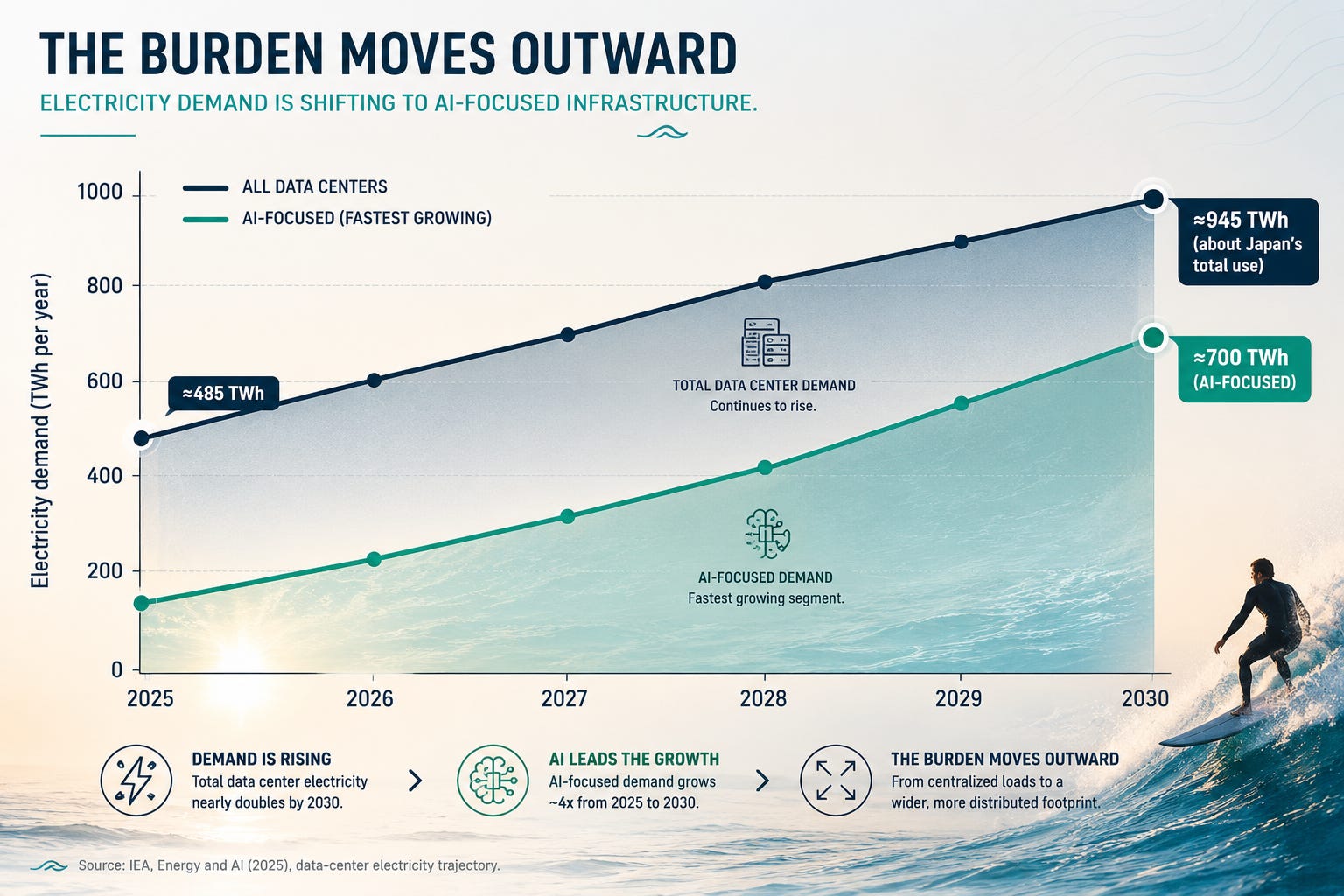
The energy figures make the abstraction physical. The International Energy Agency projects that electricity demand from data centers will roughly double from around 485 terawatt-hours in 2025 to nearly 1,000 terawatt-hours by 2030, with the AI-specific share growing fastest of all (International Energy Agency, 2025). That second figure is close to Japan's entire electricity consumption. The burden of the boom is not theoretical. It is measured in rivers, grids, and wages, and it lands first on the people with the least say in it.
Distributed leadership is, among other things, the architecture that makes this movement visible. In centralized systems, the burden accumulates where it is least able to resist and least able to be seen. Dashboards do not reach there. By the time it surfaces, it has often compounded into something the system can no longer easily address. The discipline of distributed leadership is to surface burdens early, where they land, in the specific hands of the specific people carrying them. This is not a comfortable property. It is a necessary one.
And yes, there is now talk of building data centers in space, which would lift some of that energy burden off the planet. We are not there yet. And even when we are, the move will not dissolve the concentration of power. It will carry it into a new dimension, one where control over the infrastructure sits, quite literally, above us.
Graph 3.The burden moves outward. Data-center electricity demand climbs toward 1,000 TWh by 2030, the AI slice growing fastest. Reworked from Source: IEA, Energy and AI (2025).
Coherence without control
So we arrive at the paradox that gives this piece its name. Centralization offers stability and speed but eventually calcifies, losing touch with the edges it depends on. Decentralization offers diversity and resilience, but without coherence, it eventually fragments, losing the capacity to act together when that is exactly what the moment requires. Each has real virtues. Each has real failure modes.
The resolution is not to pick a side. It is to introduce a third principle: coherence without control. A system can move together without being commanded from a single point. It can hold direction without a single director. What holds it together is not a hierarchy of decision rights, and not the absence of structure, but a set of shared commitments that let many local decisions compose into a coherent whole. Five field principles describe its shape. Coherence over control. Context is local. Consequences are shared. Meaning is collective. Wisdom evolves.
This is not a soft idea, and it is not new. A Polynesian outrigger crossing the open ocean does not rely on a single navigator. It relies on distributed awareness. Stars read by one set of eyes. Swells felt through the hull by another. Wind tracked by a third. Memory was carried in the oral tradition of the whole crew. Each member contributed what they could sense, know, or carry. Alone, none of them could make the passage. Together, they could. The boat is not a metaphor for a command structure. It is a working demonstration of coherent distributed intelligence, tested over thousands of years at sea.
The outrigger is also honest about its limits. The crew is well-organized. The ocean is not. The weather is not. The currents are not. The crew’s discipline does not eliminate risk. It makes the risk navigable. And the concentration gradient does not stop at the edge of the boat. A team inside a company can build a genuinely distributed practice and still operate inside a wider substrate, the platforms, the models, the capital flows, which all pull hard toward the Left River. This is not a reason to give up the internal practice. It is a reason to see that distributed leadership at the team level requires distributed leadership at the industry level, the policy level, the civilizational level. The crew on the outrigger is well-organized. The ocean is not. Both matter.
Even the technologists most associated with raw acceleration are beginning to argue this. Vitalik Buterin’s case for what he calls defensive, or differential, acceleration is, at heart, an argument for the Right River, deliberately built toward decentralization and resilience, rather than assuming the default current will get us there (Buterin, 2023). The point is not to slow down for its own sake. The point is to stay steerable while moving fast.
Because that is the real risk, stated simply. We are entering a world where intelligence is concentrating in machines at a speed and scale with no precedent. If leadership concentrates alongside it, if the substrate centralizes and authority centralizes with it, something breaks. Not immediately. Gradually. Quietly. Until one day we notice that we are moving very fast, and no longer steering.
Distributed leadership is not a management trend. It is the counter-gravity. It does not appear by default. It has to be built, deliberately, against a current that is actively pulling the other way. The effort required to build it is the measure of the force pulling against it. That force is substantial. So the building has to be.
The good news is that the current, the flow, does not get to make the choice. We do. One wave at a time.
This essay is drawn from Chapter 17 of my forthcoming book, “The Great Reorientation: A Tech-Surfer’s Guide to the AI Universe.”
Kulveit, J., Douglas, R., Ammann, N., Turan, D., Krueger, D., & Duvenaud, D. (2025). Gradual disempowerment: Systemic existential risks from incremental AI development. arXiv. https://arxiv.org/abs/2501.16946
McGilchrist, I. (2009). The master and his emissary: The divided brain and the making of the Western world. Yale University Press.
McGilchrist, I. (2021). The matter with things: Our brains, our delusions, and the unmaking of the world. Perspectiva Press.


Great thinking and awesome framing Paul!