
Intelligence You Can’t Solve It With The Same Thing That Created It
A contribution in the spirit of Tech-Surfing This essay follows “The Illusion of Quantity to Capture Wisdom

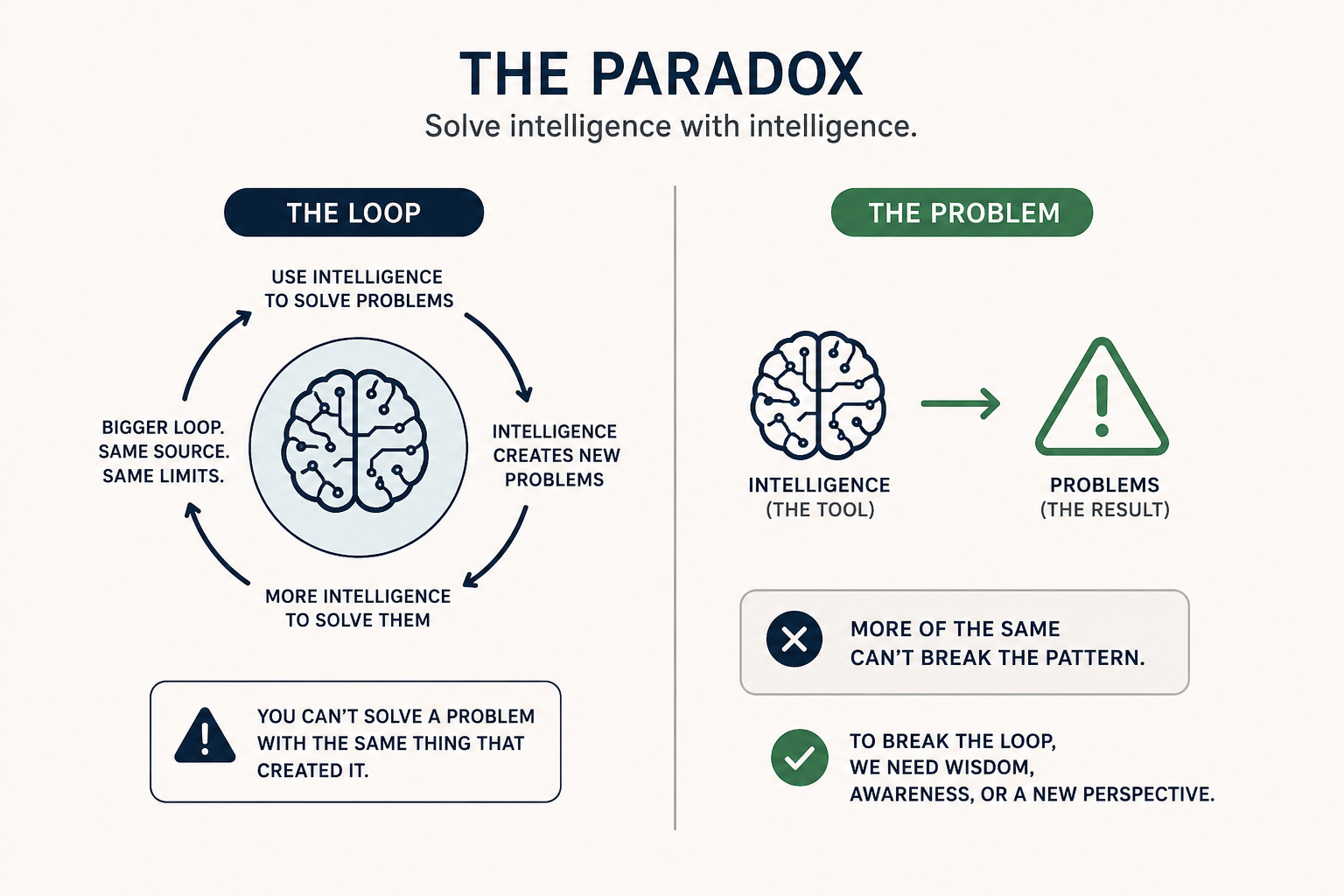
The Mission Statement’s Hidden Flaw
DeepMind’s mission is one of the most quoted in technology: “Solve intelligence, then use that to solve everything else.”
Demis Hassabis has lived this mission for over a decade. A chess prodigy, neuroscientist, game designer, and 2024 Nobel laureate in Chemistry, he is perhaps the most credentialed person alive to make such a claim. And at Google I/O in May 2026, he shared his line of thought with the world: we are standing in the “foothills of the singularity.” AGI, he said, could come by 2029. When it does, it will be “ten times the industrial revolution at ten times the speed.”
I first encountered the sharpness of this claim through Ruben Hassid’s newsletter How to AI, written after Hassid met Hassabis in person and left with one striking impression: the man was not hedging. Four years. As a genuine working expectation.
Take it as a provocation rather than a prediction. And then ask the one question the mission statement never answers:
“What if intelligence is not the solution — because it is the source of the problem?”
The Paradox No One Puts in a Mission Statement
There is a principle so well-established it appears across mathematics, physics, philosophy, and organizational theory, yet is almost never applied to the AI debate:
You cannot solve a problem with the same thing that created it.
Einstein, or at least the thought attributed to him, framed it this way: “We cannot solve our problems with the same level of thinking that created them.” He was talking about nuclear weapons, a technology produced by the most concentrated application of human intelligence in history. More thinking, he understood, would not undo what thinking had made possible. Something of a different order was required.
Kurt Gödel proved it mathematically in 1931. His incompleteness theorems demonstrated that no sufficiently powerful formal system can prove its own consistency from within itself. The system cannot audit itself. It cannot see its own blind spots. To verify the system, you must step outside it, and that outside position is, by definition, not the system.
The human cost of that proof is rarely told. John von Neumann, arguably the most complete mathematical mind of the twentieth century, the man who designed the computational architecture that every computer in existence still runs on, was shaken by Gödel’s theorem to something approaching distress. According to Ananyo Bhattacharya’s biography The Man from the Future, and Labut’s biography “the Maniac” (The title is an acronym: Mathematical Analyzer Numerical Integrator and )
Automatic Computer), von Neumann grasped the implications faster than almost anyone and was nearly driven to despair by what he understood: that the dream of a perfect, complete, self-consistent formal system for all of mathematics, the foundation on which so much of his intellectual life had been built, was not merely unfinished. It was structurally impossible. The system could not close itself. It never could. The greatest formalist of his era had to live with the proof that formalism has a ceiling it cannot see from inside.
The connection to our moment is not decorative. Von Neumann went on, despite that distress, to design the foundations of modern computing. His architecture is the direct ancestor of the systems that now claim to approach general intelligence. The man most haunted by the theorem that intelligence cannot fully understand itself from within is also the man who built the machine we are now asking to do exactly that. The strange loop runs all the way down.
Gregory Bateson, the anthropologist and systems theorist, called the same phenomenon a double bind: a situation in which the rules of the game make it impossible to win by playing the game. You need a second-order intervention, a change not of moves, but of the game itself.
Thomas Kuhn showed us that this is how science actually progresses: not by accumulating more evidence within a paradigm, but by breaking the paradigm altogether. The Copernican revolution did not come from better Ptolemaic astronomy. Quantum mechanics did not come from better Newtonian physics. The breakthrough always requires stepping outside the frame the previous intelligence built.
Now apply this to DeepMind’s mission. The problems Hassabis wants to solve, such as disease, climate change, economic inequality, and scientific stagnation, are not random misfortunes. They are, in substantial part, the products of human intelligence applied without adequate foresight, without wisdom, without understanding of second and third-order consequences. We industrialized intelligently and warmed the planet. We optimized food systems intelligently and created chronic disease epidemics. We built financial instruments intelligently and generated systemic fragility. We applied human intelligence, our best tool, and produced the very crises we now want intelligence to fix.
Do you feel that paradox? On steroids, fuelled by the law of more, stripped of wisdom.
DeepMind’s response is to build more intelligence. Faster. At unprecedented scale.
This is not a criticism of DeepMind. Their science is extraordinary. AlphaFold’s solution of the protein-folding problem is one of the genuine breakthroughs of this century. But there is a deep philosophical tension in the mission itself: if intelligence created the problems, can intelligence, even superintelligence, solve them? Or does it simply execute the same paradigm faster, at greater scale, with greater consequences when it fails?
The Singularity as Amplification, Not Transcendence
This is where the Singularity concept requires careful examination.
The Singularity, the moment at which artificial intelligence surpasses human intelligence and begins improving itself recursively, is typically framed as a rupture: a before and after, a point beyond which everything changes. Hassabis describes it as the beginning of an era. Others have called it the last invention humanity will ever need to make.
But consider what is actually being proposed. The Singularity does not introduce a new kind of intelligence. It takes the existing kinds of pattern recognition, optimization, prediction, and reasoning within defined parameters and scales them beyond anything human minds can match. It is, in the most precise sense, more of the same thing.
If the thesis holds, that you cannot solve a problem with the same thing that created it, then the Singularity does not transcend the paradox. It deepens it. AGI operating at superhuman speed and scale within the same paradigm of intelligence that created our current problems is not a solution. It is an acceleration.
This is not a fringe position. Yann LeCun, former chief AI scientist at Meta, one of the few people most responsible for the deep learning revolution, argues that current AI systems, including the most capable LLMs, do not possess genuine intelligence at all. They are sophisticated pattern matchers operating without world models, without causality, without the kind of understanding that would allow them to reason about genuinely novel situations. His response to Hassabis’s singularity framing was blunt: “complete delusion.”
Hassabis is not alone in his assessment, and some go considerably further. Dr. Alexander Wissner-Gross, physicist and AI researcher, does not describe the Singularity as approaching. In his Moonshot podcast appearances and across his Substack The Innermost Loop, he returns repeatedly to one claim: we are already inside it. The inflection point is not ahead of us. It is beneath our feet.
His essay Solve Everything, co-authored with Dr. Peter Diamandis, makes this viscerally concrete. The prologue, set in 2026, which is to say now, opens with: “The exponential progress curve hasn’t just bent. It has snapped. We are living in the vertical asymptote now.” Note the title. Solve Everything. The echo of DeepMind’s mission is not accidental; it is the animating premise of the entire document. Where Hassabis frames the mission as a two-step sequence, solve intelligence, then use it to solve everything else, Wissner-Gross and Diamandis collapse the two steps into one ongoing event. The solving is already underway. The question is not when it will begin. It is whether we are ready for what it produces.
Ray Kurzweil, the most widely cited Singularity theorist, is more measured. He keeps his timeline at around 2040, consistent with his long-standing predictions, and has not moved that date despite the acceleration around him. What is striking across all three positions, Hassabis, Wissner-Gross, Kurzweil, is not the disagreement on timing but the agreement on direction, and the fact that what the Singularity actually means for human beings remains genuinely uncertain. That uncertainty is, perhaps, another dissatisfying aspect of an approaching storm that may or may not blow us, humans and history, away.
Here is what that uncertainty reveals. The Singularity is not a prophecy. It is a projection: the extrapolation of AI advancement curves, a calculated fact, not a vision, mathematics applied to observed trends. What it does not and cannot tell us is what it means. A concept that can tell you when but not why it matters is a product of intelligence operating without the guidance of wisdom. It describes the shape of the wave with precision. What to do when it arrives, who it serves, what it costs, who was asked, those are the questions it leaves entirely unanswered. Intelligence formulated the Singularity. Wisdom would have started with different questions.
The Hassabis-LeCun debate is not merely a technical dispute. It is a dispute about what intelligence is, and therefore about what “solving” it could possibly mean. When two of the most credentialed people in the field cannot agree on that, the wave’s shape is uncertain, not just its timing.
The Strange Loop at the Center
There is a further layer to the paradox, which Douglas Hofstadter (1979) spent his career illuminating. His work is one I return to whenever a conversation demands it, and this one certainly does.
A strange loop, his term, occurs when you ascend a hierarchy and find yourself unexpectedly back where you started. Escher’s staircase, always climbing yet always returning to the same step. Gödel’s theorem again: a system that refers to itself can generate statements it cannot evaluate. The map that contains itself cannot accurately represent itself.
DeepMind’s mission has exactly this structure. To “solve intelligence,” you must first use intelligence to define what intelligence is, to set the goalposts for what “solved” would mean, to design the systems intended to surpass human cognition, and to evaluate whether they have succeeded. The solver is embedded in the problem at every stage. Human intelligence is the ruler, the thing being measured, and the hand doing the measuring, simultaneously. Good luck!
This is not a reason to abandon the project. It is a reason to be philosophically humble about what can be claimed when the project “succeeds.” What DeepMind and its peers are building is real and consequential. But “solving intelligence”, in the sense of standing outside it, fully understanding it, definitively surpassing it, may be structurally impossible. You cannot step outside the system you are made of.
Unless we are no longer human. Unless we become a new kind of being, what we might call artilligence: an artificial species that operates on a fundamentally different wavelength of intelligence, no longer constrained by the biological loop it emerged from. But we are still human. Right?
Intelligence Scales. Wisdom Doesn’t. That Is the Point.
Here is where the paradox resolves, partially, and in a direction that matters enormously for anyone trying to ride this wave.
Intelligence is scalable. That is now a demonstrated fact. You can train a model on all of recorded human knowledge. You can run a billion instances of it simultaneously. You can compress the pattern-recognition work of ten thousand analysts into a query response. Whatever intelligence is, it can be amplified, accelerated, and distributed at near-zero marginal cost.
Wisdom cannot be scaled. This is not a limitation of current technology. It is structural. Wisdom, Aristotle’s phronesis, practical judgment, is the capacity to perceive what truly matters in a specific situation and act accordingly. It is forged from consequence: from having acted, been wrong, suffered the result, learned from others, and refined one’s judgment over time. It cannot be trained on data because it is not a pattern in data. It is a relationship between a person and reality, tested across a life.
Crucially, wisdom is also the second-order intervention that Bateson, Kuhn, and Einstein were pointing toward. It is what allows you to step outside the frame that intelligence built. No more analysis. Not faster optimization. A different quality of attention, one that can ask not just how but whether, not just what works but what we should be doing at all.
There is a word that needs defending here: slowness. It does not mean falling behind. It does not mean ignorance of the wave. It means something closer to what Daniel Kahneman described as System 2: the deliberate, reflective mode of thinking that checks and corrects the fast, associative conclusions of System 1. Wisdom is not slow because it is weak. It is slow because it is thorough, because it refuses to mistake speed for accuracy, or volume for understanding. It stays, in the most productive sense, a little bit behind the leading edge: close enough to see the wave clearly, far enough back to read its shape.
The Singularity, if it arrives, does not solve this asymmetry. It sharpens it. As intelligence becomes cheap and ubiquitous, the scarcest resource is not cognitive power. It is the System 2 judgment to know what cognitive power should be aimed at, and what it should leave alone.
Can There Be Wisdom Without Intelligence?
We accept easily that intelligence can exist without wisdom. The evidence is everywhere: brilliant people who ruin what they touch, sophisticated systems that optimize the wrong objective at catastrophic scale, an entire Silicon Valley culture that celebrated move fast and break things, disrupt before you will be disrupted, which is, in essence, a philosophy of intelligence without wisdom.
Can wisdom exist without intelligence?
Not in the sense of sophia, the theoretical understanding of why things are as they are. For that, you need the capacity to reason, to hold abstractions, to follow arguments. Some cognitive substrate is required.
But for phronesis, practical wisdom, the knowledge of what to do, the threshold is much lower, and the source is different. A grandmother who has raised children, buried two, and learned to tell the difference between what can be fixed and what must be endured possesses a form of practical wisdom that no intelligence test would surface. Indigenous communities that have maintained ecological balance for millennia possess wisdom encoded in practice and ritual, not in formal reasoning. The Japanese martial concept of mushin, “no mind,” a state of heightened effective action achieved by suspending deliberate intelligence, points toward a wisdom that intelligence can actually obstruct.
The philosopher Michael Polanyi called this “tacit knowledge”: we know more than we can tell. A master craftsman knows how to cut wood in a way she cannot fully articulate. A skilled negotiator reads a room in ways she cannot reduce to rules. This knowledge is real. It is not intelligence. It is something older, slower, and in its own domain, more reliable.
So the asymmetry is genuine but not symmetric. Intelligence without wisdom is common and frequently dangerous. Wisdom without intelligence is rare, partial, and tends to be humble about its limits, which is itself a form of wisdom.
There is a further question hiding here, one that Ray Kurzweil takes seriously in a way that demands engagement. He conceives of biology itself as an information-processing system. If the brain, including its emotional and experiential architecture, is ultimately a biological computer, then it may be possible, cell by cell, signal by signal, to digitize it. Consciousness, in his view, is information processing at sufficient complexity; and information processing is, in principle, substrate-independent. If he is right, then AI will not merely simulate wisdom, it will eventually drive us toward a new kind of being: a non-biological species that emerged from the biological one. And that prospect leaves every individual alive today, sooner than most imagine, with a choice no previous generation has faced: to remain biological, or to become something else. The wisdom to navigate that choice cannot itself be artificial. It must come from somewhere still human.
The Wave and the Rider
For TechSurfing, the practical implication is this, and it is more urgent than most people have registered.
The dominant narrative around AI positions the critical decisions as future events. AGI arrives in four years, or ten, or twenty; we will need to be ready; society will need to adapt. This framing is comfortable. It implies time. It implies that the moment of consequence is still ahead of us, and that there is space between now and then for reflection, preparation, and choice.
Wissner-Gross and Diamandis puncture that comfort directly. Their Solve Everything essay, written not as a prediction but as a dispatch from the present moment, describes 2026 as “The Lock-In.” Not a transition point. Not a foyer. A moment in which the path dependencies of the next century are being hard-coded into the substrate right now. The foundational architecture of how intelligence gets deployed, who owns it, what problems it is aimed at, and under what governance it operates, these are not decisions being deferred. They are being made now.
By whom? Not by governments. Not by philosophers. Not by citizens’ assemblies convened to weigh consequences. The Lock-In decisions are being made by developers who build the systems and investors who fund them, two groups operating almost exclusively under the intelligence of doing business: return on capital, competitive advantage, speed to market, first-mover dominance. This is not a moral failure. It is an ancient structural one. The incentive system does not reward pause. It does not reward the raising of red flags. It rewards deployment. And so, wisdom, the second-order faculty that asks, should we? before it asks how fast? is largely absent from the room where the most consequential decisions in human history are being made. Driven, in no small part, by the fear of missing out. That is not a healthy foundation for civilizational architecture.
Wissner-Gross and Diamandis celebrate this moment with a phrase that deserves scrutiny: “the rails are already winning.” In their framing, this is a positive signal, evidence that the right infrastructure is being built, that progress is unstoppable. And perhaps it is. But the metaphor reveals something its authors may not have intended. He or she who lays the rails first controls the territory. He or she who controls the territory extracts the rent. This is not a new intelligence. It is one of the oldest we have, the intelligence of competitive conquest, unchanged in its logic since the medieval lord who enclosed the commons, the colonial power that claimed the harbor, the industrial baron who bought the right of way before the farmers knew what it was worth, or the emissary who acts as the master. In every era, the rails won. In every era, the question that wisdom would have asked, winning for whom, and at what cost to those not at the table? arrived too late, after the track was laid and the trains were running. Full stop. The old world in new clothes.
This reframes TechSurfing entirely. The wave is not approaching. It is already beneath the board. The surfer who waits to see its full shape before deciding how to move will find the decision has been made for them.
So, what does wisdom-driven navigation actually look like? It is not found in strategy documents or mission statements. It is revealed in texture: in an organization’s openness, its transparency, its capacity for genuine respect, of employees, customers, communities, and futures it will never see. The wisdom spine of an organization is a collective achievement, not a leadership attribute. It cannot be decreed from the top; it must be grown from within. It becomes visible through the inclusiveness of its decision-making, how many voices shape what matters, how much dissent is tolerated, how far the time horizon extends beyond the next quarter. Patagonia, examined at length in Tech-Surfing, is the reference case: a company whose wisdom is legible not in its branding but in its behavior, in what it refuses to do, in the supply chains it restructures, and in the legal status it adopted to protect its mission from future owners. That is wisdom made institutional. That is the second-order intervention in practice.
The paradox at the heart of the wave is that the technology designed to solve everything cannot solve the thing that most needs solving: the judgment about what should be solved, by whom, for whose benefit, at what cost, and with what care for those who come after.
That judgment is wisdom. And wisdom cannot be outsourced to the wave, and it cannot be deferred to the future, because the future is being written now.
The leaders, companies, and individuals who will navigate this wave are not those with the most access to AI capability. In a world where intelligence is a commodity, everyone will have access. They will be those who have cultivated the second-order capacity: the ability to ask the question that intelligence cannot formulate for itself.
Not how do we solve this?
But should we? And who decides?
Hassabis may be right that we are at the foothills. Wissner-Gross may be right that we are already past the inflection. What both positions share, and what LeCun’s skepticism does not refute, is that the decisions being made right now about the direction of intelligence will shape everything that follows. The question for the rest of us is not whether to climb. It is whether we have developed the wisdom to know what kind of mountain this actually is, and whether reaching the summit is the same thing as arriving somewhere good.
The Lock-In is not a warning about the future. It is a description of the present. And the window in which wisdom can still shape what gets built is not closing. It is already narrowing.
“We are building the most powerful instrument in history, aimed by the least wise moment in which we have ever held such power.”
Sources
● Alexander Wissner-Gross & Peter Diamandis. (2026). Solve Everything: Achieving Abundance by 2035
● Alexander Wissner-Gross, (2026). The Innermost Loop (Substack)
● Hassid, R. (2026). How to AI (Substack), “I Shook Hands with a Nobel Prize Winner”.
● Semafor, Hassabis: “foothills of the singularity”, 2026
● Axios, DeepMind CEO says we’re close to AGI, 2026
● The Decoder, Hassabis vs. LeCun on singularity and intelligence, 2026
● Huckins, G. (2026). MIT Technology Review, Google I/O and the path for AI-driven science, 2026
● Simonite, T. (2016). MIT Technology Review — How Google Plans to Solve Artificial Intelligence
● Wikipedia, Strange loop (Hofstadter)
● Hofstadter, D.R. (1979). Gödel, Bach, Escher. An eternal Golden Braid. Basic Books
● LessWrong — Strange Loops, Self-Reference and AI
● Bhattacharya, A (2021). The Man from the Future: The Visionary Life of John von Neumann. Allen Lane
● Labut, B. (2023). The Maniac. Pinguin Press
● Paul Epping — “The Illusion of Quantity to Capture Wisdom” (Substack)
Hi Frank, Thanks! Nice to hear that you like it! Please share the story... Working on other essays as well! Hope all is good.
Hi Paul,
I truly enjoyed reading your essay. Not in the fear of what is coming towards us in terms of AI and AGI, but more in the hope you reveal about holding true wisdom and how that shallinterfere and 'balance' with riding the Techwave(s). In the last paragraphs I recognize stories of old wisdom that I learned from parents, teachers, philisophers and narratives that came to me through poetry, arts and the Bible. Unfolding that kind of wisdom from many different sources and places brings me the joy of hope, the anchor to hold on to during the storm, the vision of what shall be (at what cost and for whom) that I want to pass on.
Thank you for your splendid unravelling of this moment in history.