
Phase 4: The adaptive response cycle
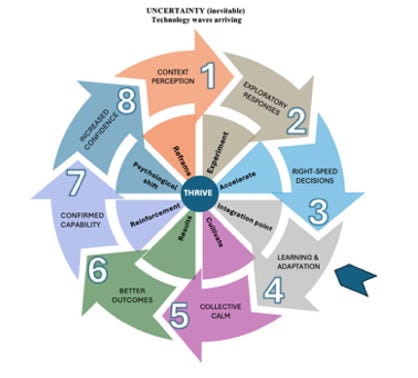
Learning and Adaptation: the Integration Point


Introduction
Watch an expert surfer and you’ll notice something remarkable. They’re not fighting the wave. They’re not merely reacting to it. There’s a moment—often imperceptible to the untrained eye—when the surfer commits fully, edges the board, and creates a flowing path through dynamic water. Surfers call this “carving the line.”
It’s not just riding the wave. It’s integrating with it.
The surfer has synthesized their understanding of wave dynamics, their physical capabilities, their board’s characteristics, and the immediate conditions into a single fluid response. The learning has become embodied. The distinction between surfer and wave begins to blur—not because the wave has been tamed, but because the surfer has developed the capacity to move with it.
This is what happens at the integration point of the ARC. It’s the moment where experience transforms into capability, where insight becomes embodied skill, and where individual discovery scales into organizational capacity.
This isn’t just another stage in the cycle. It’s the hinge point that determines whether you’re simply surviving uncertainty or actually growing stronger because of it.
Every surfer eventually learns that the sea has no memory. Each wave arrives as a new equation of energy, wind, and depth. In that truth lies the essence of learning and adaptation: to meet what comes without assuming that what worked yesterday will hold today. Learning is not just about adding knowledge; it is about reshaping our mental models — our living frameworks of perception and response — in a world that shifts faster than we can plan.
Carving the Line: Learning and Adaptation in the Adaptive Flow
As you drop in on that committed wave—fresh from right-speed decisions via your internalized (OODA)-B rhythm—the ARC doesn’t let you coast blindly.
Enter learning and adaptation, the integration engine that turns raw ride data into refined mastery. This isn’t passive absorption; it’s the dynamic carve, where you adjust your line mid-face, feeling the wave’s feedback through your board and body.
In tech-surfing’s churning ‘seas’, where AI swells morph hourly and blockchain currents twist unpredictably, this step transforms experiments ‘echoes and decisions’ wakes into evolutionary leaps. You’re not just surviving the set; you’re evolving with it, building a neural surf quiver that anticipates the next breaker. Core to this are iterative reflection, knowledge integration, and cultural embedding—practices that ensure learning isn’t a one-off splash but a compounding current.
At its heart, learning and adaptation demand structured reflection: pausing after the drop to dissect what propelled you forward or caused a spill.
The Learning-Adaptation Gap
Most organizations confuse learning with adaptation. They are related but fundamentally different:
Learning is acquiring new knowledge or insight:
- “We discovered that our customers respond differently to AI-powered features”
- “We learned that remote work changes team dynamics”
- “We now understand that our competitors are moving faster than expected”
Reflection Box
Surfing as Learning
Therefore, surfing, at its heart, is a continuous experiment in learning loops. Every session brings unfamiliar conditions — wind that changes direction continuously in the surf, waves that shift rhythm, currents that resist memory. The body and brain must learn anew, building on previous experience while discarding patterns that no longer fit. Adaptive learning occurs through cycles of perception, feedback, and recalibration.
In the modern technological surf, we all face similar waters. Whether navigating shifting industries or adjusting to new technologies, we are continuously being asked to read the water faster and adapt our balance. Learning, therefore, becomes a survival skill — not in the narrow sense of accumulating skills, but in cultivating the ability to re‑learn, un‑learn, and integrate experience into flexible new responses.
Adaptation is changing behavior based on that knowledge:
- “We redesigned our product roadmap based on customer AI preferences”
- “We restructured our collaboration processes for distributed teams”
- “We accelerated our decision-making cycles to match competitive pace”
Reflection box
The Adaptive Cycle
Learning and adaptation follow a rhythm similar to the waves themselves. Ecologists call it the Adaptive Cycle: growth, conservation, release, and renewal. In human terms, it represents how we learn, stabilize, lose balance, and recover stronger.
1. Growth – We explore new ideas, technologies, or practices. Like a surfer approaching a wave, we expend energy without knowing whether it will lift us.
2. Conservation – Once balance is found, we optimize. Routines and efficiencies build momentum.
3. Release – The environment changes — a new competitor, a disruptive technology, a personal setback. Our old patterns fail, and the wave collapses beneath us.
4. Renewal – In the turbulence that follows, new configurations emerge. We experiment, adjust, and find a new rhythm.
The gap between learning and adaptation is where most organizations fail. They conduct post-mortems, gather insights, write reports, hold retrospectives—and then continue operating exactly as before. The learning never integrates into the system. It remains abstract knowledge rather than embodied capability.
Think of it like a surfer who studies wave theory, watches videos, understands the physics—but never gets on the board. All that learning means nothing without integration into practice.
Organizations, communities, and individuals cycle through these phases constantly. The key is awareness: to know which phase you’re in and to act accordingly.
Mental Models as Surfboards
Our mental models are the surfboards of the mind (in part II, we will elaborate on the architecture of the board) — the tools we use to interpret reality and make decisions. They are shaped by experience, culture, and identity, yet they must remain adjustable. A surfer does not ride the same board in every condition; likewise, we must learn to shape and reshape our mental models for changing contexts.
Rigid mental models create wipeouts. They trap us in routines that no longer match reality. Flexible models allow for innovation and empathy — the ability to see from multiple perspectives. In the age of AI, adaptability is no longer optional. Machines will out‑calculate us; what remains distinctively human is our ability to learn across contexts and integrate meaning from chaos. We understand rather than merely knowing. That distinguishes humans from AI (for the foreseeable future, then it bounces off into the unknown).
Adaptation in the Age of AI
Technology now learns faster than we do. Machine learning compresses years of trial and error into minutes of computation. Yet the human advantage remains in meaning — we decide what matters. Adaptation in this era requires a partnership between biological and digital intelligence.
Just as early navigators learned to read both stars and tides, modern learners must integrate intuition with data. AI can optimize routes, but it cannot yet understand purpose. Adaptation, therefore, shifts from competing with machines to collaborating with them. The goal is not to mimic machine logic, but to enhance human creativity through augmented awareness and understanding.
The Feedback Dance
Every surfer becomes a master of feedback. The body senses minute changes in pressure and adjusts before conscious thought catches up. This is learning in real time — a closed feedback loop between perception and action. For humans and organizations, feedback is the foundation of learning.
Organizational learning theorists distinguished between single-loop learning (detecting and correcting errors within existing frameworks) and double-loop learning (questioning and modifying the underlying assumptions and frameworks themselves). The integration point is where double-loop learning happens. It’s where you don’t just fix the immediate problem but evolve your entire approach to navigating uncertainty (Argyris & Schön, 1978).
Yet many systems resist feedback. Bureaucracy, ego, or fear of failure block the signals that tell us how to adapt. In contrast, adaptive cultures treat feedback as oxygen — essential, continuous, and shared. They replace blame with curiosity, turning mistakes into data.
Collective Adaptation
Adaptation scales. Just as individual surfers learn from the ocean, entire cultures learn from collective experience. When a team, organization, or society embeds learning into its structure, it becomes an adaptive organism — a living system that evolves through shared insights.
Learning as Flow
True learning resembles flow — a state where attention, skill, and challenge align. In surfing, this happens when the body merges with motion; in life, when effort feels effortless because focus is total. Achieving flow in learning requires focus, clarity, challenge, and feedback.
Resilience and Renewal
Every surfer knows the inevitability of wipeouts. Resilience is not the absence of failure but the art of recovery. In the human domain, resilience combines emotional regulation, social support, and meaning-making. The most resilient individuals and teams don’t just bounce back — they bounce forward, integrating what the wave taught them.
Integrating Learning and Adaptation
At the intersection of learning and adaptation lies wisdom — the ability to discern when to act, when to wait, and when to change course. In fast-changing environments, the separation between learner and performer disappears. Every action becomes an experiment, every experiment a form of learning.
Learning and adaptation are no longer separate processes. In the ocean of technology and change, they have merged into one continuous flow. The question is not whether we can keep up, but whether we can stay attuned — flexible enough to read the next pattern while still honoring the last. Like the surfer scanning the horizon, we live in motion. To learn is to adapt; to adapt is to stay alive.
The Integration Imperative in Exponential Times
In an era of exponential technological change—where AI, biotech, quantum computing, and other technologies are accelerating and converging—the integration point becomes not just valuable but essential for survival.
The pace of technological change is accelerating faster than most organizations’ learning cycles. If your learning-to-adaptation cycle takes 12 months, but technology shifts every 6 months, you’re always behind.
Integration accelerates your learning cycle by converting learning to capability faster, building transferable capabilities, and developing organizational muscle memory.
Technologies aren’t just accelerating—they’re interacting in unpredictable ways. AI accelerates biotech. Biotech creates new data that trains better AI. Quantum computing will accelerate both. The complexity is cascading.
Integration builds meta-capabilities that work across different types of uncertainty: not just “how to implement AI” but “how to navigate emerging technology.” Not just “how to respond to this disruption” but “how to thrive in continuous disruption.”
Organizations are diverging into two groups: those who can navigate uncertainty and integrate learning (pulling ahead exponentially) and those who can’t (falling behind exponentially).
The gap, however, is widening at an accelerating rate.
Evidence of the gap is widening faster: Drowning victims begin to wash ashore
Although this sounds negative, even dystopian, that is not the sentiment of this book. Being positive about everything is a pitfall, and closing the eyes for precessional effects may lead to catastrophic results. The accelerating process of AI propelled by the trillions of dollars being poured, e.g. in new datacenters, leads to the problem that many aspects of parts in a process can’t keep up with that pace. Bottlenecks are created and will have a stagnating effect on processes and adjacent developments of AI.
Bottlenecks strangle system performance—no matter how fast one part moves, the whole system is limited by its slowest component (Goldratt, 1990). Here’s the paradox: a one-sided focus on AI can actually accelerate bottleneck effects. As AI capabilities surge forward, they expose and intensify constraints in everything that can’t keep pace—logistics chains still bound by physical reality, adjacent technologies that haven’t evolved as quickly, production processes dependent on legacy systems, organizations structured for a pre-AI world (Brynjolfsson & Hitt, 2000, 2021; Fountaine et al., 2019).
Furthermore, analysis of 2,000+ technologies and enterprise surveys, with projections showing widening gaps in process efficiency.
Hype-driven adoption of technologies like AI will lead to a “trough of disillusionment,” where bottlenecks in adjacent technologies (e.g., integration with legacy systems) cause stagnation. They note this effect accelerates in logistics and production as AI scales unevenly (Gartner, 2023; Deloitte, 2025).
The faster AI advances in isolation, the more severe these bottlenecks become. It’s like installing a Formula 1 engine in a car with bicycle brakes—the acceleration just makes the constraint more dangerous. With all the intelligence that we have and are eagerly developing, we are obviously not taking care of this wave properly. Better bring the ambulances to the shores!
Learning in this context is a hard thing, especially when big money is in the mix!
References
- Argyris, C., & Schön, D. A. (1978). Organizational learning: A theory of action perspective. Addison-Wesley.
- Brynjolfsson, E., & Hitt, L. M. (2000). Beyond computation: Information technology, organizational transformation and business performance. Journal of Economic Perspectives, 14(4), 23-48.
- Brynjolfsson, E., Rock, D., & Syverson, C. (2021). The productivity J-curve: How intangibles complement general purpose technologies. American Economic Review, 111(1), 52-89.
- Fountaine, T., McCarthy, B., & Saleh, T. (2019). Building the AI-powered organization. Harvard Business Review, 97(4), 62-73.
- Edmondson, A. C. (2018). The fearless organization: Creating psychological safety in the workplace for learning, innovation, and growth. Wiley.
- Ericsson, K. A., Krampe, R. T., & Tesch-Römer, C. (1993). The role of deliberate practice in the acquisition of expert performance. Psychological Review, 100(3), 363-406.
- Ericsson, A., & Pool, R. (2016). Peak: Secrets from the new science of expertise. Houghton Mifflin Harcourt.
- Kahneman, D. (2011). Thinking, fast and slow. Farrar, Straus and Giroux.
Gartner’s “Hype Cycle for Emerging Technologies” (Annual Report, e.g., 2023 Edition)
Deloitte report, (2025) AI adoption challenges and operational complexities.
[1] The side effects or “90-degree” consequences of a body in motion acting on another body in motion. (E.g. technology: developing a new technology often leads to unexpected and innovative new applications.)