
SECTION 2: Purpose as Hydrodynamics
The Three-Fin Thruster Model


“If you let AI optimize your organization today, what exactly would stop it from optimizing away your values tomorrow?”
In windsurfing, fins convert lateral pressure into forward drive. When wind pushes your sail sideways, the fin resists and redirects that energy forward. The fin fights back against the water, and that resistance becomes lift.
Purpose works the same way—it converts external pressure into forward momentum.
Before we dive into that, I’m using the left and right fins for clarification. These are twin fins. Their qualities are interchangeable depending on the direction you sail. The ‘Strategic Clarifying Fin’ is always at the windward side (where the wind is coming from).
Center Fin: Purpose (Deep Keel)
Your deepest fin provides directional stability. It determines whether external forces blow you off course or get converted into progress.
Deep fin example: Patagonia’s ownership transfer to ensure all profits fund environmental causes isn’t symbolic—it’s structural. The purpose is embedded in governance, not just culture.
Shallow fin example: Most “Massive Transformative Purpose” statements are crafted in off-site workshops. They sound inspiring, but provide zero resistance when actual pressure hits.
Left Fin: Direction (Strategic Clarity)
This fin defines where you’re heading—specifically, not aspirationally.
Deep fin example: Microsoft’s “Cloud-first, mobile-first” (2015) gave every team a clear decision filter. Build for Azure? Yes. Build another Windows Phone? No.
Shallow fin example: “We’re becoming data-driven.” Sounds directional, but provides no actual direction.
Right Fin: Resistance (Intelligent Friction)
This fin defines what you won’t do, even under pressure. Your educated immune system.
Deep fin examples: Basecamp’s approach of having “no VC funding, no exit strategy” ensures they maintain control over their development process, allowing them to create software at their own pace without external pressures. Similarly, Epic, a developer of electronic medical records systems, chose to prioritize its vision over shareholder demands, which has ultimately secured its position as the leading EMR supplier globally. Both companies demonstrate how independence from traditional funding routes can foster innovation and longevity in their respective fields.
Shallow fin example: Values statements nobody references during hard decisions. If your values don’t create real resistance to real pressures, they’re decoration.
Purpose vs. MTP: Why Most Purpose Statements Fail
Here’s where we need to address a fundamental problem: Organizations adopt “Massive Transformative Purpose” (MTP) statements that sound ambitious but lack structural depth.
I’m not criticizing MTP as a concept—I’m criticizing shallow implementation. The ExO framework is right that exponential organizations need massive, transformative purpose. But they need it as hydrodynamic structure, not inspirational aspiration.
The System 1 Purpose Problem
Daniel Kahneman’s distinction between System 1 (fast, intuitive) and System 2 (slow, analytical) thinking explains why purpose statements so often fail:
System 1 Purpose: Feels emotionally right, sounds inspiring, passes the “Does this resonate?” test.
“Democratizing finance”
“Empowering humanity to achieve more”
“Making the world more open and connected”
These statements trigger positive emotional responses (System 1) which bypass critical scrutiny (System 2). They feel meaningful, so we don’t examine whether they actually constrain anything. These responses are emotional.
System 2 Purpose: Passes the “Does this create measurable resistance?” test.
“Building financial tools for people with < $ 500 savings, even if it means rejecting features that only benefit high-net-worth users”
“Empowering every person and organization through cloud infrastructure, even if it means cannibalizing our legacy Windows business”
“Connecting people while preventing algorithmic amplification of misinformation, even if it reduces engagement metrics”
System 2 purpose statements are less inspiring but more structural. They define trade-offs. They create constraints. They look at future consequences other than revenues. They force hard choices.
The diagnostic:
System 1 purpose: Would this look good on a poster? (Yes = probably shallow)
System 2 purpose: Does this rule out profitable opportunities? (Yes = probably deep)
The Three Tests of Purpose Depth
Your purpose fin needs to pass three tests:
Test 1: The Trade-off Test
Has your purpose caused you to sacrifice revenue, growth, or market share in the last 12 months?
If yes: Your purpose has structural depth
If no: Your purpose is aspirational or you haven’t faced real pressure yet.
Test 2: The Whistleblower Test.
Would anyone risk their career to defend your stated purpose?
Real purpose creates natural whistleblowers—people who can’t stay silent when the organization drifts from stated values. Performative purpose creates cynics.
When Frances Haugen leaked Facebook documents about Instagram harming teenage mental health, she was pointing to a gap between stated purpose and actual practice. Facebook’s “Give people the power to build community” was specific enough to create detectable drift.
Reflection box
When your organization has a strong purpose like “Making social communication accessible for all,” but then hires ‘dopamine consultants’ who focus on creating addictive algorithms that ensnare users, it’s crucial to reflect on the ethical implications of such actions. Would you feel compelled to step up and communicate to the board that this approach contradicts the organization’s core mission? It’s vital to ensure that the use of technology aligns with values that prioritize people’s well-being over profits, especially when the impact on vulnerable populations, such as young people, is at stake.
A vaguer purpose—”Empowering human connection”—wouldn’t have created the same clarity about what drift even looks like.
The Whistleblower Test asks:
Is your purpose specific enough to create detectable drift?
Have you created cultural safety for people to name that drift?
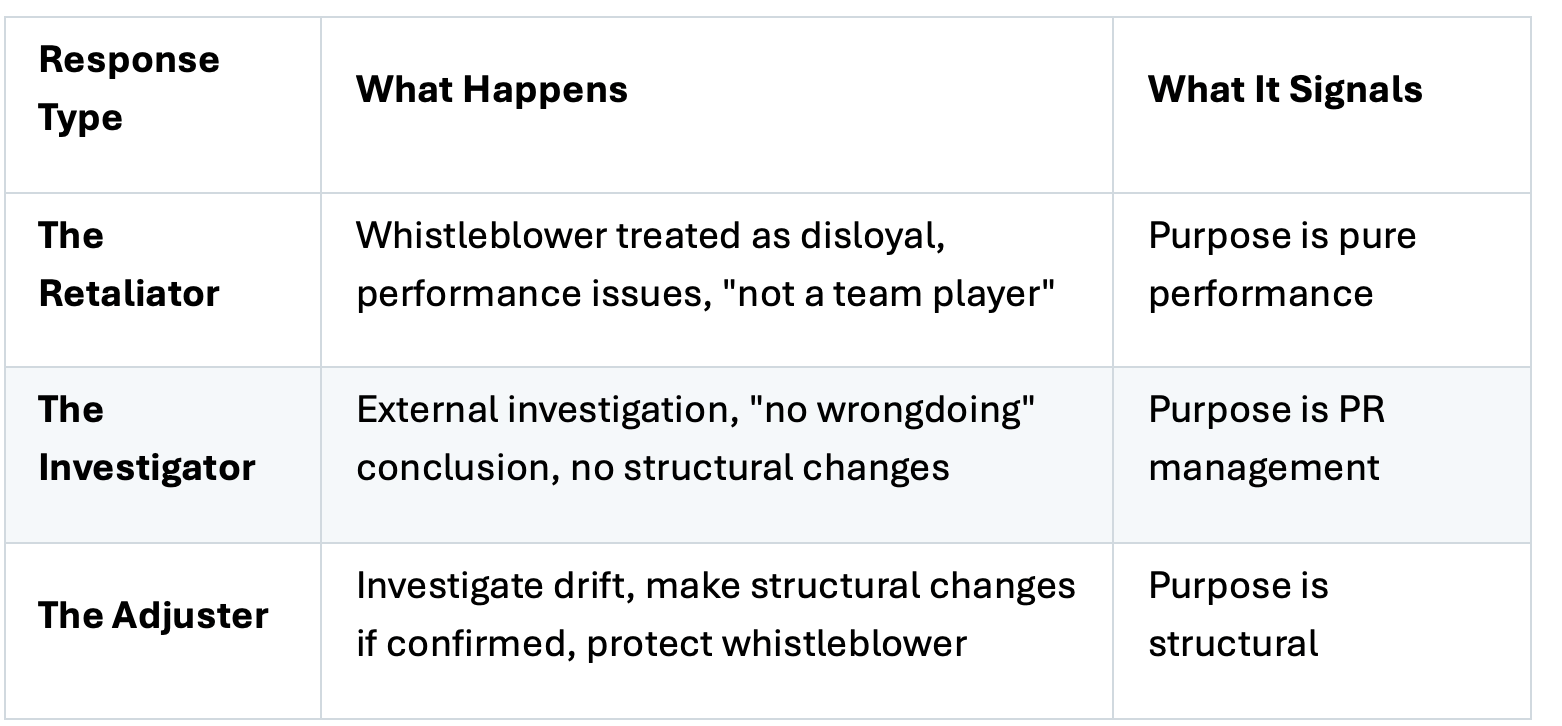
When people blow the whistle internally, do you investigate or retaliate?
Three response patterns:
Case Example: Google’s Project Maven
When ~4,000 Google employees protested AI development for the Defense Department drone targeting (2018), this was only possible because:
Google’s “Don’t be evil” was specific enough to create clear drift detection
Employees believed it was real enough to risk their careers defending it
The stated purpose actually constrained a profitable opportunity
Google’s response: Didn’t retaliate, didn’t renew the contract, published AI Principles, created governance structures. This confirmed their purpose had structural depth.
The diagnostic question:
“In the last 12 months, has anyone internally raised concerns that we were drifting from our stated purpose? What happened to them?”
No concerns raised: Purpose isn’t real enough to defend, or it’s perfectly aligned (unlikely)
Concerns raised, person marginalized: Purpose is performative
Concerns raised, organization adjusted: Purpose has structural depth
Test 3: The Steward Agent Test
If you deployed autonomous AI agents to optimize your operations, would your purpose constrain what they’re allowed to optimize for?
This is where purpose depth becomes technologically testable.
Steward Agents: AI Monitoring AI for Purpose Drift
As organizations deploy autonomous agents (customer service, data analysis, content generation, process automation), those agents optimize for defined metrics. But metrics drift from intent over time.
Steward Agents are AI systems that monitor autonomous agents to prevent drift from organizational purpose. They’re a meta-layer that:
Observes autonomous agent behavior in real-time
Detects when actions drift from purpose/values/constraints
Can pause, flag, or constrain agents before problems cascade
Essentially: “The agent that watches the agents.”
The three drift types Steward Agents detect:
1. Synthetic Drift (Automation Decay)
Gradual deviation between what your systems optimize for and what your purpose requires.
Example: Amazon warehouse algorithms optimized for “items picked per hour,” which created injury rates conflicting with “operational excellence.” The metric didn’t change—context did. The optimization became misaligned with the purpose.
2. Human Drift (Value Erosion)
Cultural misalignment occurs as the organization scales, bringing people who don’t embody original values.
Example: Boeing’s shift from engineering-led (pre-1997) to finance-led culture (post-McDonnell Douglas merger). Stated purpose didn’t change (”Build excellent aircraft”), but lived purpose became “Maximize shareholder returns through production efficiency.” Result: 737 MAX crisis.
3. Historical Drift (Institutional Amnesia)
Loss of memory about why certain structures exist. Leads to removing “Chesterton’s fence”—barriers whose purpose has been forgotten.
Example: Meta’s “Move fast and break things” worked for college social networks. It became dangerous for global political discourse. The shift to “Move fast with stable infrastructure” (2014) recognized historical drift—early identity no longer matched systemic impact.
Human Whistleblowers + AI Steward Agents = Complete Sensing
Human Whistleblowers:
Detect value/ethical drift that humans sense
Require psychological safety and cultural legitimacy
Work well for cultural and strategic drift
Steward Agents:
Detect technical/systematic drift at scale
Monitor autonomous systems 24/7
Work well for synthetic drift happening too fast for human oversight
Together:
Steward Agents catch technical drift in automated systems
Human Whistleblowers catch cultural drift in human decisions
Both report to governance for investigation and adjustment
This is a genuinely novel organizational infrastructure for maintaining purpose alignment as you scale both human and AI operations.
Implementation requirements:
For Steward Agents (Technical):
Luciana Ledesma’s research on AI governance architecture, as explained briefly above, provides the framework
Requires explicit purpose encoding (not just metrics)
Needs organizational commitment to pause operations when drift is detected
Must have human oversight of Steward Agent decisions (who watches the watchers?)
For Whistleblower Infrastructure (Cultural):
Explicit protection policies (”Raising purpose-drift concerns is valued, not punished”)
Anonymous reporting channels + protection for public whistleblowing
Board-level oversight of whistleblower concerns
Career protection for good-faith concerns
Recognition/rewards for early drift detection
In surfer terms, we are spotting this ripple, which may swell rapidly because organizations want to be in control.