
Stage 6: Better Outcomes
Catching Waves Others Miss


1. The Scoreboard
Here’s what separates good surfers from great ones: wave count.
On any given day at a quality break, everyone in the water sees roughly the same waves. But watch for an hour and you’ll notice something: some surfers catch three times as many good waves as others. They’re in position when sets arrive. They commit at the right moment. They ride waves successfully rather than wiping out. And while others are still sailing or paddling back out, they’re already positioned for the next one.
The difference isn’t luck. It’s the accumulated effect of better perception, better decisions, better execution, and better learning—compounding over time into measurably superior results.
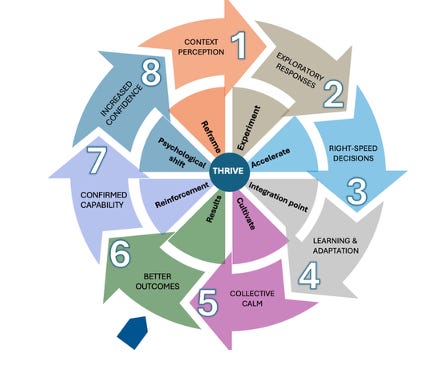
This is Stage 6 of the ARC: where all the previous stages—reframing uncertainty, right-speed decisions, integration, collective calm—translate into tangible outcomes. Not just feeling better about uncertainty. Actually performing better because of how you navigate it.
2. Catching Waves Competitors Miss
In 2016, Microsoft faced a strategic choice about AI. Most tech companies were focused on consumer applications—chatbots, virtual assistants, recommendation engines. The obvious wave everyone was paddling for.
Microsoft saw a different pattern. Under Satya Nadella’s leadership, they’d developed the organizational capacity to read technological terrain differently. They noticed that while consumer AI was crowded, enterprise AI infrastructure was wide open. Cloud computing plus AI could transform how businesses operate—but someone needed to build the platform.
They positioned for a wave most competitors didn’t see coming.
The result: Azure AI services became the foundation for thousands of enterprise AI applications. When ChatGPT exploded in late 2022, Microsoft was already positioned—they’d invested in OpenAI years earlier, integrated GPT models into their products, and built the infrastructure to scale rapidly.
Fast forward to 2025, and a new ripple is emerging—rapidly growing from barely visible to unmissable.
AI coordination platforms: steward agents overseeing specialized agents’ work.
Think of an octopus. Each arm operates with remarkable autonomy—sensing, grasping, and problem-solving independently. Yet the octopus’s central brain coordinates these autonomous arms into coherent action. Without that coordination, you’d have eight arms working at cross-purposes.
This is the challenge emerging with AI agents. As organizations deploy specialized agents—one for customer service, another for data analysis, another for content creation, another for supply chain optimization—they face a paradox: the very autonomy that makes agents powerful creates fragmentation risk.
Each agent optimizes for its narrow focus. The customer service agent promises delivery dates that the supply chain agent can’t meet. The content creation agent produces messaging that the brand strategy agent would reject. The data analysis agent surfaces insights that the decision-making agent can’t integrate. Autonomous arms thrashing independently.
And this fragmentation will accelerate. As agent capabilities expand and deployment becomes easier, organizations will spin up dozens, then hundreds of specialized agents. Without coordination, the result isn’t enhanced capability—it’s chaos.
Organizations with the pattern recognition capability built through the ARC are seeing this wave early. They recognize it because they’ve seen this movie before—not with AI agents specifically, but with the fundamental pattern.
Platform strategist Sangeet Paul Choudary calls this the “bundling-unbundling-rebundling” cycle in his work Reshuffle (Choudary, 2025). Technologies enable unbundling (breaking apart integrated systems into specialized components), which creates value through specialization but eventually creates coordination costs that demand rebundling (reintegrating components under new coordination mechanisms).
We saw this with:
Microservices architecture: Unbundling monolithic applications into specialized services created agility but demanded new coordination platforms (Kubernetes, service meshes)
Cloud computing: Unbundling IT infrastructure into specialized services (compute, storage, networking) required coordination layers (orchestration platforms, management consoles)
SaaS proliferation: Unbundling enterprise software into specialized tools created “SaaS sprawl”, demanding integration platforms (Zapier, Workato, enterprise iPaaS)
Now we’re seeing it with AI agents: Unbundling AI capability into specialized agents creates power through autonomy but demands coordination platforms to prevent fragmentation.
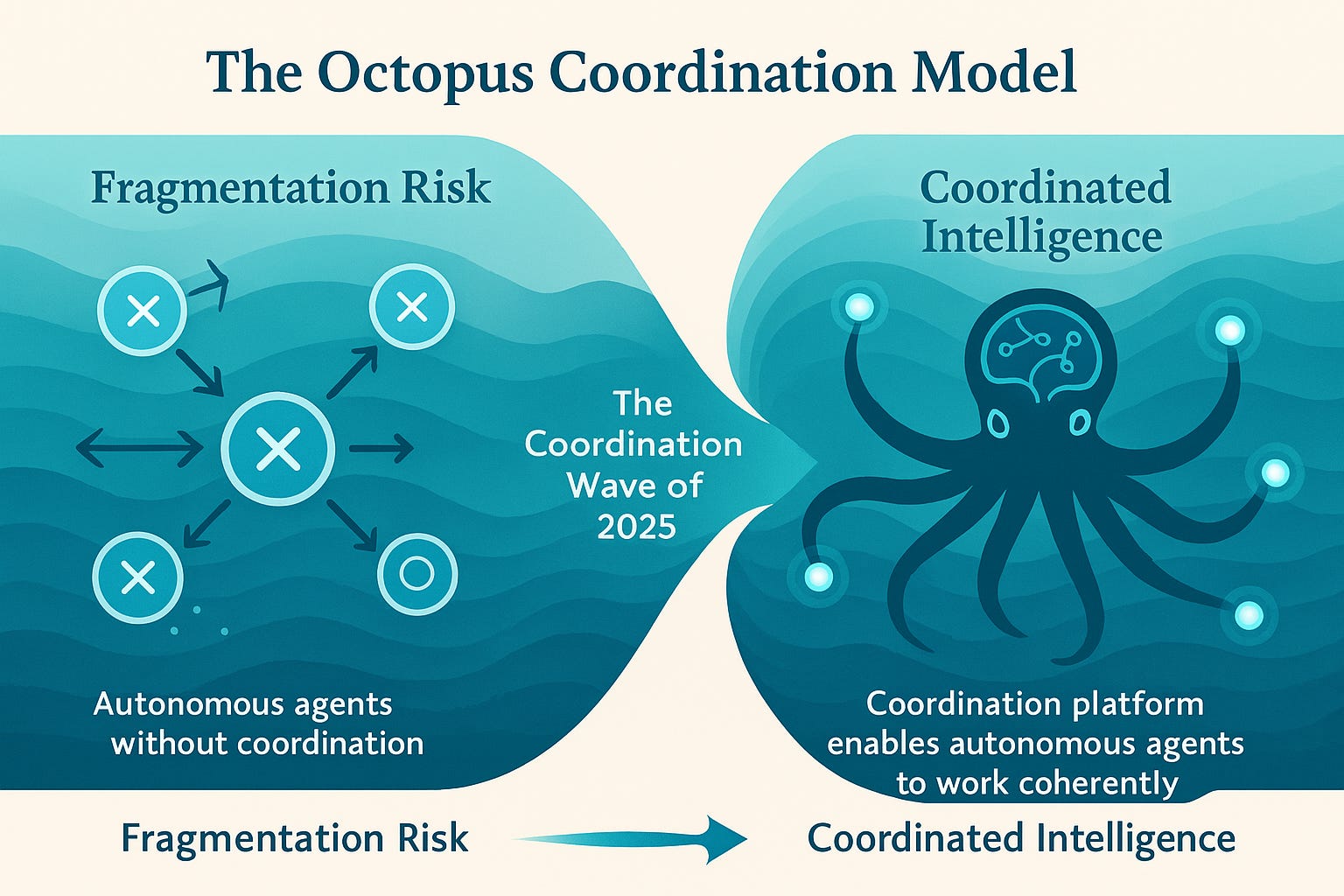
‘The octopus solution’ (generated with DALL-E)
This is what better outcomes look like: catching technology waves others miss. Not through prediction—through superior pattern recognition, faster experimentation, and organizational capacity to commit when the right wave appears.
The manifestations are specific:
Earlier adoption of valuable technologies: Not bleeding-edge adoption of everything (that’s expensive and distracting), but earlier recognition of which emerging technologies align with your strategic terrain. You’re experimenting with AI applications while competitors are still debating whether AI matters.
Faster scaling of successful experiments: When experiments show promise, you can scale them rapidly because you’ve built the organizational capacity—technical infrastructure, process flexibility, leadership alignment—to move quickly. Competitors are still writing business cases while you’re already in the market.
More effective pivots when needed: When experiments reveal that the wave isn’t what you thought, you can adjust course without organizational trauma. The sunk cost fallacy doesn’t paralyze you because you’ve normalized experimentation and adaptation.
3. The Widening Gap
Here’s where it gets interesting: the performance gap compounds over time.
Organizations that master the ARC don’t just perform slightly better. They pull progressively further ahead because advantages accumulate and multiply:
Faster time-to-market for innovations: Each cycle through the framework builds capability, making the next cycle faster. Your first AI implementation might take 18 months. Your fifth takes six months. Your tenth takes six weeks. Competitors still on their first implementation can’t catch up by working harder—they’re missing the accumulated learning.
Higher success rate on strategic initiatives: As pattern recognition improves and decision-making accelerates, you waste less effort on initiatives that won’t work and invest more in ones that will. Your success rate climbs from 30% to 50% to 70%. Competitors stuck at 30% can’t match your output even with equivalent resources.
Better talent attraction and retention: People want to work where they can navigate uncertainty effectively rather than being paralyzed by it. Organizations with collective calm and psychological safety become talent magnets. Your recruiting advantage compounds as reputation spreads.
Superior customer outcomes: Faster innovation cycles and better adaptation mean you’re solving customer problems competitors haven’t recognized yet. Customer loyalty increases. Switching costs rise. Market position strengthens.
The surf parallel: the surfer who catches more waves gets more practice, which improves their wave selection, which means they catch even more good waves, which builds more capability... The gap between them and the struggling surfer widens exponentially, not linearly.
Research on technology adoption confirms this pattern. MIT economists Erik Brynjolfsson and colleagues studied firms implementing AI and found that those who invested in complementary organizational capabilities—exactly what the ARC builds—saw productivity gains 3-5x higher than firms that just deployed the technology. The gap widened over time as learning compounded.
4. Organizational Resilience: The Compounding Advantage
But here’s the most valuable outcome: each wave navigated successfully builds capacity for the next.
In 2020, when COVID-19 hit, organizations diverged dramatically in their responses. Some froze, paralyzed by unprecedented uncertainty. Some thrashed, making reactive decisions that had to be reversed weeks later.
A smaller group navigated the disruption with remarkable composure. They’d built the organizational capacity to handle uncertainty—not because they’d prepared for a pandemic specifically, but because they’d developed meta-capabilities for navigating any major disruption.
Companies like Shopify, which had already built distributed decision-making and rapid experimentation into their culture, pivoted to support suddenly-digital merchants within weeks. Traditional retailers that lacked this capacity took months or failed entirely.
The capability to navigate one type of uncertainty transfers to navigating other types.
This is organizational resilience: not just bouncing back from disruption, but bouncing forward —emerging stronger because each challenge builds capacity for the next.
Think of it like a surfer’s progression. Your first big wave is terrifying. Your tenth is challenging but manageable. Your hundredth is exhilarating. Not because waves got smaller, but because your capacity expanded. Each wave successfully navigated builds confidence, skill, and judgment for the next.
Organizations that master the ARC develop this compounding resilience:
Reduced vulnerability to single-point failures: When decision-making is distributed and experimentation is normalized, no single wrong decision or failed initiative threatens the whole organization. You’ve built redundancy and optionality into your operating model.
Adaptive capacity becomes a competitive moat: Competitors can copy your products, pricing, and marketing. They can’t easily copy your organizational capacity to navigate uncertainty. This becomes your most defensible advantage—especially as technological change accelerates.
Confidence in capability: Perhaps most valuable, the organization develops genuine confidence (not false bravado) in its ability to handle whatever emerges. This confidence enables taking intelligent risks that create asymmetric opportunities.
5. The Measurable Evidence
Better outcomes aren’t abstract. They show up in metrics:
Revenue growth from new initiatives: Track what percentage of revenue comes from products/services that didn’t exist three years ago. Organizations mastering the cycle see this number climb steadily—20%, 30%, 40%—while competitors’ revenue remains concentrated in legacy offerings.
Market share gains in emerging segments: You’re not just defending existing markets; you’re winning in new ones. When AI-powered customer service becomes a category, you’re already a leader. When edge computing creates opportunities, you’re positioned.
Employee engagement and retention: Surveys show higher engagement. Turnover drops, especially among high performers. Exit interviews reveal people leaving competitors to join you, citing your ability to navigate change effectively.
Customer satisfaction and loyalty: Net Promoter Scores rise. Customer lifetime value increases. Churn decreases. Customers explicitly cite your responsiveness and innovation as reasons for loyalty.
Innovation pipeline health: You have a robust portfolio of experiments at various stages—some early exploration, some scaling, some being integrated. The pipeline stays full and flowing rather than feast-or-famine.
Speed of strategic execution: Time from “strategic decision” to “measurable impact” compresses. What used to take 18 months now takes 9. What took 9 months now takes 4. Velocity becomes visible.
6. The Confidence Feedback Loop
Here’s where Stage 6 connects to Stage 7: better outcomes provide evidence that the approach works.
When you successfully navigate uncertainty—catching waves competitors miss, adapting faster, building resilience—it confirms your organizational capability. This confirmation isn’t just psychological (though that matters). It’s empirical evidence that your approach to uncertainty works.
This evidence creates a powerful feedback loop
Success builds confidence → Confidence enables taking on greater uncertainty → Greater uncertainty navigated successfully builds more capability → More capability enables even better outcomes → Better outcomes build more confidence...
The surf parallel: after successfully riding increasingly challenging waves, you have earned confidence. Not recklessness—calibrated confidence based on demonstrated capability. This confidence lets you paddle out on bigger days, which builds more capability, which enables tackling even bigger challenges.
Organizations stuck in fear-based responses to uncertainty can’t access this feedback loop. They avoid uncertainty when possible, react defensively when forced to engage, and never build the capability that would let them thrive in it. The gap between them and organizations mastering the cycle widens with each technological wave.
The Visible Difference
Walk into an organization that’s mastered the ARC, and you feel it immediately. There’s energy but not frenzy. Focus, but not rigidity. Confidence but not arrogance. People talk about challenges openly without catastrophizing. Experiments are discussed matter-of-factly—some working, some not, all generating learning.
Compare this to organizations paralyzed by uncertainty: meetings filled with anxiety, decisions endlessly deferred, blame when things go wrong, silence about problems until they’re catastrophic, talent fleeing, customers frustrated by slow response to their evolving needs.
The performance gap is visible before you see any metrics.
But the metrics confirm what you sense: better outcomes across every dimension that matters. Not perfect outcomes—uncertainty guarantees some initiatives will fail. But consistently better results from navigating uncertainty effectively rather than being paralyzed by it.
Positioning for the Next Set
The best part about better outcomes: they position you for the next wave.
In surfing, successfully riding a wave puts you in a good position for the next one. You’re already outside, already moving, already reading the water. While others are still recovering from wipeouts or sailing back out, you’re positioned to catch the next good wave.
Organizations that achieve better outcomes through the ARC gain the same advantage. Success with AI positions you for quantum computing. Success with digital transformation positions you for whatever emerges next. Each wave successfully navigated builds capability that transfers to the next challenge.
This is the essence of tech-surfing: using each wave of technological change to position for the next, building compounding capability over time.
The outcomes aren’t just about this quarter’s results or this year’s innovations. They’re about building an organizational capacity that becomes more valuable as change accelerates—because while others are overwhelmed by increasing uncertainty, you’re getting better at navigating it.
The wave is always building. The question is: are you catching them?
The Bridge You’re About to Cross
You’ve built the capability through six stages. You’ve produced better outcomes that provide evidence that the approach works.
Now you’re standing at the threshold of Stage 7: where that evidence becomes confirmed capability, where success reinforces the cycle, and where your organizational identity transforms from “trying to be adaptive” to “being adaptive.”
This is where the ARC becomes self-sustaining. Where the capability you’ve built becomes the foundation for navigating whatever emerges next. Where uncertainty stops being something you survive and becomes the medium in which you thrive.
The next wave is building on the horizon. But now you’re not wondering if you can catch it.
You’re choosing which one to ride.