
Tech-Surfing
Surfing the Storms: The Art of Riding Technology Waves in Business and Life

Introduction
We are living through an era of overlapping technology waves—multiple “AlphaFold” moments[1] unfolding at once. Artificial intelligence, biotechnology, robotics, autonomous systems, the Internet of Things, augmented reality, and advanced manufacturing are converging and compounding their effects. Each technology wave creates new possibilities, but also new perturbations: deviations from what we consider normal, with ripples that disturb economies, institutions, and daily life. Learning to read these ripples and waves—and to ride them with intent—is the central task of our time. If you discover the principles of waves and, with that, minimize the mysteries of them, you will make better decisions, as opposed to seeing each of them as a threat. It is a system we are dealing with, and that system can be understood. And yes, there are exceptional waves that may overwhelm you in the first instance, but that is where the real fun happens: to figure out how these can be mastered. The good news is that they have different principles that can be learned, too. However, there are two sides to a coin, meaning: without suffering, no surfing. A few dips in the surf are hardly avoidable.
That is the promise of tech-surfing: mastering our ability to read the technology waves, anticipate, act, and, eventually, survive. I love teaching and allow me to teach you the subtleties of riding tech-waves.
The early adopter
I chose windsurfing as an apt metaphor. When windsurfing was gaining popularity, about 50 years ago, I was compelled to jump aboard.
Birth, infancy, and ripples of AI developments coincided with the ripples I was sailing on my first board, hardly recognizable
The first waves hitting the board felt large and awkward, and it took ages to tack or jibe, which is why we nicknamed the first generation of these large boards ‘floating doors’. A significant advantage, however, was that you could stand on them and pull the sail out when it slipped out of your hands for the millionth time. But it was fun, on those ripples of water on the nearby lake, which is like the manageable technology ripples of the nearly forgotten past.
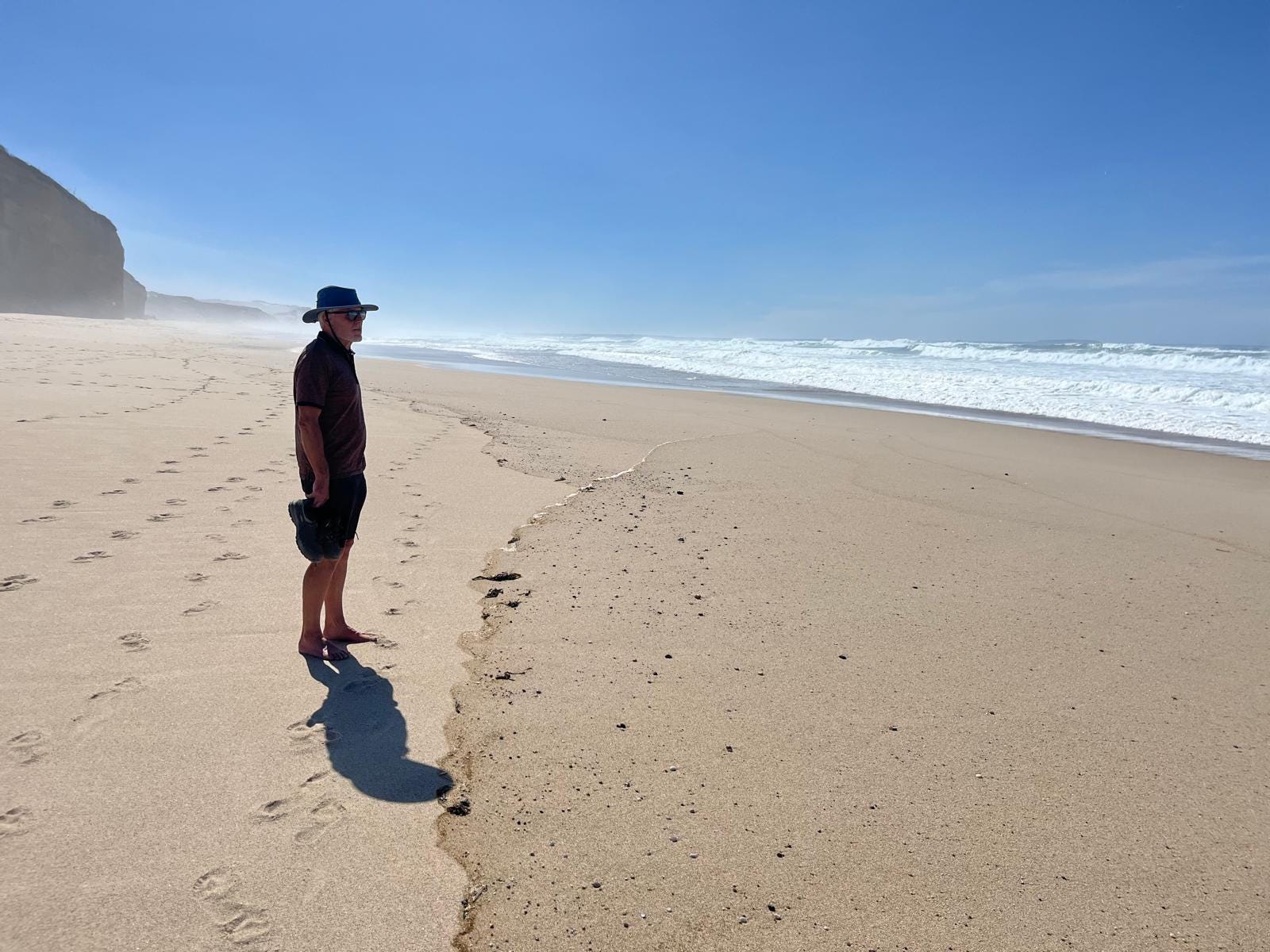
A stone's throw away from where I lived at that time, waves were pounding on the beach. Thus, the ability to broaden my experiences lay around the corner. So, from that moment on, my playfield shifted from ripples to waves. Getting my gear there was a little problem to solve. On a special cart pieced together by my father, I loaded the equipment behind my bicycle and shipped it to the beach. Along the ride, it attracted the attention of quite a few people, and I would not have been out of place in a carnival parade. But I was loaded with the courage to conquer these ‘massive’ waves, at least for my ‘door’.
Getting on and standing on that beast, in waves of about one to two meters tall, was close to impossible. My first attempt was nearly two hours of fighting against and being washed by the waves. In addition to the ride with the cart, I became a beach attraction to the point that the surf guard decided to pick me up once I was about 500 meters out from the beach and had drifted about one kilometer down by the waning tide. All beginnings are harsh, I told myself. However, my skills improved with various iterations of more sophisticated equipment, coaching, and numerous dips! The development of sails and boards was staggering. Because my salary was on a different path, the cycle of renewals was a bit slower.
Riding the waves and the thrill
What kept me going was the memory of the first time I conquered a wave. As a quick learner, the number of waves I conquered began to grow exponentially, in line with my enthusiasm and mounting adrenaline. The smaller my newer boards were, the higher the waves I could beat, the greater the thrill of the jumps, and the better I could position the sail with confidence.
On top of the waves, the view was stunning, and the anticipation of riding the next wave became second nature—all because I learned how to read the water.
Surfers do not control the ocean. They cultivate awareness, timing, balance, and judgment. They respect the power of the swell, anticipate cross‑currents, and choose which waves to ride and which to let pass. It's a process that can be repeated perpetually without going anywhere other than the surf. Escaping the surf occasionally opened new horizons. The waves behind the surf had a different shape and were easier to handle. More importantly, I witnessed the birth of the surf, and with that, a level higher in mastering the white, swirling mass in front of me. Ultimately, that was the area where they released their power. The oversight of all that, behind the surf, revealed their pattern, their principles! I not only saw the change but lived it, a feeling of oneness! Both dancing worlds were endlessly connected, allowing me to choose whatever direction while my confidence accumulated. The road to get there had some pegs: suffering + reflecting + applying = growth. There is no end to that cycle.
Likewise, advancing technology is not a destiny; it’s a process. People can lead and change by choosing the direction. Mindset shift precedes method. Without adopting a different way of seeing and deciding, more technology often accelerates old patterns—sometimes the very ones we are seeking to leave behind.
Navigating the change
To navigate the change, we need a shared language. Change is a process: replacing something with something newer or better within the bounds of an existing system. Transformation is the result of a marked change in form or nature, which then becomes the new starting point from which to launch the next cycle. Adaptation is nature’s ongoing response to external forces; our survival depends on it. Confusing these dynamics leads to poor choices. We often use the term “exponential transformation,” yet exponentiality is not a destination; it is a process. We will not “arrive” at an exponential state or become exponential. Further down the metaphorical road, Kurzweil discusses a dramatic change he has dubbed ‘the Singularity’, stating that “The Singularity will allow us to transcend these limitations of our biological bodies and brains ... There will be no distinction, post-Singularity, between human and machine."[2] How will this process be initiated? Well, he predicts the singularity will arrive around 2045. A dramatic change in which biological and artificial intelligence converge.
Given its potential significant impact, this needs to be fleshed out from the perspective of a tech-surfer.
Some simple questions that we will explore later on in the series articles are:
- Will there still be tech waves that can be tech surfed by a human being?
- What can we do to build the capacity to adapt to this new set of conditions at the pace reality now demands, and can we manage that?
- At that point, have we not passed the ‘haven’ of a right or wrong mindset?
- Why are we trying to mimic or copy human cognitive functions to systems that are way more capable of doing that?
- Can embedded technology in biological systems transform simultaneously?
Puzzle and Mystery
Another helpful distinction is between puzzles and mysteries. Puzzles present data within clear boundaries in a way that can be solved. Mysteries require making sense of data amid vast, noisy, often contradictory information. The explosion of data has turned many puzzles into mysteries. As the number of options multiplies, a clear solution does not automatically follow. We must develop the discipline to frame problems, filter signals from noise, and make decisions when certainty is not available. Even as an experienced tech-surfer, you are often confronted with waves that have unexpected forms, ridges that are at the ‘wrong’ side. I call these phenomena ‘mysteries’. The number of influences on a wave in those few seconds requires a new ballgame where you set the rules in that small window of time. On the other hand, the puzzle can be solved when the boundaries and ripples on the inside of the ridge are clear, and usually requires a little more pressure on one side of the board or a slight adjustment in the sail's position. That’s it. But we are living in very, very many mysterious waves.
Shocks and misalignment
The experience of the last few years has demonstrated how external shocks reveal “rejection systems” within organizations and societies. Episodes such as the rapid digitization of multiple facets of life as occurred at the start of the pandemic, rising sense of autocracy, the polarity of inflation and interest‑rate, and political uprisings revealed latent fragilities and unexamined assumptions. They also revealed interdependent tensions (efficiency vs. resilience, growth vs. equality, speed vs. deliberation) that must be navigated rather than “solved.” Detecting and working with polarities is a core tech-surfing skill. In fact, the rise of fast-growing organizations is now a decisive factor in widening economic polarities, accelerating our addiction to GDP growth while masking the costs that growth displaces.
After the initial shock of COVID‑19, much of the world rushed to restore “business as usual”—commutes, flights, production volumes, and quarterly targets—faster and bigger than before. This reflex illustrates what I call the Great Detachment: a growing disconnection between our actions and their consequences for people and planet. We celebrate faster networks, smarter devices, and frictionless services, while overlooking the material realities beneath the digital sheen such as the extraction of raw materials, planned obsolescence built into product cycles, and waste streams that outpace our capacity to recover and reuse. Convergence accelerates innovation, but the outputs are not “walking bits and bytes.” They are products, plastics, energy, and labor—costs borne unevenly across the world. One of the qualities of a tech-surfer is to expose this. Technologies always cause and drag consequences at the same time. A dilemma that can only be ridden with an independent view of both worlds.
Demonetization and democratization
The rhetoric of demonetization and democratization promises abundance, yet access remains uneven. Infrastructure without affordable devices, banking access, or digital literacy does not close divides; it can widen them. Those who live on a few dollars a day are told that opportunities are “around the corner,” but the corners keep moving. Meanwhile, environmental signals remind us that externalities are real and pervasive. Take rainwater—once a symbol of nature’s purity—is rarely clean anymore. Or, consider the shift in the use of oil, from fueling transportation to plastic production, given evidence that our brains are contaminated with microplastics[3], among other factors. In short, not all progress is evenly distributed, and not all technology-driven “better” is better for everyone or everything. Someone pays the bills.
These outcomes are not inevitable; they are choices. Our global institutions and policy frameworks often prioritize growth above all, reinforcing power imbalances and normalizing inequality. We continue to measure success by what we produce and consume, then act surprised when the system delivers precisely what it was designed to maximize. As long as growth is the unquestioned altar, technology will tend to amplify existing incentives, including those that marginalize the vulnerable, and float with the pilgrimages to support the belief in the holy GDP. That is why a mindset shift is not optional; it is foundational, tech-surfing as a savior.
Tech-Surfer
What, then, does it mean to be a successful tech-surfer?
- First, cultivate discernment. Not every wave is yours to ride. Choose based on purpose, values, and fundamental human needs—not on hype, fear of missing out, or advertising that equates novelty with progress.
- Second, strengthen your adaptive capacity. Build systems—personal, organizational, societal—that learn, iterate, and recover. Treat perturbations as information, not as failures to be hidden.
- Third, master the art of navigating polarities. Many tensions are permanent and dynamic. The goal is not to pick a side, but to balance and rebalance deliberately as conditions change.
- Fourth, honor material reality. Design with full life‑cycles in mind: sourcing, energy, durability, repairability, reuse, and end‑of‑life. Digital solutions live in physical ecosystems.
- Fifth, develop sense-making skills for a world of mysteries. Frame problems well, scan widely, and decide under uncertainty with humility and courage.
- Sixth, working through the exercises and applying where needed, but not without reflection.
As Peter Drucker noted, the most important development of our age may be that unprecedented numbers of people now have choices—and therefore must manage themselves and that for which they want to be remembered[4].
Cresting the waves is, at its core, about stewardship, attention, choices, and consequences.
The scaffolds
This series of articles is an invitation to join me on the journey of riding technology waves and a guide to master them. It offers a way to recognize technology waves early, read their signals, and respond with intention. It distinguishes change from transformation and shows how to design for adaptation rather than chase illusory endpoints. It provides tools to detect polarities and work with them. It addresses the human side of technology—mental models, ethics, literacy—without which our systems will continue to recreate yesterday’s problems faster. Exercises will help you build your skills.
The aim is not to slow the waves or to romanticize a return to simpler times. The aim is to ride with skill: to create value that matters, to reduce harm, and to expand genuine opportunities. Not in the sense of the occurrence of opportunities during a crisis, since technology has created many crises that have not been solved by technology; it propelled us to the next crisis, faster!
Instead, if we do this well and without fear, technology remains a means, not a master. We become participants, not passengers—surfers, not beachcombers.
Let’s ride some waves and generate excitement with some of the DNA of a (tech)surfer!
What to expect?
The insights in this book emerge from countless conversations, observations, and experiences—always viewed through the lens of a tech-surfer who questions conventional wisdom. The windsurfing metaphor proved remarkably robust, applying equally well whether you're riding solo, surfing as part of a team, or coaching others through the waves.
What follows are fourteen chapters that will equip you with the skills to navigate our technology-driven world with intention and wisdom. Each chapter builds your capacity for critical thinking, helping you distinguish between genuine breakthroughs and mere hype—those moments that make you pause and ask 'really?' versus those that inspire a genuine 'wow!'
The principles of wave-reading, balance, and adaptive response translate seamlessly from water to the digital realm. Just as every surfer must learn to read wind patterns, wave formations, and weather systems, every tech-surfer must develop the ability to recognize emerging patterns, assess risks and opportunities, and respond with skill rather than react with fear.
This is your invitation to step onto the board. The waves are building, the conditions are changing, and the time for passive observation has passed. Let's explore what it truly means to surf the technological storms of our time.
[1] I got bored with the ‘Gutenburg-moment’ cliché
[2] R. Kurzweil, The Singularity Is Near, p. 9. Penguin Group, 2005
[3] Nihart, A.J., Garcia, M.A., El Hayek, E. et al. Bioaccumulation of microplastics in decedent human brains. Nat Med 31, 1114–1119 (2025). https://doi.org/10.1038/s41591-024-03453-1
[4] P. F. Drucker, Managing Oneself, Harverd Business Review, 2017