
Tech-Surfing Section 3 The Adaptive Response Cycle - Full Version - Introduction
Turning Fear into Flow

Each stage will be shared in a new post — Warning: the entire ARC is an essential but long read! But don’t worry, I’ll post each stage separately and include sufficient time in between to digest the material.
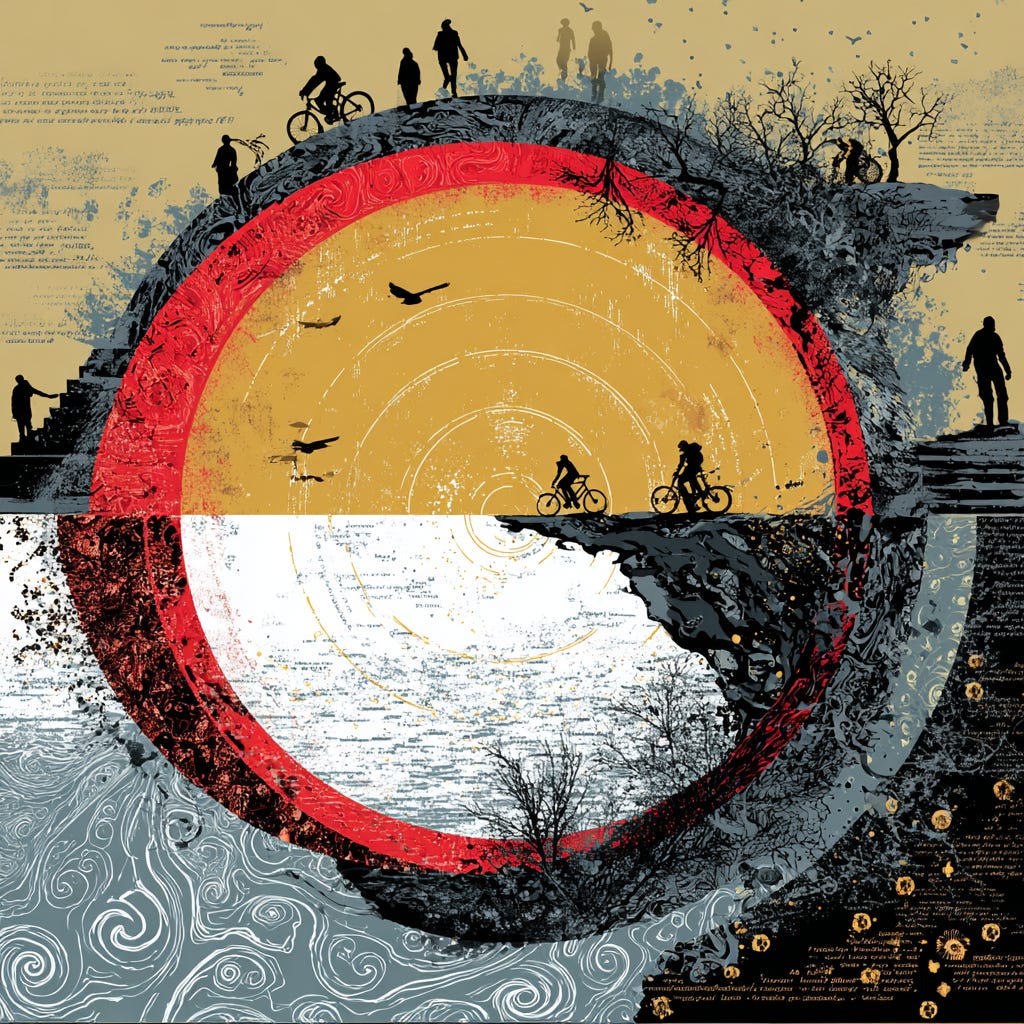
The Adaptive Response Cycle: Thrive or Suffer.
The choice is yours.
After the swimmer’s mistake and the fear-response cycle, the question becomes simple: If we can’t control the waves of technology, how do we ride them? The answer is an eight-stage rhythm — the Adaptive Response Cycle (ARC) — that turns paralysis into participation. Each stage is a movement from threat to flow, from reaction to response, from fear to confidence.
Introductory Note — The Roots of the Adaptive Response Cycle
The Adaptive Response Cycle (ARC) draws inspiration from Adaptive Response Theory (ART), a framework originally developed in the field of art therapy. ART explores how humans respond to perceived threats through creative, survival-oriented, and imaginative processes — turning anxiety into adaptation.
In art therapy, the act of creation becomes a way of regaining agency: the individual transforms fear into form, chaos into coherence. The framework examines the dynamic between maker, medium, and meaning — how a person, guided by a therapist, reshapes internal turbulence through tangible expression.
The same principle applies in technological and organizational life. When faced with disruptive change, teams and leaders must also ‘make art’ under pressure — crafting adaptive meaning through experimentation, reflection, and collective creativity.
Thus, the ARC can be seen as a leadership analog of ART:
• Where the artist responds to an existential threat through imagination and narrative,
• The adaptive organization responds to disruption through innovation and learning,
Both processes convert threat into transformation. Both rely on presence, play, and practice. And both reaffirm a core evolutionary truth: humans survive by creating.
I have chosen to provide a more detailed explanation of the Adaptive Response Cycle because it is important to understand that there is a powerful way to escape the fear response cycle, which many people seem unable to do.
What to expect?
ARC (the escape).
Escaping the fear cycle demands the adaptive loop: Begin with uncertainty as a signal, not a storm. Shift to context perception, reading the water—scanning patents, user trends, and ethical ripples to discern true threats from noise. Follow with exploratory responses, prototyping AI tools in safe pilots, much like testing a new sail in light winds. Make right-speed decisions, neither hasty nor hesitant, balancing tempo with conditions. Through learning and adaptation, failures become feedback, fostering collective calm—teams united in reflective pauses (Schön,1983). This yields better outcomes, confirming capability and building increased confidence, turning dread into mastery. Before we go into more depth on the fear-response cycle, I believe that it provides you with more context when we understand uncertainty from a few different angles.
Corporate Immune System
For years, I carried a doubt that felt almost heretical in the circles I moved through. As a chapter lead for Singularity University in several places, I was immersed in the gospel of exponential transformation. The doctrine was clear, repeated like a mantra at every gathering: corporate immune systems are the enemy. They’re the antibodies that attack innovation, the white blood cells that swarm around new ideas and kill them before they can take root. The solution? Bypass them. Overwhelm them. Move so fast they can’t react.
But something never sat right with me. Every time someone diagnosed a failed transformation with “the corporate immune system rejected it,” I felt a cognitive dissonance I couldn’t quite articulate. It wasn’t until much later, after watching countless transformation initiatives crash and burn despite—or perhaps because of—their attempts to suppress organizational resistance, that the obvious finally became clear.
Without an immune system, you’re dead.
Not struggling. Not slow. Not resistant to change. Dead.
This realization didn’t come from another framework or methodology. It came from sitting with the discomfort of that doubt, from watching what actually worked versus what the exponential evangelists promised would work, and from eventually discovering that the Adaptive Response Cycle offered something the tech-determinists had missed entirely: a way to make the immune system smarter, not weaker. That’s what we are about to discover in this section when we dive deep into the details of the ARC.
3.1 The Uncertainty We Face: Technology’s Uncharted Waters in Business and Personal Lives
In the vast ocean of technological evolution, uncertainty crashes like an unpredictable set of waves, testing both corporate boards and individual souls. Just as a windsurfer scans the horizon for hidden swells—those distant storms birthing chaos—we confront advanced technologies like AI, quantum computing, and biotechnology, which promise transformation but stir deep fears. These “technology waves” surge with ambiguity: Will they elevate humanity or erode our foundations? The fear-response cycle—freezing in panic, reacting defensively—often leaves us wiped out. Yet, embracing an ARC offers escape: from uncertainty to confidence, wave by wave.
The Business Uncertainty: When the Playbook Dissolves
Consider business landscapes first. Leaders grapple with AI’s exponential swell, where algorithms optimize supply chains but threaten jobs—McKinsey predicts 45 million U.S. roles disrupted by 2030 (Bughin et al., 2019). Uncertainty looms: How to integrate neural networks without ethical undertows, like biased hiring tools amplifying inequality? Or quantum computing, whispering of unbreakable encryption yet risking cyber vulnerabilities that could topple financial dikes. Organizations face the paradox of protection versus flow—rigid legacy systems defend against disruption but block innovation, fostering a culture of anxiety where teams hoard resources rather than explore.
The Personal Uncertainty: When Expertise Becomes Obsolete
Personal lives mirror this turbulence. Smart devices weave into our daily currents, offering convenience but eroding privacy; data swells harvested by platforms create “digital nicotine” addictions, as I term it, outsourcing identities to unseen servers (Tufekci, 2018). Biotechnology’s gene-editing waves, like CRISPR, promise health miracles but provoke fears of designer inequalities or unintended mutations. In intimate realms, uncertainty breeds isolation: social media’s algorithms amplify echo chambers, heightening mental health rips, with one in five adults reporting tech-induced anxiety (Cascio, 2020). What will longevity developments and trends do in the longer term? Will the children of my grandchildren, in 50 years from now, still be humans as we know them today, or eroded to cognitive super beings? Caught in the humanity paradox. Will that be a blessing or an endless struggle of identity?
The covered fear: We don’t know what we don’t know
In both boardrooms and bedrooms, the uncertainty cycle begins with not knowing, but survival cannot be built on anxious reaction alone. The leaders and individuals who escape the fear-response cycle are those who pause and read the water: perceiving the context, launching small-scale exploratory responses, and calibrating the right-speed decisions for the moment. They turn to adaptive learning, use missteps as pivots for better responses, and foster collective calm—an antidote to the chaos of 24/7 news and notification feeds. This practice does not dissolve uncertainty, but transforms it: each completed cycle enhances capability, strengthens confidence, and allows the next wave to be met not with bracing dread, but with a poise born of experience and reflection. If the coming decades are an age of accelerating tech-driven ambiguity, then the art of adaptive response—surfing uncertainty, not drowning in it—is the vital muscle to develop at every scale of human endeavor
The Convergence Uncertainty: When Waves Collide
We stand at a peculiar moment in human history. The technological waves crashing over us aren’t just bigger than before—they’re fundamentally different in character. Where previous generations faced singular disruptions—the printing press, the steam engine, electricity—we face a convergence of exponential forces arriving simultaneously: artificial intelligence that writes, reasons, and creates; quantum computing that threatens to unravel our encryption; biotechnology that edits the code of life itself; and climate technologies racing against planetary boundaries.
This isn’t your grandfather’s industrial revolution. It’s something stranger, faster, and far less predictable.
– Intermezzo -
Surfer principle: ‘The ocean will always be unpredictable—mastery means dancing with uncertainty, not eliminating it.’
Every experienced surfer knows a fundamental truth: you cannot control the ocean. You cannot make the waves smaller, the wind calmer, or the currents more predictable. The ocean operates according to forces vastly larger than any individual—atmospheric pressure systems, lunar gravitational pull, underwater topography, thermal dynamics. The novice fights this reality, exhausting themselves trying to impose order on chaos. The master accepts it, developing instead the capacity to read, respond, and flow with what cannot be controlled.
A personal story of neglecting basic principles
The days dragged on. For days on end, it felt like peeling back the foggy blankets of the landscape. On the way to school, I was constantly scared by my own mysterious, moving shadows in front of me, illuminated by the approaching cars behind me in the misty darkness. It was the ultimate sign that there was no wind in the weather forecasts for the early fall that year. Boring. But it would become memorable. After the slow days, the wind claimed its dominance back and blew my dusty mind clean. A storm was heading toward the coast. I started preparing by working hard to finish my tasks in advance. Who knew when I would be needed on my board?
That night, we woke up from flying branches hitting the windows. Adrenaline seeped into my body. I needed to do something at my work. That had priority, but only in my mind. When I was ready, I jumped on my bike and, despite headwind, I made the ride to the beach, to my surf cabin, in record time.
Squeezed my body into the neoprene suit and grabbed my equipment. In a split second, I decided not to wear my life vest because that limited my freedom of movement. Off to the narrow beach that seemingly gave up its fight against the waves. White mass, as far as my eyes reached. A few people were on the beach, as if they were watching a spectacular movie. No other surfers as far as I could see. The sail was tensioned, my knees were on the board to prevent it from flying, mast and sail were secured on the board.
Damn! The balance between excitement and fear held me back. After a long moment of inner dialogue, excitement triumphed. I found that small window of a perfect rip current that would pull me to the first waves that were not too high. Strategy worked! 1-O!
The further I got into the surf, the higher and less predictable they got. I looked back at the place I had launched myself from the beach. “Hmmm, that’s quick!”, I thought. Already made it about 500 meters. Then I saw something unusual. One of the ropes of my 3,2 m2 sail wasn’t properly secured.
Strategy two, airborned with the next jump. A nice one!
I decided to sail until I’m out of the rough surf and avoid jumps at all times! That ‘strategy jump’ was a bonus. The rope was still in the clamp! The route to the proximate destiny still had ways out. But I made it together with the dancing rope! The waves there were longer, and the valleys impressive. I turned the board quickly, jumped off, and repositioned the sail so that I could fix it. Strategy worked! 2-0!
I worked hard to get it done while ‘float-dancing’ on the waves. Focus was 100% on the rope. Done! 3-0!
The next period of whatever time became a life lesson. The deafening noise of the crest of a huge wave ushered in the experience like being in a washing machine on the spin cycle. Board and sail disappeared while the wave tucked me in and kissed me good night. It’s not night! I had to fight; flight was not an option because there were no clear direction indicators when you are tumbling! So, any direction was good, which only added to the confusion of the swirling experience. Therefore, fight. Welcome to the arena of waves. Within no time, even for a well-trained athlete at that time, I got exhausted. All the oxygen had been used.
Quietness, darkness… No concept of time…
Then all of a sudden, for some reason, I was floating in the hands of a wave. Light, noise, white foam.
Did I see that correctly?
My board was diving into the next valley of water about 50 meters in front of me. I had no power to swim, and could only float while gaining strength. It seemed to last forever. The strong current pushed me and the board, still in front of me, quickly away from my starting point. I felt power regaining in my body and started to benefit from the waves by steering with my arms. I came closer. One more wave and I’d be close to my savior. Then, after looking twice, I couldn’t believe my eyes!
The sail lay windward, meaning that the top of the sail pointed into the direction of the wind. In these conditions, that never happened! When I was at the board again, I only needed to lift the sail a little bit from the point until it caught the wind, then slide towards the board while lifting the sail a bit more. A technique that I trained endlessly and perfected. Within a second, I was standing again and chose the least resistant route to the beach. I made it, still alive!
BUT: 3-5! I lost!
What I realized at that moment was that I was damn lucky, that I overestimated my capabilities and majorly underestimated the power of water and wind. The start of peeling off my ego!
My learning points:
1. Before running to the equipment room and putting my neoprene suit on, walk on top of the dunes and observe
i. People, other surfers, current, rip currents, gusts
ii. If surfers are hanging out, talk and get some advice
2. In these conditions, check everything twice, and use another pair of eyes
3. Wear a life vest during those conditions
4. Never, ever go on the water all by yourself! Who’s your buddy? No buddy, no surfing. Period!
5. If there is a problem, don’t go further into no man’s land, but take the shortest route to safety!
6. When you have to detach yourself from the equipment, keep reading the water!
7. When caught by a wave, don’t fight; take a deep breath and stretch your body to gain floating mass.
8. The power of the ocean lies in the compounded forces, wind, gravity, earth rotation, and bottom structure. You can’t change that, but deal with it.
9. Get a sense of the current and choose a point on the horizon, and start to navigate there, using the current
10. Even if you don’t understand forces, be humble
11. Take time to evaluate when you are in a safe spot
12. Lastly, don’t go into the surf at all, and you’ll be avoiding all waves.
Leaders facing technological disruption face an identical reality. You cannot stop AI from advancing, prevent competitors from innovating, or freeze markets in their current state. The technological ocean operates according to forces beyond individual control—combinatorial innovation, network effects, global capital flows, and scientific breakthroughs. Yet the instinctive leadership response mirrors that of the novice surfer: treating uncertainty as a threat to be eliminated rather than as terrain to be navigated.
This fundamental misframing—uncertainty as enemy rather than environment—triggers the fear response cycle that drowns organizations. Breaking free requires a cognitive revolution: reframing your relationship with uncertainty itself.
The explanation of the eight stages will follow, one by one, in new posts.