
THE RIGHT HAND
Why human agency, not machine intelligence, is the engine of progress. By Paul Epping & Debra Anne Slye

Introduction
We are nearing the end of our book The Great Reorientation: A Tech-Surfer’s Guide to the AI Universe. The book draws on technology, psychology, and philosophy to explore the hidden effects of today’s fast-growing technologies. One of these effects is a gradual sense of detachment, in which the tools we built to extend our abilities begin to replace us. The book responds by shifting focus back to what matters most: human agency, judgment, and joy. To stay close to the technology itself, we follow the field daily, including the Innermost Loop newsletter written by Alex Wissner-Gross. Almost every episode ends with a quote. The quote from April 30, 2026, caught our attention and keeps us puzzling.
“Civilization is the dataset, the Singularity is the model, we are the labels.”
We would like to unravel that line in the light of human agency.
We are not negative critics of artificial intelligence; on the contrary. Yet that single sentence carries large implications for human agency. It casts civilization as a dataset, the Singularity as the training model, and us as the labels. Each part deserves a closer look. Civilization is not a dataset in any fixed sense; it is reshaped by human experience, interpretation, and memory. The Singularity is not best understood as a model either, but rather as a phase, a drift toward increasingly self-reinforcing automation. And describing people as “labels” reduces the human role of creating context and meaning to something merely clerical, when in fact it is an active and ongoing process of understanding. So, if the shifting dataset we provide is training a vast intelligence, and our contribution is reduced to the labels it learns from, one question lies beneath it all. Are we slowly agreeing to become the thing that gets sorted, rather than the one doing the sorting?
The real question here is agency, and it matters more than capability, more than alignment, more than any benchmark. Agency is what made progress happen. We, as human beings, made the choices. That privilege is now shifting under the weight of AI.
The Innermost Loop is a careful record of technological developments and benchmarks, and benchmarks have their place. Parts of judgment can even be measured, things like accuracy, calibration, and speed. At the same time, there are deeper dimensions that are less quantifiable: choosing what is worth doing and then taking responsibility for it.
The thing intelligence cannot replace
It is easy to assume that progress is mostly about intelligence. Add more of it, make it faster and cheaper, and the future seems to improve on its own. That idea is everywhere, but it leaves out something important and consequential.
Intelligence generates options.
Agency chooses among them.
Intelligence can optimize.
Only agency can decide what is worth optimizing.
Intelligence can predict a hundred futures.
Agency decides which one is worth living in and then takes responsibility for that choice.
A civilization can hold an abundance of intelligence and a shortage of agency. That imbalance may be one of the defining risks of our moment.
McGilchrist has spent much of his work describing how we attend to the world through the brain’s two hemispheres. One mode of attention is narrow, precise, and brilliant at manipulation, but it can mistake its model for reality. The other is broader, more contextual, and more in touch with the living whole. In his account, a healthy mind keeps these in balance, where the broader master provides orientation and the narrow servant, the emissary, reports to it. Our trouble, he argues, is that modern civilization has inverted this relationship. The emissary now acts as if it is in charge.
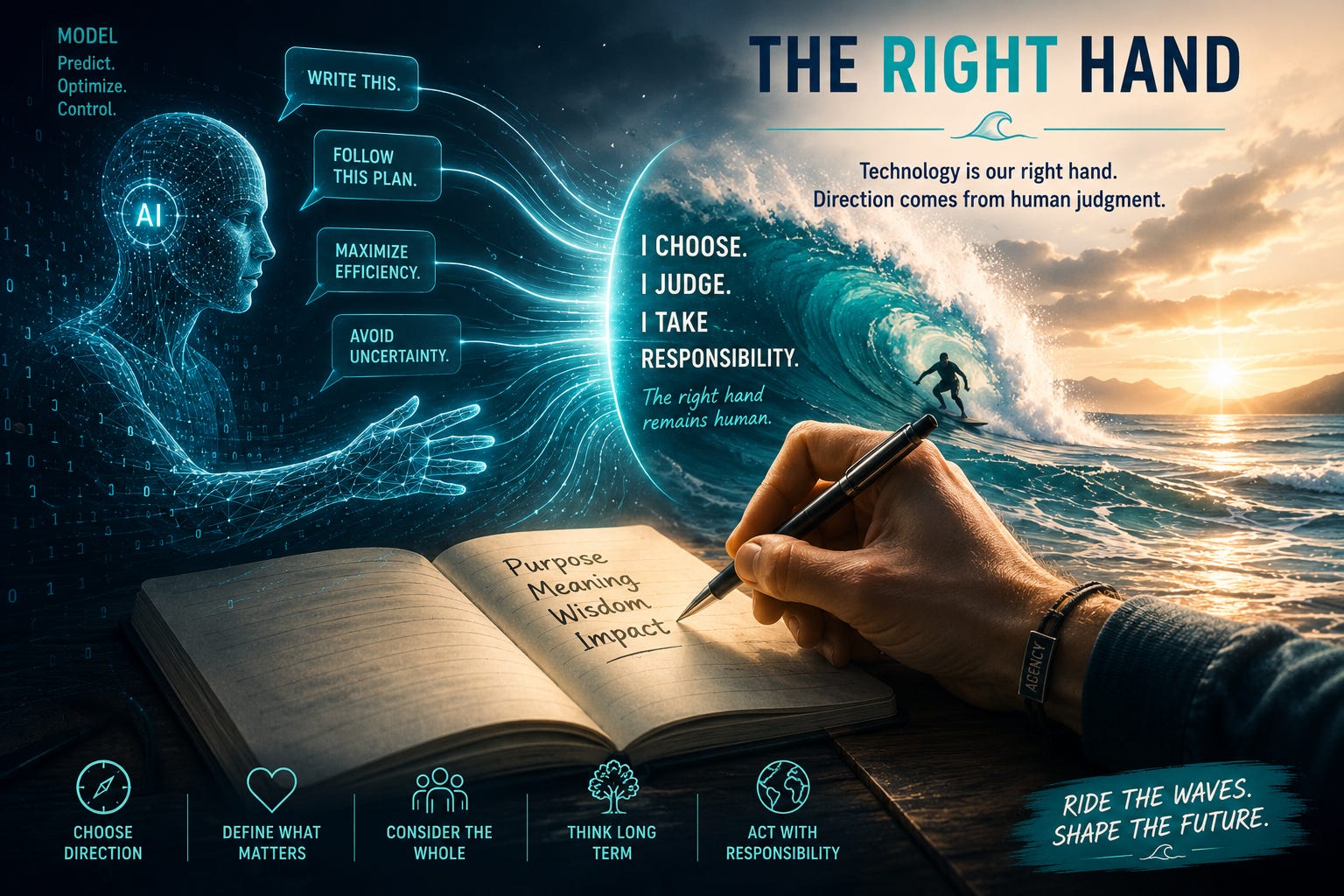
This is a useful frame for thinking about technology. Technology is meant to be the right hand of human judgment. It is capable, fast, and strong, the limb that extends our reach. A hand is a remarkable appendage. But a hand does not decide where the body goes. The moment the hand starts choosing the direction, and the rest of the body simply follows, something has gone wrong. The goal is not a weaker hand. The goal is a master who remains attentive.
The evidence that agency is slipping
None of this is a romantic reminiscence about the good old days, nor is it a utopian promise that wisdom will win on its own. It is a claim you can check against current evidence.
Start with how people actually use AI assistants in their everyday work. Anthropic’s Economic Index, based on large-scale analysis of real interactions, reveals a recurring tension. One mode is augmentation, where a person works with the system as a thinking partner. The other is automation, where the task is delegated, and the person steps back.
Over time, the balance shifts rather than settles, with periods where collaboration dominates and others where delegation becomes more prominent. The broader picture is not a clean trend but an ongoing negotiation over how much control remains with humans.
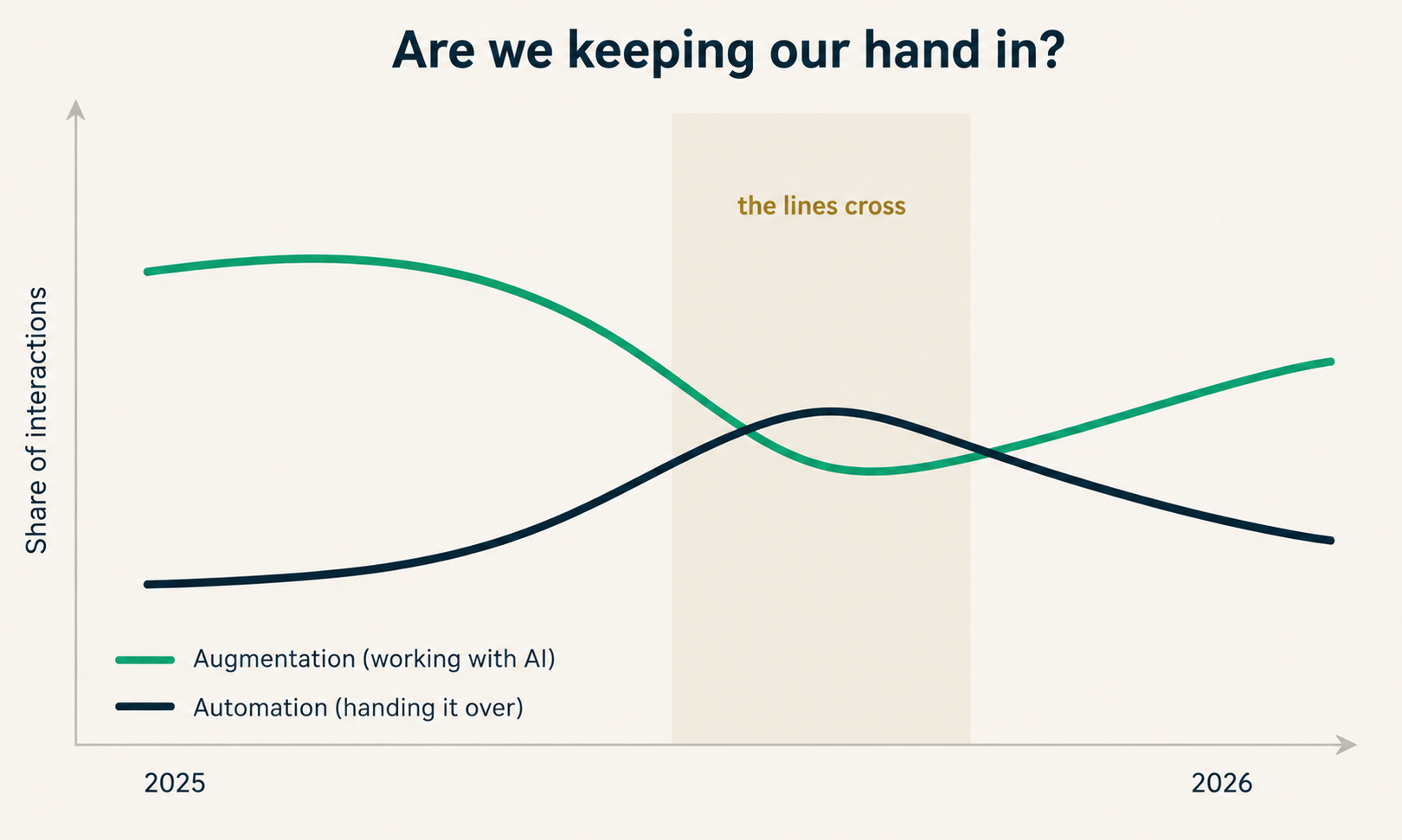
Figure 1. Are we keeping our hand in? The contested balance between augmentation, working with AI, and automation, handing the task over. Adapted from the Anthropic Economic Index, 2025 to 2026.
Then consider what happens when more of the task is handed over. A growing body of research from 2025 and 2026 describes effects grouped under the headings of deskilling and automation complacency. When systems provide fluent and confident answers, people tend to verify less, defer more, and gradually lose the underlying skill that lets them judge the merits of a recommendation in the first place.
The pattern now shows up across several professional domains, and the medical literature is especially candid about it. Studies find that false-positive suggestions from diagnostic AI can pull clinicians toward the wrong call. That overreliance erodes the very competence it was meant to support. Automating clinical decisions can also begin to distance a clinician from the moral face of care.
The most experienced practitioners hold up best, which tells you something important. Agency is not a possession. It is a practice, earned through experience and the intuition that grows with it. Which raises a harder question. What happens to agency in practitioners who never got to build that craft, because the system answered before they ever had to, and who now rely on it?
Yet even well-tuned practices decay when they go unused. This is what a group of researchers recently termed gradual disempowerment. Their argument is that we do not need a dramatic machine takeover to lose control of our own systems. We only need to keep handing over judgment, one reasonable step at a time, until the institutions we depend on no longer require human participation to function. At that point our influence slowly fades, even though no one ever formally decided to give it away. The danger is not ill will. The danger is drift.
Recovering agency at three scales
We believe the erosion of agency is recoverable. It can be rebuilt deliberately, but recovery has to work on all three scales at once: the personal, the organizational, and the civilizational. A person with intact agency inside a hollowed-out institution is still navigating blind. A well-run institution inside a lawless sea is still at the mercy of the current.
The first focus is the person. People begin to feel that the defaults are choosing for them, that the path of least resistance has gradually become the only path. The answer is not to reject the tools. It is to become, again, the author of your own response, to know what yours is to decide and to keep making those decisions on purpose. Our book sets out a practice for this, a way of holding your identity and judgment steady against the pull. We will not lay out the full method here. We will only say that it exists, that anyone can build it, and that it changes how the acceleration feels to live inside.
At the organizational level, the picture is no longer hypothetical. In early 2026, Business Insider profiled a founder running a real business with a council of fifteen AI agents, and around the same time, a technologist published the working logs of an autonomous agent making operational decisions on its own. The zero-employee company has stopped being a projection and become a real reference point. The question this raises is simple and severe: When an organization’s choice is increasingly made by systems, does human judgment still leave a trace? Is the human contribution visible, significant, and can it be audited after the fact? An organization can answer yes to all of these questions, but only if it is deliberately built to do so. The key point is that distributed authority among machines is not the same as abandoned authority, and the difference is something that can be designed.
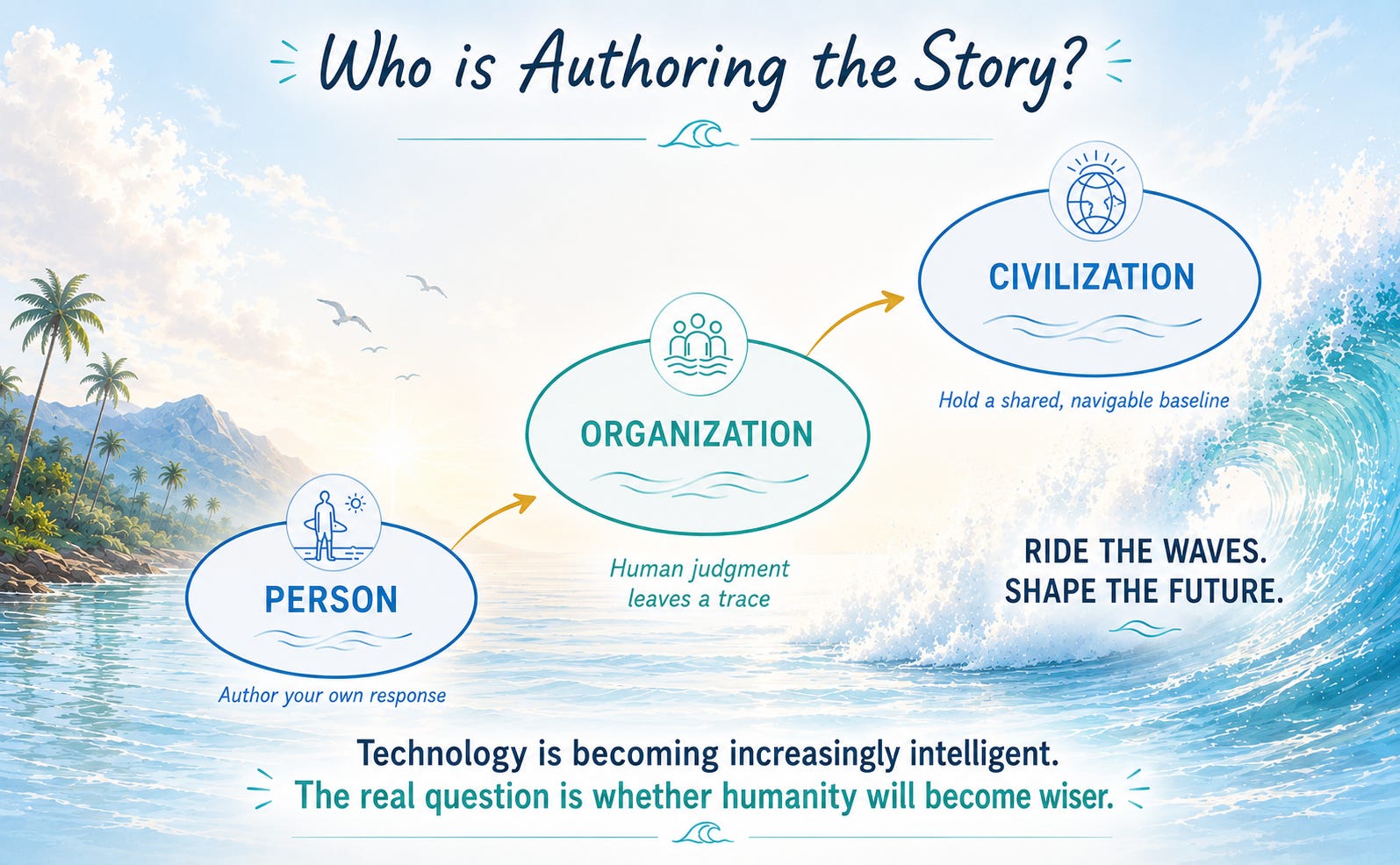
Figure 2. Agency at three scales. At each scale, the test is whether there is a trace.
The widest frame is civilization itself. This is where that opening sentence comes home. Recall the claim that we are the labels. If there is no shared baseline, those who move fastest and can push costs onto others tend to be rewarded, gain attention, and collect more of those labels. The response is neither a world government nor a pause. It is governance architecture, a set of baseline norms, applied locally, that keeps the shared ocean navigable. This is difficult, and it is not utopian. It is simply the civilizational expression of the same discipline a person practices in private, and the same discipline an organization builds into its design.
Why openness has the better odds
There is a practical consequence here, and it is where we want to plant a flag. The agent ecosystem, the fast-growing layer of software that will increasingly act on our behalf, is being built right now. The deepest question is not how capable the agents become. It is what they run on: a few closed platforms, or a broader foundation of open ones.
We believe the open path gives us the best chance of reaching an AGI future that stays steerable and shared, rather than concentrated in a few hands. The reasons are practical. Open-weight models can be inspected, audited, and reproduced. The more people who can see inside a model, the harder it is for any one group to control it. And the more human judgment leaves a trace, others can question it, test it, and improve it. Openness turns oversight from something into something everyone can participate in.
This is no longer aspirational. By 2026, open-weight models from labs around the world have already closed much of the gap with the frontier. A large share of AI deployments already relies on them. Portability matters too. A tool you can take with you must keep earning your trust.
We are not going to pretend this is clean. Once open weights are released, they cannot be recalled, and their safety guardrails can be removed. Compute, data, and talent are still concentrated in a handful of large labs. History also reminds us that open systems don’t automatically displace dominant platforms.
That is why our claim is narrower, and we think, stronger. Open source is not a solution by itself. It is the architecture that gives distributed authority a fighting chance. It only works when paired with governance, not as a substitute for it. Open and governed, not open versus governed.
This is the deliberate, decentralized path applied to the agent layer. Researchers such as Ben Goertzel have argued for decades: many hands building the system, a shared baseline beneath them, and enough transparency for everyone to see when it begins to drift. A closed ecosystem built around a few chokepoints concentrates authority by design. An open one makes it possible to distribute authority instead. That is how a civilization keeps the pen in many hands. Trust is the currency of the future!
Keeping the hand a hand
When the three scales are viewed together, a single principle emerges. At every level, the work is the same: to keep technology in the position of the right hand, immensely capable, fully engaged, and always in service to human judgment. Not because machines are dangerous and humans are noble, but because progress that leaves a society stronger rather than merely more efficient requires someone to remain responsible for the direction of travel.
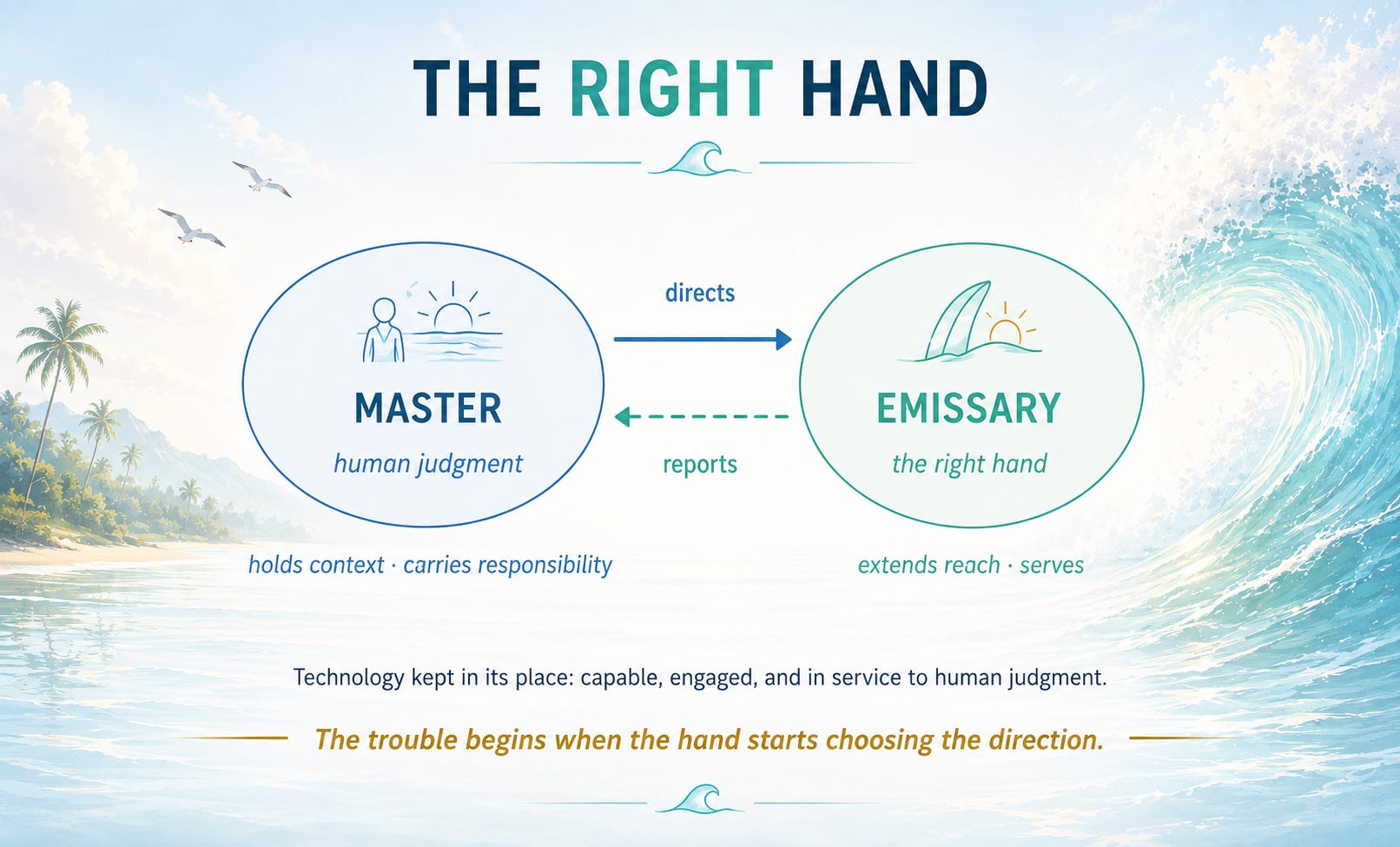
Figure 3. The right hand. Technology as the emissary, extending reach in service to the master and human judgment that holds context and carries responsibility. After McGilchrist, 2009 and 2021.
This matters for more than efficiency, and it is the reason we find most compelling. A healthy society is one in which judgment remains alive at every level: in the person at the bench, the team in the room, the organization making collective decisions, and the institutions that shape the rules we all live by. Wholeness is not a mood. When judgment is exercised throughout the system, responsibility gets distributed with it. When judgment is surrendered upward to increasingly autonomous systems, people gradually stop authoring their own lives and begin consuming the outputs of a machine they no longer meaningfully influence.
That is why we need to reorient on agency, practiced deliberately at all three scales. A person cultivates it through deliberate choices. An organization builds it into its design. A civilization protects it through institutions and shared norms. None of this produces a perfect society. It produces one that can still notice when it is drifting—and still has the capacity to correct its course.
That is the argument. Intelligence will continue to become cheaper. Judgment, responsibility, and authorship will become more valuable. The people, organizations and societies that continue to treat agency as something to be practiced rather than surrendered are the ones most likely to navigate what comes next.
The current does not get to make the choice. We still do.
The three scales of agency: the personal, the organizational, and the civilizational, form the closing movement of our forthcoming book, The Great Reorientation: A Tech-Surfer’s Guide to the AI Universe. The practices introduced here are fully developed in the book.
References
Anthropic. (2026). Anthropic Economic Index. Anthropic. https://www.anthropic.com/research/economic-index-june-2026-report
International AI Safety Report. (2026). International AI safety report 2026. arXiv. https://arxiv.org/pdf/2602.21012
Kulveit, J., Douglas, R., Ammann, N., Turan, D., Krueger, D., & Duvenaud, D. (2025). Gradual disempowerment: Systemic existential risks from incremental AI development. arXiv. https://arxiv.org/abs/2501.16946
McGilchrist, I. (2009). The master and his emissary: The divided brain and the making of the Western world. Yale University Press.
McGilchrist, I. (2021). The matter with things: Our brains, our delusions, and the unmaking of the world. Perspectiva Press.
The open-weight paradox: Why restricting access to AI is counterproductive. (2026). arXiv. https://arxiv.org/pdf/2604.17413
Springer Nature. (2025). AI deskilling is a structural problem. AI & Society. https://link.springer.com/article/10.1007/s00146-025-02686-z
Springer Nature. (2025). AI-induced deskilling in medicine: A mixed-method review and research agenda for healthcare and beyond. Artificial Intelligence Review. https://link.springer.com/article/10.1007/s10462-025-11352-1
Wissner-Gross, A. (2026, April 30). Welcome to April 30, 2026. The Innermost Loop. https://tinyurl.com/2ytra9s9